



loader image

PDO Thread Lift In Dunedin, FL

Crunches can only do so much.You can spend hours strengthening your abdominal muscles, but that doesn’t guarantee visible definition.A layer of fat sits between the muscles and the skin, and crunches can’t specifically target that fat.For many people, exercise and reducing overall body fat can help reveal their abs. But even people who are already lean and fit can have stubborn fat that hides their natural muscle definition.That’s where high-definition liposuction may help.Dr. Gopal uses HD lipo to selectively remove fat around the natural contours of the abdominal muscles, helping reveal the definition that’s already there.📍 Formation | South TampaInterested in HD lipo? Schedule a consultation to learn more.#HDLipo #HighDefinitionLiposuction #AbdominalSculpting #BodyContouring

26 1
Which one had surgery 1 or 2? 👀High-definition liposuction goes beyond traditional fat removal. Instead of simply reducing fat evenly, the surgeon strategically removes fat around the underlying muscles to make their natural contours more visible.But here’s what makes it interesting: HD lipo doesn’t create the same six-pack on everyone. Each person’s anatomy, muscle development, and desired level of definition influence the final result.Now take another look at these two patients.Which one do you think had HD liposuction, 1 or 2?Drop your guess below, then check the pinned comment for the answer!#HDLiposuction #MaleLiposuction #BodyContouring #Tampa

21 13
There’s a story behind every decision.Cosmetic surgery is a personal decision. Yet people who choose it often find themselves having to explain or defend that choice to others.Some want to restore changes after pregnancy or weight loss. Others have worked hard to get in shape but still have areas they’d like to improve. And some simply want to feel more comfortable with their appearance.The reasons are different for everyone. And they don’t have to make sense to anyone else.At Formation, Dr. Gopal believes the decision to pursue cosmetic surgery should be guided by a patient’s personal goals, realistic expectations, and what’s medically appropriate for them.Because ultimately, the person making that decision is the one who will live with it.#Tampa #CosmeticSurgery #BodyContouring #Liposuction

29 4
Our first four-legged patient. 🐾Dr. Gopal takes his liposuction and body contouring very seriously.Even when his patients have four legs.From loose skin and neck liposuction to a jawline that deserves its own before-and-after reveal, this might be his most dramatic transformation yet.And yes, he even got the patient’s permission to share the results. 😂A little Halloween fun from Dr. Gopal and his two very patient pups! 🎃🐶No dogs underwent surgery. Just two willing participants and one very committed surgeon.#SurgeonLife #tampa #necklipo

106 25
What weight loss can’t fix.After losing over 100 pounds, this patient had achieved significant weight loss, but was left with excess skin around his abdomen and back that weight loss alone couldn’t address.During an 8-hour surgery, Dr. Gopal performed a circumferential body lift, a procedure that removes excess skin around the entire midsection to improve body contour.In this video, Dr. Gopal walks through the procedure, explaining how he removed approximately 3 pounds of skin from the back and estimated another 4–5 pounds would be removed from the abdomen.He’s also using a small amount of fat collected during the procedure to add volume to the upper chest, improving its contour without performing a separate chest lift.For patients who have experienced major weight loss, body contouring can help address the excess skin that remains after the weight is gone.Considering surgery after weight loss? Schedule a consultation with Dr. Gopal at Formation in Tampa to explore your options.Actual patient footage. Individual results vary.#BodyContouring #BodyLift #ExcessSkinRemoval

47 0
Your fat is liquid gold.The fat you don’t want might be exactly what another part of your body needs.During liposuction, the fat we remove doesn’t always have to be discarded. In fact, Dr. Gopal refers to it as “liquid gold.”Why? Because that fat can sometimes be transferred to another area of the body to add volume, enhance natural contours, and create a more balanced shape.For women, that might mean adding volume to the breasts, hips, or buttocks. For men, fat transfer can help enhance the chest or shoulders.And because we’re using your own fat, we can potentially improve two areas during the same surgery.Of course, fat transfer isn’t right for everyone. It’s something Dr. Gopal discusses with patients beforehand and incorporates into the surgical plan when appropriate.Considering liposuction in Tampa? Schedule a consultation with Dr. Gopal at Formation to explore your body contouring options.#TampaLiposuction #FatTransfer #BodyContouring

27 0
A flatter stomach without a tummy tuck? 👀Pregnancy, and sometimes increased pressure from fat deep inside the abdomen, can cause the abdominal muscles to separate down the middle. This is called diastasis recti, and it can make your belly stick out even if you’re otherwise lean.Traditionally, repairing that separation often meant undergoing a tummy tuck. But what if you don’t have much loose skin to remove?For the right patient, Dr. Gopal can use robotic-assisted surgery to bring those separated muscles back together through three small incisions, without the long scar associated with a traditional tummy tuck.That’s exactly what he did for the patient in these before-and-after photos. No tummy tuck. No additional procedures.**But this approach isn’t for everyone.** If you have significant loose skin or excess fat, a different treatment may be more appropriate. That’s why understanding what’s causing your belly to protrude matters before deciding on surgery.Curious whether you’re a candidate? DM us or schedule a consultation with Dr. Gopal at Formation Tampa. Link in bio.Actual patient results. Individual results vary.#DiastasisRecti #MuscleSeparation #DiastasisRectiRepair #RoboticSurgery #Tampa

18 0
Why does fluid sometimes collect after surgery?After certain surgical procedures, fluid can accumulate beneath the skin, forming what’s called a seroma.In this video, Dr. Gopal demonstrates how he drains a seroma in a patient recovering from diastasis recti repair.This is one of the reasons postoperative follow-up matters. It allows Dr. Gopal to monitor healing, identify any issues, and address them when necessary.Considering surgery? DM us to schedule a consultation with Dr. Gopal at Formation Tampa.#DiastasisRecti #Seroma #TampaSurgeon #AbdominalMuscleRepair
37 2

What A PDO Thread Lift Does

A PDO thread lift repositions loose skin along the jawline, jowls, and upper neck using absorbable sutures placed just under the skin. The lift is visible the same day.

PDO stands for polydioxanone, a suture material used in general and cardiovascular surgery for decades. The threads carry small barbs that catch soft tissue, hold it in a higher position, and remain there while the body builds collagen around each strand. Two things happen at once. The barbs do mechanical work immediately. The healing response adds firmness over the following months. Then the material breaks down and is absorbed, which is why the effect is finite rather than permanent.

PDO threads are 510(k)-cleared Class II devices. Cleared means the FDA reviewed them as substantially equivalent to sutures already on the market. It is not the same word as approved, and the distinction is worth knowing when you are reading treatment pages that use the two interchangeably. Dr. Grandhige places every thread himself at Formation. He does not hand the work to an aesthetician or a visiting injector, which is the arrangement at a number of med spas between Dunedin and Clearwater.

Formation’s stated expectation is 12 to 18 months of effect, with the threads absorbing at around the six-month mark. You can see representative outcomes in the before and after gallery.

What The 2026 Data Actually Shows

Two large studies published in 2026 changed how carefully this procedure should be discussed, and neither one appears on the thread lift pages currently ranking for Dunedin searches.

A multicenter retrospective cohort of 2,000 PDO thread lift cases across 105 clinics reported an overall complication rate of 12.4 percent. Skin retraction accounted for 6.35 percent, asymmetry 2.9 percent, and pain 1.75 percent. Two factors independently predicted complications. Each additional thread raised the odds by about 12 percent. Age raised them far more sharply: patients aged 50 to 59 carried roughly 3.4 times the odds of those under 40, and patients 60 and over carried roughly 5 times the odds. The authors built a risk score from those two variables alone.

The published limitation matters and is worth stating plainly. The study was retrospective, and all 105 clinics belonged to a single network in Japan, so the technique mix and patient population are narrower than a global figure would suggest.

A separate meta-analysis of 26 studies covering 2,827 patients sorted outcomes by when they appear. Early events, meaning the first four weeks, ran to swelling in 34 percent of cases, bruising in 26 percent, and pain in 11 percent. Those largely resolve on their own. The late events are the ones that require a second appointment: visible or palpable threads in 10 percent, skin dimpling or asymmetry in 7 percent, altered sensation in 6 percent, thread exposure in 5 percent, and infection in 2 percent. The authors flag high statistical heterogeneity across the included studies and note that the early-event figures likely overstate clinically meaningful complications.

None of this makes a thread lift a bad procedure. It makes patient selection the variable that decides the outcome.

The Three-Route Screen: Threads, Energy, Or Surgery

Most people who ask about threads have already decided the jawline is the problem. The harder question is which layer is causing it. Formation runs the Three-Route Screen before recommending anything, and it starts with the Four-Layer Neck Read: layer one is fat, layer two is the platysma muscle and the bands that form along it, layer three is skin and its elasticity, layer four is chin projection and jaw angle.

Route One, Threads

Threads are a layer-three answer, and a partial one. They reposition skin that still has some spring left in it. The working elasticity window is roughly skin age 25 to 55. Below that range there is usually nothing to lift. Above it, the tissue often will not hold the new position, and the barbs pull through rather than catching.

Route Two, Energy Or Removal

If the problem is fat under the chin, threads will not touch it. Neck liposuction removes it. If the problem is skin that has lost its recoil but the fat is fine, energy-based tightening reaches deeper than a suture can. FaceTite works from beneath the skin rather than pulling from above. Many patients turn out to need a combination, which is what neck and jawline contouring covers.

Route Three, Something Threads Cannot Reach

When platysmal bands are the visible problem, a dissolving barbed thread is the wrong tool. A permanent suspension suture such as MyEllevate holds where an absorbable thread will not, and it can be removed if needed. When the skin has passed the point where any suspension technique helps, Formation refers the patient out. Dr. Grandhige stays in contact with the surgeons who do facelift and skin-excision work well and will point you to the right one rather than sell you a treatment that will not deliver.

That willingness to say no is the whole point of the Formation philosophy. Roughly speaking, a consultation that ends in a referral elsewhere is a good outcome, not a failed sale.

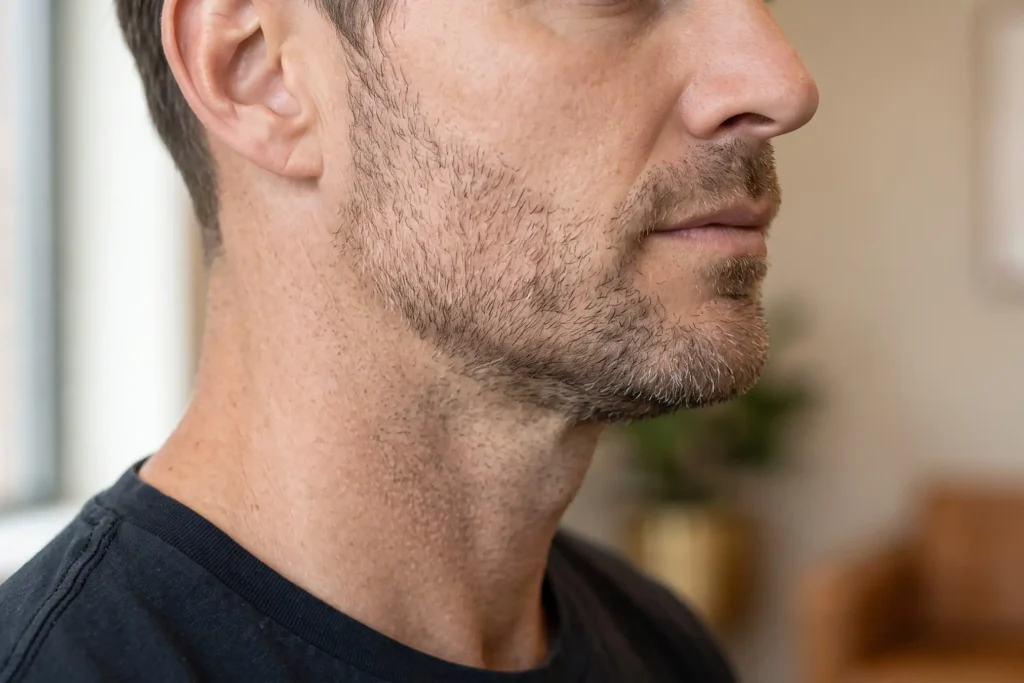
Defined jawline and upper neck, the area a PDO thread lift treats near Bradenton

Why Dunedin's Numbers Sit Where They Do

Here is the part that applies specifically to this side of the bay.

Dunedin’s median age is 58. Roughly 35 percent of the city’s residents are 65 or older, and another 29 percent fall between 45 and 64. Put that next to the elasticity window for threads, which tops out around skin age 55, and next to the age curve in the 2026 cohort, where the odds of a complication climb steeply past 50.

The math is uncomfortable and worth saying out loud: a meaningful share of Dunedin residents who search for a thread lift are, on the numbers, in the band where threads perform least predictably and complications occur most often. Skin age and calendar age are not identical, and plenty of active Dunedin patients test younger than their birth year. But a practice that books every inquiry without checking is booking a certain number of disappointments.

Formation screens for this before the procedure is scheduled. If the skin fails the pinch test, the recommendation is a different route, not fewer threads.

Proudly Serving the East Ybor Community

East Ybor sits at the heart of Tampa’s historic Latin Quarter — a neighborhood defined by its brick streets, cigar-making heritage, and the energy of Seventh Avenue. Residents enjoy easy access to Centro Ybor, the local cafés and restaurants along La Séptima, landmarks like the century-old Columbia Restaurant, and the TECO Line Streetcar that connects the district to downtown and Channelside.

Formation is proud to serve East Ybor patients from our Tampa clinic on South Howard Avenue. The drive takes only minutes, making it easy to fit a Botox appointment into your day whether you’re heading out after coffee in the district or meeting friends along Seventh Avenue afterward. East Ybor residents value authenticity, quality, and results, and that’s exactly what our team delivers, with every patient treated with the attention and respect they deserve.

The Procedure And What Recovery Looks Like

The treatment runs under an hour in most cases, with local anesthesia. You feel pressure and some tugging rather than sharp pain. The entry points are small and close without stitches.

Most patients are back to normal activity within one to two days. Mild swelling or bruising usually settles within a week. Strenuous exercise and facial massage are off the table for the first two weeks, because both can shift threads before the tissue has locked around them. That two-week restriction is the instruction patients most often ignore and most often regret, and it is a real scheduling factor if you train at a Dunedin gym or swim off the causeway most mornings.

Preparation Is Half The Result

The threads themselves are a commodity. Any clinic can buy the same box. What differs is what happens in the weeks on either side of the appointment.

Formation assesses health and diet before treatment, then adjusts nutrition, supplements, and peptides in the window immediately before and after so the body builds as much structure as it can around the threads while they are still there. Protein intake, inflammation control, and sleep are dialed in deliberately rather than left to chance. Dr. Grandhige treats the post-procedure phase as roughly 40 percent of the outcome, a figure he applies across every procedure at the practice. The instrument is identical at every practice in Pinellas and Hillsborough counties. The thinking around it is not.

Book Your Assessment

A thread lift is a good answer for a narrow group of people and the wrong answer for a fairly wide one. The difference is measurable before anything is placed, and the whole point of the screen is to find out which group you are in.

Start with the complimentary virtual evaluation with Hanna if you want a read before committing to the drive from Dunedin, or book the in-office assessment with Dr. Grandhige directly. Either way you will leave with a straight answer about which of the three routes fits your anatomy. Formation is open Monday through Friday, and Dr. Grandhige is a board-certified general surgeon who specializes in aesthetic surgery. More on the procedure itself is on the main thread lift for men page.

Frequently Asked Questions About PDO Thread Lifts

 Formation's stated expectation is 12 to 18 months, with the threads absorbing at around six months. The collagen response continues after the material is gone, which is why the effect outlasts the threads themselves. Published follow-up data does record recurrent laxity as an outcome, so plan for a finite result rather than a permanent one.

 Age alone does not disqualify anyone, but it changes the odds. The working elasticity window is roughly skin age 25 to 55, and the 2026 cohort data found the odds of a complication roughly five times higher in patients 60 and over. Skin quality is assessed directly at your consultation rather than assumed from your birth year.

 Local anesthesia is placed first. Most patients describe pressure and a tugging sensation. Pain was reported in about 11 percent of cases in the pooled meta-analysis and generally resolved within the first few weeks.

 Sometimes. The meta-analysis put visible or palpable threads at about 10 percent and skin dimpling at about 7 percent, both classified as late-onset events. Thinner skin and shallower placement both raise the risk, which is one reason placement depth is a judgment call rather than a protocol.

 No. Threads address skin position, not fat volume. Submental fat is a layer-one problem and needs removal, not suspension. Dr. Grandhige will tell you which one you are dealing with at the assessment.

 Those are platysmal bands, and they sit in layer two. A dissolving barbed thread will not hold them. A permanent suspension suture paired with platysmaplasty is the appropriate route, and that is a different conversation than this one.

 Yes, and combinations are common. Botox, an FDA-approved botulinum toxin, is often used alongside. For chin projection and jaw angle, a structural filler such as Radiesse, a calcium hydroxylapatite, or Juvederm, a hyaluronic acid, addresses layer four, which no thread reaches.

 The in-office consultation with Dr. Grandhige carries a fee. It is a full surgical assessment, and the fee can be applied toward any procedure or product at the practice. Formation also offers a complimentary virtual evaluation with patient coordinator Hanna, who reviews your goals and outlines a plan before you decide whether to make the drive across the bay.
