




loader image

Neck And Jawline Contouring In Lowry Park North, FL

Neck and jawline contouring at Formation is done awake, in the office, about 15 minutes south of Lowry Park North. You take an oral sedative. The area under your chin and along your jaw is numbed with local anesthesia. Fat is removed through very small incisions placed under the chin and behind the ears, and radiofrequency energy then tightens the skin so it contracts against the jaw instead of hanging below it. Most patients return to work in a week.

Gopal Grandhige, MD, is a board-certified general surgeon who specializes in aesthetic surgery. He performs every procedure himself and follows every patient for a full year.

Awake. In office. And not right for everyone. The next two sections tell you which group you’re in.

What Neck And Jawline Contouring Actually Is

It’s two procedures done in one sitting, not one.

Step one removes the fat pad under your chin and along the jaw. Step two tightens the skin that was draped over that fat, so it re-drapes against bone and muscle instead of sagging into the space the fat left behind. Skip step two on a neck with any laxity and you can finish looking worse than you started. That’s the part most pages leave out.

This is not a facelift. Nothing is cut away, nothing is pulled back, and there’s no incision in front of the ear. It’s also not filler. Filler adds volume along the jaw but can’t remove what’s blurring it and can’t tighten anything. If you’ve already tried jawline fillers and the definition never quite arrived, that’s usually why.

Formation runs this as part of its broader neck and jawline contouring in Tampa work, with the same protocol regardless of which neighborhood you drive in from.

The 3-Layer Profile Check

Your profile is built from three layers. Only two of them respond well to this procedure. Figuring out which layer is driving your problem takes about ninety seconds in front of a mirror, and it’s the difference between a result you like and a result you regret.

Layer 1: Fat

Tip your chin down toward your chest and pinch the tissue under your jaw. If you can grab a distinct pad between two fingers, that’s submental fat. It’s the layer liposuction removes best, it’s heavily genetic, and it’s the reason lean, fit people still have soft jawlines. Dieting harder does not reach it. Dieting hard enough to reach it usually costs you muscle first.

Layer 2: Skin

Lift your chin, turn to profile in a mirror, then gently draw the skin back toward your ear. If a jawline appears and the neck flattens, your skin needs tightening as well as fat removal. Elasticity is what decides this, and elasticity is not the same as age. Dr. Grandhige uses a working range of roughly skin age 25 to 55. Some 58-year-olds sit inside it. Some 38-year-olds don’t.

Layer 3: Structure

Run a finger along the underside of your jaw from chin to ear. Then look at your profile and find where your chin sits relative to your lower lip. If the bone drops off sharply, or the chin sits behind the lip, your problem isn’t fat and it isn’t skin. It’s the frame both of those sit on.

Removing fat from a recessed chin makes the recession more visible, not less. This is the layer where the procedure backfires, and it’s the reason Formation says no more often than most practices do.

Most candidates are Layer 1 and Layer 2 together. That combination is what this procedure was built for.

What Our Consult Log Shows About Who Actually Books

Across the last twelve months of neck and jawline consultations at Formation, six in ten patients were men, the median age was 43, and roughly one in five left without a procedure date.

That last number is the useful one. The reasons behind it, in order of how often they come up:

  • Layer 3 structure was the real driver, not fat
  • The patient was still mid-way through rapid weight loss and the skin hadn’t settled
  • Elasticity had moved past the point where tightening would return a result worth the recovery
  • What the patient actually wanted was a facelift, which is a different operation

Of the patients who did book, about seven in ten needed both fat removal and skin tightening. Three in ten were fat-only, and nearly all of those were under 40. Median return to work was six days. Nine in ten completed the full twelve months of follow-up.

Men are the majority here for an anatomical reason. Male jaw and neck tissue behaves differently under a cannula, and over-removing fat from a male neck reads as gaunt rather than sharp. Formation’s men’s aesthetic surgery work is built around that distinction.

What Happens On Procedure Day

You’re awake. That surprises people.

You take an oral sedative before you begin. The area under your chin and along your jaw is numbed with local anesthesia. Fat is then removed through very small incisions under the chin and behind the ears, in a pattern that follows your jaw line rather than flattening everything beneath it. This step is neck liposuction, and it’s the change you see first.

Radiofrequency energy is then applied under the skin to tighten it against the muscle and bone underneath. On a neck with any laxity, this step is what separates a sharper jaw from a looser one.

You go home the same day. The sedative means you cannot drive yourself.

Formation’s general-anesthesia cases run in Quad A accredited surgical facilities, where accreditation covers professional training, operational safety, and the physical setup of the room. Neck and jawline work happens in the office under local, with the same team every time.

The Safety Question That Actually Matters Here

Most liposuction safety copy is about volume. Florida caps liposuction in an office setting at 4,000 cc of removed fat, requires a surgeon to log any procedure taking more than 1,000 cc, and requires offices doing that work to register with the Florida Department of Health.

A neck and jawline procedure sits nowhere near either threshold. The volumes involved are a small fraction of the office cap. So the number that dominates the BBL and body-contouring safety conversation is not the number that should decide anything about your chin.

Three things should:

Who is doing it, and how often. Jawline work punishes inexperience faster than almost any other contouring procedure, because the margin between sharp and hollow is a few millimeters.

What’s numbing you, and who’s watching. Awake with a sedative and local anesthesia carries a different risk profile than general anesthesia. Ask which one you’re getting and why.

Who handles your post-operative care. Ask whether it’s the surgeon or a coordinator. Then ask for how long.

At Formation the answer to the third question is Dr. Grandhige, for twelve months.

Recovery, Week By Week, Through Month Nine

The honest timeline runs longer than most pages admit. Fat removal shows up fast. Skin tightening does not.

Days 1 to 3. Swelling, bruising, and a tight feeling under the jaw. You wear a chin compression garment. Nothing looks like a result yet, and this is where people panic if nobody warned them.

Week 1. Most patients return to work and social plans. The garment stays on 12 to 24 hours a day through this week.

Weeks 2 to 4. Swelling keeps dropping and the liposuction result becomes visible. Most patients are back in the gym inside this window.

Month 3. Skin tightening becomes visible and the jawline itself changes shape. This is the milestone most people are actually waiting for without knowing it.

Months 6 to 9. Final result. Skin contraction has finished.

If you have a wedding, a reunion, or a season of client-facing photography, count backward from month three, not from week two. Booking on a two-week assumption is the most common scheduling regret we see.

On longevity: the fat cells removed don’t come back, as long as your weight stays stable. Dr. Grandhige describes the effect on the neck as resetting the aging clock. Aging continues, but it restarts from a better position.

What GLP-1 Weight Loss Changed About This Procedure

If you’ve lost weight on semaglutide or a similar medication, your candidacy is different, and timing matters more than technique.

The American Society of Plastic Surgeons reports neck lifts posting the strongest growth of any facial procedure in its most recent statistics, and connects the broader rise in facial work partly to these medications, which can leave skin laxity around the face and jaw after rapid loss.

Two consequences for you:

Your skin becomes the variable, not your fat. Rapid loss often takes the fat and leaves the envelope. That pushes you toward Layer 2, and it shifts how much of your result depends on the tightening step rather than the removal step.

Wait until your weight is stable. Contouring a neck that’s still changing means designing a jawline for a face that won’t exist in six months. If you’re still losing, Dr. Grandhige will tell you to come back. That’s not a soft no, and it’s not a scheduling tactic.

Side view man posing with mirror piece
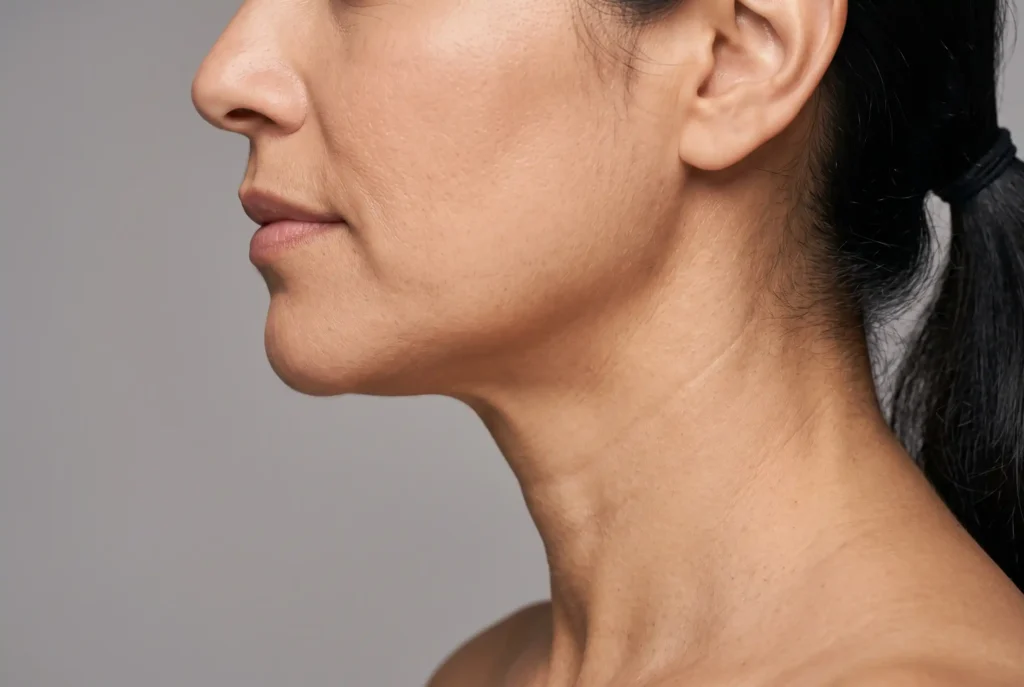
Close-up profile showing a defined jaw and neck angle after neck liposuction

How This Procedure Goes Wrong

The failure mode isn’t removing too little. It’s removing too much.

Over-aggressive fat removal under the chin creates contour irregularities you can see in angled light, and it can age the area instead of refreshing it, because the skin has nothing left to drape over. Pulling too hard on the tightening step produces the strained, over-corrected look people are describing when they say they don’t want to look done.

Dr. Grandhige’s rule for this area is to respect the natural jaw angle and build sharpness without tension. He’d rather leave a small amount of fat behind than create a hollow nobody can put back.

The other half of the failure rate happens after you leave the room. His own framing: the surgery is 60 percent of the result and post-operative care is the other 40, and poor post-op care can undo good surgery. That’s why Formation owns the follow-up instead of handing you a printout and a phone number. It’s a large part of how the practice is built.

What The Result Actually Looks Like

Nobody guesses surgery. They guess sleep.

The pattern at the three-month visit is a colleague saying you look rested, or asking whether you’ve been training. One Formation patient in his 40s came in because he hated every photo of himself and had assumed his neck was simply how he was built. What he reported back afterward wasn’t about his jaw at all. He said he’d started getting in pictures again.

That’s the outcome to plan for: your face matching the rest of you, not a different face. You can see the range in Formation’s neck and jawline contouring gallery.

Getting Here From Lowry Park North

Formation is at 1315 South Howard Avenue in Tampa. From the 33604 and 33612 ZIPs around ZooTampa at Lowry Park, that’s I-275 south to the Howard Avenue exit, roughly 15 to 20 minutes outside rush hour and closer to 30 during it.

Three things to plan before you book:

You need a driver. The oral sedative rules out driving yourself home. From Lowry Park North that’s a 15-to-20-minute ride each way for whoever takes you, plus the wait.

Your first month is the busy one. Post-operative visits cluster inside the first four weeks. Budget for several round trips down I-275 while you’re still wearing the garment.

You don’t need a hotel. Formation coordinates discounted stays for patients traveling from Orlando, Naples, Sarasota, or out of state, and Dr. Grandhige visits those patients in their rooms during early recovery. Living eight miles north, you skip all of that and recover at home. That’s a real advantage, and it’s worth using.

One local note: wearing a chin garment 12 to 24 hours a day in week one is a different experience in July than in January. If you spend time outdoors along the Hillsborough River or train outside, schedule that first week for a cooler month if the choice is yours.

Frequently Asked Questions

Not if it's done with restraint. The results that get noticed are the over-corrected ones. Conservative fat removal that preserves the natural jaw angle reads as looking rested or fitter, which is why the most common comment patients report is about sleep or the gym rather than surgery.

Age isn't the gate. Skin elasticity is. The working range is roughly skin age 25 to 55, which some people sit inside well past 55 and some sit outside well before it. If your skin no longer contracts, tightening won't return enough to justify the recovery, and you'll be told that directly.

Most patients return in about a week, and our median is six days. You'll be presentable before you're finished swelling. Plan the week, not the day.

The fat cells removed don't regenerate, but the ones remaining can enlarge. A stable weight protects the result. A swing of twenty or thirty pounds will show up in the neck along with everywhere else.

Yes. Consultations are by appointment and run as a full surgical assessment: anatomy evaluated, candidacy assessed, options and limitations discussed honestly, and guidance on timing. The fee is what allows the appointment to be an evaluation rather than a sales meeting.

Both. Male and female jaw and neck anatomy require different technical approaches, and the plan is built to the anatomy in front of us rather than to a template.

You'll be told, and you'll be told why, using the same three layers described above. If a facelift is the honest answer rather than contouring, Dr. Ahmad Saad is the board-certified plastic surgeon on the Formation team and that conversation happens in the same building.

The Bottom Line

This procedure works well for one specific problem: fat and loose skin sitting on a jaw with good underlying structure. It works poorly, and sometimes makes things worse, when the jaw structure itself is what’s bothering you. Which of those describes you is knowable in ninety seconds with the 3-Layer Check above and confirmable in a single appointment.

Formation is a boutique practice on purpose. Gopal Grandhige, MD limits how many procedures he performs so he can plan, operate on, and follow every one of them himself. That means fewer available dates. It also means the person holding the instrument is the person who answers when something feels wrong in week two.

Come in with your questions. You’ll leave knowing whether this helps you, whether something else would, or whether the honest answer is to wait.

Book Your Consultation

Use the form below to request your consultation and the team will follow up to schedule your visit. If you’re anywhere in Lowry Park North or greater Tampa and want a clear read on your candidacy, book with Gopal Grandhige, MD. You’ll leave knowing exactly where you stand.

Skin quality changes everything.Neck liposuction can create a more defined jawline and neck contour by removing unwanted fat, but the result also depends heavily on skin quality and elasticity.When skin has good elasticity, neck lipo alone may be enough for the skin to contract around the new contour. With some skin laxity, Dr. Gopal may combine liposuction with a skin-tightening treatment such as Renuvion or FaceTite. With significant laxity, a neck lift may be the more appropriate option.That’s why evaluating the skin is an important part of determining the right approach before neck liposuction.Considering neck liposuction in Tampa? Schedule a consultation with Dr. Gopal Grandhige at Formation Tampa.#NeckLiposuction #NeckLipo #JawlineContouring #Tampa

16 0
Liposuction can change more than the body.I’ve watched patients become more confident, make changes in their careers, show up differently in their relationships, and start making different choices for themselves.That’s when I know I’ve done my job well.Because high-definition liposuction isn’t only about creating a leaner, more defined physique. Sometimes the physical transformation becomes the catalyst for changes that reach far beyond the operating room.Dr. Gopal GrandhigeConsidering HD liposuction in Tampa? Schedule a consultation with Dr. Gopal Grandhige at Formation Tampa.#BodyContouring #HDLiposuction #tampa #Liposuction

27 3
Male liposuction requires a different approach.The contours that create a more feminine shape aren’t necessarily the same ones that create a strong, athletic male physique.With male high-definition liposuction, Dr. Gopal considers how the chest, abdomen, waist, ribs and back work together—and how the underlying muscle anatomy should guide where definition and shadow are created.That’s also why the chest matters. A highly defined abdomen and back paired with a rounder, less-defined chest can make the overall result feel out of proportion.The goal is a cohesive, athletic contour that works with the patient’s natural anatomy.Considering male HD liposuction? Schedule a consultation with Dr. Gopal Grandhige at Formation Tampa.

31 0
6 months post high-definition liposuction with moderate definition.The goal wasn’t just less fat. It was a leaner, more athletic contour with visible definition through the abdomen and torso, without pushing the result to the highest level of definition.High-definition liposuction strategically sculpts around the underlying anatomy and can be customized based on a patient’s anatomy, muscle structure, and the degree of definition they want to achieve.For this patient, moderate definition created the balance Dr. Gopal was looking for.Results vary by patient and depend on individual anatomy, skin quality, and treatment plan.Considering HD liposuction? Schedule a consultation with Dr. Gopal Grandhige at Formation Tampa. Link in bio.#HDLiposuction #Liposuction #BodyContouring #MaleLiposuction #tampa

10 1
Your lipo results at 2 weeks are not your final results.And sometimes, what you see during those early weeks can be unsettling.Swelling can temporarily make the treated area look larger. The tissue may feel firm, tight or lumpy. The definition you were expecting may not be visible yet.That doesn’t necessarily mean something went wrong. It simply means your body is still healing.After liposuction, recovery happens in stages, from the initial inflammation and swelling to tissue repair, skin contraction and the gradual emergence of the new contour.Significant changes often become more apparent around the 3–6 month mark, with continued refinement as the tissues heal and mature.That’s why comparing yourself a few weeks after surgery to someone’s polished before-and-after photo can create a very unrealistic expectation. Those two photos may represent months of healing in between.The operation creates the contour. The final result reveals itself over time.If you’re considering HD liposuction, schedule a consultation with Dr. Gopal to understand the procedure, recovery, and what to realistically expect from your results (link in bio).#tampa #liposuction #hdliposuction

83 2
Some surgical decisions are much harder to correct than they are to avoid.That’s what Dr. Gopal means when he says, “I wish more patients knew that you pay more to undo a cheaper procedure.”With liposuction and body contouring, removing fat is only one part of the process. Your surgeon has to understand your anatomy, know how much fat to remove and where to preserve it, create smooth transitions between areas, and consider how the final contour fits the rest of your body.But the procedure doesn’t end when you leave the operating room. Recovery and aftercare matter too. The right guidance around compression, lymphatic massage, incision and drainage care, activity and nutrition can help manage swelling and support your body as it heals.When something doesn’t go as planned, correcting dents, irregularities, poor proportions or an unnatural contour can be more complicated than doing the procedure properly the first time. And sometimes, there’s less to work with the second time around.So when you’re comparing surgeons, don’t compare price alone. Look at their training, experience, surgical approach, before-and-after results, and what their care includes before and after surgery.Because a cheaper procedure can become a very expensive one when you have to do it twice.#tampa #HDLiposuction #lipo

16 0
Lipo recovery can be a lot.There can be swelling, drainage, compression garments, limited activity, and a period where your body may look worse before it starts looking better. And when the final result can take months to fully reveal itself, recovery can take an emotional toll too.That’s why Dr. Gopal views a successful surgical experience as three equally important parts: pre-op care, the operation itself, and post-op care.At Formation, that process starts four weeks before surgery. Patients are prepared physically for the procedure and mentally for what they may experience during recovery.That support continues after surgery with a private nurse during the initial recovery period, supplies and education for at-home care, nutritious meals, and in-home lymphatic massage to help manage postoperative swelling and fluid.None of those pieces are considered extras. They’re part of the surgical experience.Because the goal isn’t just to perform the procedure. It’s to make sure you know what to expect, you’re prepared for it, and you’re properly cared for through the recovery that follows.Considering liposuction or body contouring in Tampa? Schedule a consultation with Dr. Gopal Grandhige at Formation Tampa.#tampa #hdLiposuction

70 4
