


loader image

PDO Thread Lift In Palma Ceia Pines, FL

A PDO thread lift places dissolvable barbed sutures under the skin through a few small entry points to pull a softening jawline and early jowls back up. You see the lift the same day, with no surgical incisions or general anesthesia, and many patients are back at work within a day or two. From Palma Ceia Pines, Formation is a short drive east on Swann Avenue, so the follow-up visits that protect a thread result are easy to keep. Before any thread is planned, Dr. Grandhige reads your jaw and neck to decide whether threads are the right tool at all.

How A PDO Thread Lift Works On The Jawline

A PDO thread lift works in two phases: an immediate mechanical lift, then a slower firming that continues after the threads dissolve.

The first phase happens in the chair. Tiny barbs grip the tissue under the skin, and the jowl and jawline move up before you leave the office. That only holds when there’s less loose skin than a suture can carry.

The second phase is biological. Polydioxanone is a suture material the body absorbs, and the threads dissolve within about six months. As they go, firmer tissue forms along each track, which is why results typically last 12 to 18 months instead of ending the day the threads disappear. Skin with little recoil left gives this phase less to work with.

At Formation, treatment takes place in the office under local anesthesia, with oral sedation if you want it, and usually runs under an hour. Dr. Grandhige designs each patient’s PDO thread lift in Tampa around their anatomy, the same way he plans contouring surgery.

PDO threads are 510(k)-cleared devices, not FDA-approved, and each thread system is cleared for its own labeled indication. Ask which system and K-number your plan uses, then look it up yourself in the FDA 510(k) database.

The Four-Layer Neck Read: Where Threads Fit

Before he designs a thread pattern, Dr. Grandhige reads the jaw and neck in four layers and matches each one to its own fix. Threads answer one of the four. Most necks show aging in more than one layer at once, so a plan built on a single tool tends to leave part of the problem in place.

Layer one, fat. Fullness under the chin and along the jaw has to come out, and a thread removes nothing. Lifting skin over a fat pad barely changes your profile. This layer belongs to neck and chin liposuction.

Layer two, the platysma. When vertical platysmal bands stand out as you tense your neck, the muscle has separated. For those bands, MyEllevate, a permanent suspension suture, paired with platysmaplasty holds the muscle in a way a dissolving thread can’t. MyEllevate is nonabsorbable and can be removed. PDO threads are built to disappear.

Layer three, the skin. This is the thread layer. Skin that springs back quickly after a pinch holds a lift longer than skin that settles slowly, and the realistic window runs from roughly skin age 25 to 55. Renuvion, a helium plasma device, also works at this layer when the skin needs tightening more than repositioning.

Layer four, the frame. Chin projection and jaw angle come from bone and support, and suspension builds neither. Radiesse, a calcium hydroxylapatite, or Juvederm, a hyaluronic acid, adds structure at the chin point and along the angle. A request for a superhero jawline is usually a request about this layer.

Our first four-legged patient. 🐾Dr. Gopal takes his liposuction and body contouring very seriously.Even when his patients have four legs.From loose skin and neck liposuction to a jawline that deserves its own before-and-after reveal, this might be his most dramatic transformation yet.And yes, he even got the patient’s permission to share the results. 😂A little Halloween fun from Dr. Gopal and his two very patient pups! 🎃🐶No dogs underwent surgery. Just two willing participants and one very committed surgeon.#SurgeonLife #tampa #necklipo

46 8
What weight loss can’t fix.After losing over 100 pounds, this patient had achieved significant weight loss, but was left with excess skin around his abdomen and back that weight loss alone couldn’t address.During an 8-hour surgery, Dr. Gopal performed a circumferential body lift, a procedure that removes excess skin around the entire midsection to improve body contour.In this video, Dr. Gopal walks through the procedure, explaining how he removed approximately 3 pounds of skin from the back and estimated another 4–5 pounds would be removed from the abdomen.He’s also using a small amount of fat collected during the procedure to add volume to the upper chest, improving its contour without performing a separate chest lift.For patients who have experienced major weight loss, body contouring can help address the excess skin that remains after the weight is gone.Considering surgery after weight loss? Schedule a consultation with Dr. Gopal at Formation in Tampa to explore your options.Actual patient footage. Individual results vary.#BodyContouring #BodyLift #ExcessSkinRemoval

46 0
Your fat is liquid gold.The fat you don’t want might be exactly what another part of your body needs.During liposuction, the fat we remove doesn’t always have to be discarded. In fact, Dr. Gopal refers to it as “liquid gold.”Why? Because that fat can sometimes be transferred to another area of the body to add volume, enhance natural contours, and create a more balanced shape.For women, that might mean adding volume to the breasts, hips, or buttocks. For men, fat transfer can help enhance the chest or shoulders.And because we’re using your own fat, we can potentially improve two areas during the same surgery.Of course, fat transfer isn’t right for everyone. It’s something Dr. Gopal discusses with patients beforehand and incorporates into the surgical plan when appropriate.Considering liposuction in Tampa? Schedule a consultation with Dr. Gopal at Formation to explore your body contouring options.#TampaLiposuction #FatTransfer #BodyContouring

27 0
A flatter stomach without a tummy tuck? 👀Pregnancy, and sometimes increased pressure from fat deep inside the abdomen, can cause the abdominal muscles to separate down the middle. This is called diastasis recti, and it can make your belly stick out even if you’re otherwise lean.Traditionally, repairing that separation often meant undergoing a tummy tuck. But what if you don’t have much loose skin to remove?For the right patient, Dr. Gopal can use robotic-assisted surgery to bring those separated muscles back together through three small incisions, without the long scar associated with a traditional tummy tuck.That’s exactly what he did for the patient in these before-and-after photos. No tummy tuck. No additional procedures.**But this approach isn’t for everyone.** If you have significant loose skin or excess fat, a different treatment may be more appropriate. That’s why understanding what’s causing your belly to protrude matters before deciding on surgery.Curious whether you’re a candidate? DM us or schedule a consultation with Dr. Gopal at Formation Tampa. Link in bio.Actual patient results. Individual results vary.#DiastasisRecti #MuscleSeparation #DiastasisRectiRepair #RoboticSurgery #Tampa

18 0
Why does fluid sometimes collect after surgery?After certain surgical procedures, fluid can accumulate beneath the skin, forming what’s called a seroma.In this video, Dr. Gopal demonstrates how he drains a seroma in a patient recovering from diastasis recti repair.This is one of the reasons postoperative follow-up matters. It allows Dr. Gopal to monitor healing, identify any issues, and address them when necessary.Considering surgery? DM us to schedule a consultation with Dr. Gopal at Formation Tampa.#DiastasisRecti #Seroma #TampaSurgeon #AbdominalMuscleRepair

35 2
The fat is gone. But what takes its place?When fat is removed during liposuction, it leaves behind space beneath the skin. As the body heals, fluid can sometimes collect in that space, creating what’s called a seroma.And here’s why that matters.If fluid continues to collect, it can potentially affect the final contour.That’s why Dr. Gopal pays close attention to fluid buildup during recovery. His approach is to identify seromas early and address them quickly.Considering liposuction in Tampa? Schedule a consultation with Dr. Gopal at Formation to learn more.#Liposuction #Seroma #BodyContouring

56 5
From medical weight loss to body contouring, her transformation was approached as a journey, not just a single procedure.This patient started with a personalized medical weight loss program at Formation, working with Dr. Gopal to achieve significant weight loss. Once she reached her goal, Dr. Gopal performed a tummy tuck to remove excess abdominal skin and refine her contour.Considering medical weight loss or a tummy tuck? Schedule a consultation with Dr. Gopal at Formation Tampa. Link in bio.Actual patient results. Individual results vary.

9 2
Not every patient who wants surgery is ready for it.One patient came to Dr. Gopal wanting a tummy tuck. Over the next 18 months, she returned multiple times, having lost more weight each time. And each time, the answer was still no.Not because she couldn’t have the surgery, but because she wasn’t where she wanted to be yet.Instead of rushing into surgery, the focus was on helping her reach a healthier, more sustainable weight through nutritional counseling, lifestyle support, and medical weight management.By the time she had lost 80 pounds, she was ready, both physically and mentally.For Dr. Gopal, being a good surgeon isn’t just about knowing how to perform a procedure. It’s also about knowing when not to perform one.Sometimes the best result starts long before the operating room.Considering a tummy tuck? DM us to schedule a consultation with Dr. Gopal at Formation Tampa.#Tampa #TummyTuck #BodyContouring

71 5
Defined jawline and upper neck, the area a PDO thread lift treats near Sun City Center

What 2,000 Thread Cases Show About Age And Thread Count

Older age and a higher thread count each raise the odds of a complication after a PDO thread lift, according to a 2026 multicenter study in Aesthetic Plastic Surgery. The researchers reviewed 2,000 randomly selected cases from 105 clinics, treated between November 2020 and December 2023. About one patient in eight had a complication, an overall rate of 12.4 percent. Skin retraction led at 6.35 percent, followed by asymmetry at 2.9 percent and pain at 1.75 percent.

Each added thread raised the odds by about 12 percent. Age carried more weight. Compared with younger patients, the odds ran 2.14 times higher in the 40s, 3.38 times higher in the 50s and 5.08 times higher at 60 and up.

Set that beside layer three. The decades where complication odds climb are the same decades where skin starts losing the recoil that holds a lift. Both findings point toward treating earlier with fewer threads, rather than waiting until there’s more to lift.

The study is retrospective, so it shows association rather than cause, and its exact rates may not carry over to every thread system or technique. The direction of both findings still applies to your planning. At Formation, Dr. Grandhige sets the thread count for your anatomy and explains why he chose that number before anything is placed.

Preparation And Recovery Under The 60/40 Recovery Standard

Dr. Grandhige divides every result the same way: the procedure accounts for about 60 percent, and the care after it accounts for the other 40. Poor aftercare can undo well-placed work, so recovery at Formation is run by the team instead of handed off as a printout.

Preparation starts before the appointment. Your health and diet are assessed first. Nutrition, supplements and peptides are then adjusted in the window just before and just after treatment, so your body builds as much new structure as it can while the threads are there to build around. Protein intake, inflammation control and lymphatic flow are dialed in, and every outside provider involved has been personally vetted by Dr. Grandhige. That’s what Formation means by treating care as one connected system, and it applies to every procedure.

Every practice can buy the same threads. The thinking around them is where practices part ways.

The First Week

Expect mild soreness or tightness for a few days, similar to the day after a hard workout, plus some swelling or bruising. Many patients return to work within one to two days. Hard training waits one week.

Week Four And Beyond

Once early swelling clears, the stretch that matters most begins. A 2026 meta-analysis of 26 studies sorted thread lift complications by timing. Its authors classed swelling, pain and bruising as early events within the first four weeks. They classed visible or palpable threads and skin dimpling as late-onset problems that appear or persist after that. The analysis pooled permanent and dissolving threads, so its timing pattern matters more here than its rates. Follow-up visits after the first month are where an outcome can still be adjusted, and Dr. Grandhige follows his patients for a full year.

From Palma Ceia Pines To South Howard Avenue

From Palma Ceia Pines, Formation is a short drive on surface streets. Take Swann Avenue, the neighborhood’s southern edge, east to Howard Avenue, then turn south to 1315 South Howard. In a straight line, the office sits about a mile from Mitchell Elementary.

Palma Ceia Pines runs south from Kennedy and Henderson Boulevards to Swann Avenue, between Himes Avenue on the west and Armenia Avenue on the east. The City of Tampa describes it as roughly 1,250 households, businesses, schools, churches and nonprofits, with Mitchell Elementary and Congregation Schaarai Zedek inside its lines.

That short distance matters more for threads than for most treatments. The visits after week four are where a visible thread end or an early dimple can still be caught. From anywhere between Himes and Armenia, a quick check doesn’t turn into a half-day errand. Whoever treats you, ask who sees you after the first month and how often.

Timing is easy to plan from here. The procedure itself usually runs under an hour, short enough to fit between morning drop-off and afternoon pickup at Mitchell Elementary. A Friday treatment gives the first day or two of swelling a weekend to settle. If your week includes a run along the Bayshore Boulevard sidewalk, give it one week after threads.

Patients already come to Formation from South Tampa and Hyde Park, and jawline refinement is one of the procedures people seek out the practice for. Threads are only one of the tools in jawline and neck contouring, and the right one depends on which layer is driving the change.

Your first step can happen from home. Formation offers a complimentary virtual evaluation with patient coordinator Hanna, who reviews your goals and outlines a plan before you decide to come in. The in-office consultation with Dr. Grandhige carries a fee because it’s a full surgical assessment, and that fee can be applied toward any procedure or product at the practice.

When Threads Are The Wrong Tool

Threads change position. They don’t add volume, and they don’t take it away.

That’s the Formation Add-or-Subtract Rule, and it settles many consultations early. If what bothers you in photos is volume, either too much under the chin or too little at the chin point, repositioning won’t reach it. Fat comes out with liposuction, frame goes in with structural filler, and a lift only moves what’s already there.

Heavy skin excess along the jaw rules threads out. Pulling on surplus skin creates visible tension, and tension is what people read as work. Patients whose laxity is beyond what suspension can handle are referred out: Formation stays in contact with the surgeons who do skin-excision work well and points each patient to the right one. When skin is thin and slow to recoil but not in excess, FaceTite, a radiofrequency device, treats it from underneath with heat instead of tension.

One Formation patient, a professional in his 40s, had disliked his neck and jawline in photos for as long as he could remember, and the area never changed with weight loss. The problem sat in layer one, so threads were never the answer. Targeted neck liposuction with jawline contouring was. Colleagues told him he looked more rested, and he started getting in pictures again.

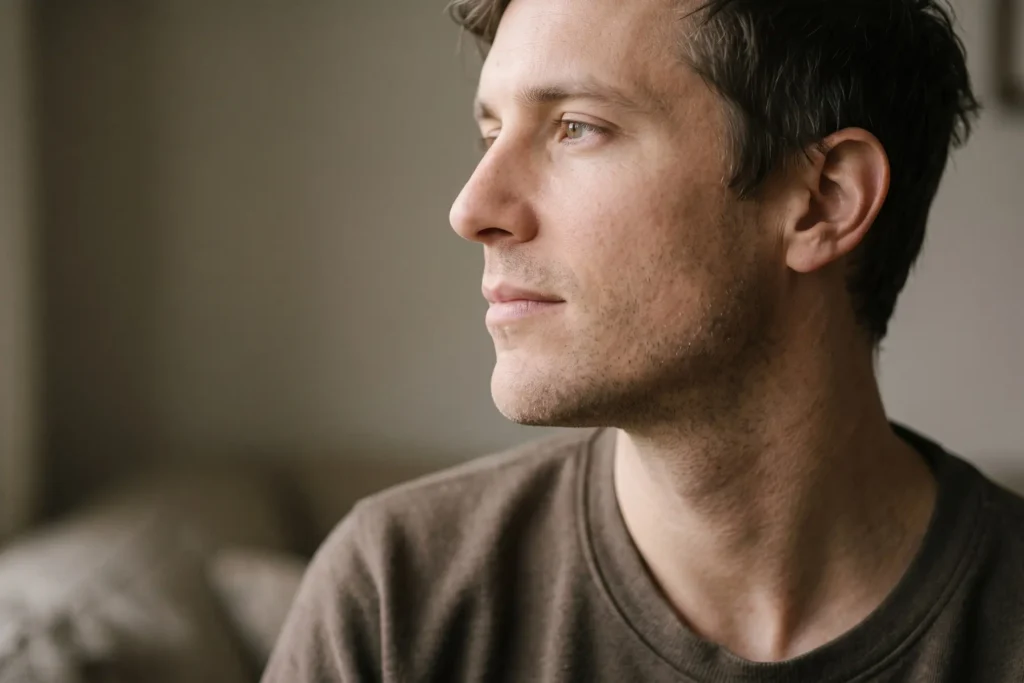
Man in his early thirties in profile, showing the jawline and upper neck a PDO thread lift treats

Who Plans Your Treatment

Gopal Grandhige, MD is a board-certified general surgeon who specializes in aesthetic surgery. He brings more than 15 years of surgical experience and several thousand procedures to every plan.

He earned his medical degree at the University of Michigan Medical School and matched into a six-year combined plastic surgery residency at Yale before turning toward a broader surgical education. He completed a full general surgery residency, followed by fellowship training in burn surgery, critical care, and minimally invasive metabolic and foregut surgery. He is certified by the American Board of Surgery. Years spent where wound healing had immediate consequences shape how he reads tissue before placing a single thread.

Formation keeps its volume low on purpose, so he can evaluate every patient and design every plan himself. Some patients leave with a thread plan. Others hear that the better answer is to wait, treat a different layer, or see a different surgeon.

A Male Jawline Needs Its Own Thread Plan

Male aesthetics is one of the areas Dr. Grandhige is known for, and it changes the pattern. Male skin is thicker, fat sits differently, and a masculine jaw should read angular rather than lifted and softened. A vector designed for a female face can feminize a male one. Formation plans PDO thread lifts for men to protect the angle at the jaw and keep the line under the chin clean.

Frequently Asked Questions

 Results typically last 12 to 18 months. The threads dissolve within about six months, so the mechanical lift softens as they go, while the firmer tissue built along each track holds longer. Many patients choose maintenance treatments to extend results. Keeping each round light makes sense, since each added thread raises complication odds.

 Age changes the odds more than it rules anyone out. Skin holds a lift best from roughly skin age 25 to 55, and a 2026 study of 2,000 thread cases found complication odds climbing decade by decade from age 40 on. Past that window, Dr. Grandhige may recommend a different layer or a different procedure.

 The count is set for your anatomy. In a 2026 study of 2,000 thread cases, each added thread raised complication odds by about 12 percent, so the right number is the fewest that does the job. Dr. Grandhige explains the count he chooses before anything is placed.

 The goal is for people to say you look rested. Over-tensioned thread patterns are what make a lift recognizable, which is why Dr. Grandhige favors restraint.

Treatment is done under local anesthesia, with oral sedation if you want it, and most patients describe minimal discomfort. Afterward, expect soreness or tightness for a few days, similar to the day after a hard workout.

Usually, but tell your surgeon about every thread round you've had. Fibrosis along old thread tracks changes how tissue planes behave during surgery. One conservative round adds a small variable, and several stacked rounds add a larger one.

 Many patients return to work within one to two days. Hard training, including a run on the Bayshore Boulevard sidewalk, waits one week.

No. Start with the complimentary virtual evaluation with patient coordinator Hanna, who reviews your goals and outlines a plan before you come in. The in-office consultation with Dr. Grandhige carries a fee, is a full surgical assessment, and the fee can be applied toward any procedure or product at the practice. From Palma Ceia Pines, that visit is a short drive east on Swann Avenue.

Your Next Step From Palma Ceia Pines

A PDO thread lift can sharpen a jawline that’s starting to soften when the problem is position and your skin still has the recoil to hold a lift. Fat, a separated platysma and a missing frame each need a different answer, and complication odds rise with both age and thread count. Begin with the virtual evaluation from home, and bring the thread-count question to your consultation with Dr. Grandhige. Put the follow-up visits on your calendar before you book, since each one is a short trip down Swann Avenue. Use the form below to request your consultation.