



loader image

PDO Thread Lift In Bradenton, FL

A PDO thread lift repositions a softening jawline and upper neck in about an hour, with no operation and no general anesthesia. The lift is already there when you stand up from the chair. At Formation, your threads are placed by a board-certified general surgeon who will tell you plainly when threads are the wrong instrument for your anatomy, which is the answer more people need than get.

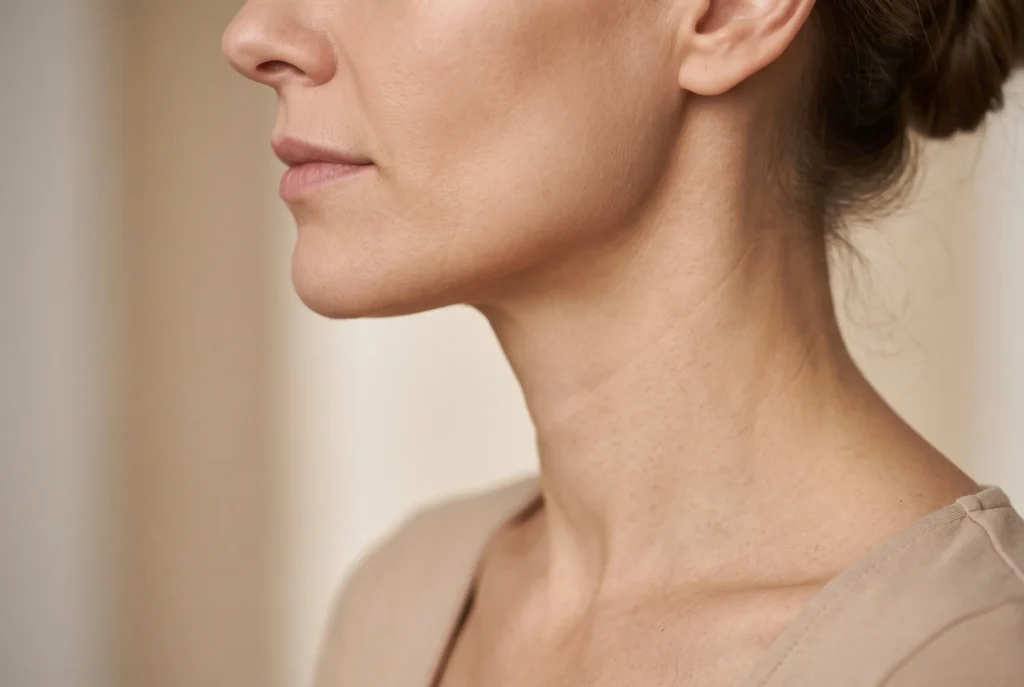
Close-up of a defined jawline and neck, the areas a PDO thread lift treats near Tampa

What A PDO Thread Lift Does, And What It Does Not

A thread lift moves tissue. It removes nothing and it builds nothing. Understanding that single sentence sorts most people into the right treatment before they ever book.

PDO is polydioxanone, an absorbable suture material used in surgery for decades. Threads enter through a few small points along the jawline, jowls and upper neck. Barbs along each thread catch loose tissue, carry it to where it should sit, and hold it there. The entry points close on their own.

The result arrives on two clocks. The first is mechanical and immediate: the thread is physically holding skin in a new position, and that part softens as the material breaks down over roughly 12 to 18 months. The second comes from your own tissue. Threads provoke fibroblasts, the cells that lay down collagen and elastin, so skin quality keeps improving for about six months after placement. Your physiology decides how much of that second result you get, which is why the weeks around your appointment matter more than most clinics admit.

If your concern sits along the jaw line rather than across the whole lower face, a jawline thread lift treats that single line with fewer threads and a shorter appointment.

The Four-Layer Neck Read, And Where Threads Fit

Most necks show aging in more than one layer at once, and threads reach only one of them. Formation screens every neck and jawline patient with the Four-Layer Neck Read before anything gets scheduled. It takes a few minutes in the exam chair and it decides the plan.

Layer One, Fat

Pinch the tissue under your chin and ask what you are holding. A soft pad of fat means threads are the wrong instrument, because threads move tissue and remove nothing. Fat under the chin responds to chin and neck liposuction. Most people who walk in asking for threads land here, and most clinics place the threads anyway.

Layer Two, The Platysma

Vertical cords that stand out when you tense your neck are platysmal bands. Threads do not touch muscle. Bands call for MyEllevate with platysmaplasty, a permanent suspension suture paired with a muscle repair. The distinction is worth holding onto: a PDO thread dissolves and a MyEllevate suture does not, and the permanent one can be removed if it ever needs to be. Placing threads over active bands hides nothing and spends the appointment badly.

Layer Three, Skin

Skin that has lost its snap is the layer threads work on, within limits. Threads reposition skin more than they tighten it. When the skin itself needs heat to contract, FaceTite jawline tightening, a radiofrequency device that works from under the skin rather than across the surface, reaches deeper than any suspension and is often the better single choice. The window where threads perform well runs roughly from skin age 25 to 55.

Layer Four, Chin Projection And Jaw Angle

A weak chin or a soft jaw angle is a structure problem, not a laxity problem. Here Formation applies the Add-or-Subtract Rule: decide whether the jawline needs something taken away or something put in, because the two answers use opposite instruments. No thread builds a superhero jawline out of a recessed chin. Structural filler does. Radiesse, a calcium hydroxylapatite, and Juvederm, a hyaluronic acid, add projection along the chin and jaw. Plenty of patients get more from chin and jawline filler than from any lift.

Clear layers one, two and four, land inside layer three, and you are a strong thread candidate. Fail layer one or layer two and threads will disappoint you regardless of who places them.

The Complication Numbers Most Thread Lift Pages Skip

Thread lifts are low risk, and the risk is measurable. Almost no clinic page prints the figures, so here they are with the caveats that belong beside them.

A 2026 meta-analysis in Frontiers in Surgery pooled 26 studies covering 2,827 thread-lift patients. Swelling appeared in roughly 34 percent of cases and bruising in about 26 percent, with pain in about 11 percent. Visible or palpable threads ran about 10 percent, dimpling or asymmetry about 7 percent, tingling or numbness about 6 percent, thread exposure about 5 percent, and infection about 2 percent.

Here is the part that changes how you should read those numbers, and it comes from the authors themselves. They separate early events from late ones. Swelling, bruising and pain show up in the first four weeks, resolve on their own, and may be normal tissue response to a needle rather than true complications. Visible threads, dimpling, numbness and thread exposure are the events that appear or persist past four weeks, and those are the ones that track technique. That distinction matters more to your decision than the headline percentage does.

Three limitations belong with the figures. The pooled studies ran from 2002 to 2021 and covered patients aged 14 to 87. They mixed dissolving threads with permanent ones, and the authors ran no separate analysis by material, so this is not a clean PDO-only estimate. Variation between studies was high, at 92 percent for swelling alone. Treat the numbers as a range rather than a forecast for your own face.

What The Largest Published Thread Lift Series Shows About Thread Choice

The biggest dataset in this field says something that cuts against how threads are usually sold: PDO alone is not the most common way threads are actually used.

A 2025 review of 111,948 facial thread lift procedures performed between 2020 and 2024 across more than 100 clinics broke procedures down by thread type. PDO paired with a second material accounted for about 39 percent of cases. PDO used on its own accounted for about 37 percent. The remaining quarter used other materials entirely. So in the largest series ever published, a PDO-only thread lift was the minority approach.

The same dataset shows the median patient age climbing every year of the study: 34 in 2020, 36 in 2021, 39 in 2022, and 42 in both 2023 and 2024. Older tissue behaves differently under a barb than younger tissue does, and a market treating a 42-year-old the way it treated a 34-year-old five years ago is a market that has not adjusted.

One limitation deserves stating clearly, and no clinic page in this market states it. That series and the other large PDO dataset frequently quoted in patient counseling both come from the same Japanese cosmetic surgery network. Their protocols, thread lengths and patient population are consistent by design, which is what makes the numbers clean and also what limits how far they travel. Useful figures. Not universal ones.

While we are on precision: PDO threads reach the market as Class II devices through the FDA’s 510(k) clearance pathway. That is clearance, not approval. Any page claiming threads are FDA-approved for facial lifting is either careless or selling.

How Formation Prepares You Before The Threads Go In

The second half of a thread result is collagen your body has to build, so Formation treats the weeks around your appointment as part of the procedure rather than as an afterthought.

Your health and diet are assessed before anything is placed. Protein intake, inflammation, sleep and current supplements all get reviewed. Nutrition, supplements and peptides are then adjusted in the window immediately before and after the appointment, so your tissue builds the most structure it can while the threads are holding it in the new position. Dr. Grandhige has run his surgical practice this way for years, and the reasoning carries directly across to threads.

Formation works to a 60/40 standard: the placement is 60 percent of the result and the aftercare is 40 percent. Poor aftercare can undo well-placed threads, and good aftercare cannot rescue bad placement.

The threads themselves are the same product every practice buys. The instrument is identical across this market. The thinking around it is not.

The Drive From Bradenton, And When To Schedule

Bradenton patients cross the bay for this, and the crossing shapes two separate decisions.

Formation sits on South Howard Avenue in South Tampa, roughly 45 to 50 miles from Bradenton by road. The usual route runs I-75 north, then I-275 north over the Sunshine Skyway, through St. Petersburg, and across the Howard Frankland Bridge into Tampa. Budget about an hour, longer on a weekday morning northbound. The I-75 route around the east side of the bay runs a similar distance and skips the Skyway toll, which is worth knowing if you drive it often.

One recent change is worth planning around. As of August 22, 2026, the I-275 express lanes across the Howard Frankland collect tolls electronically around the clock through SunPass. Those lanes run from 4th Street North in St. Petersburg to just north of the bridge in Tampa, which is exactly your northbound stretch, and only passenger vehicles, registered vanpools and buses may use them. The wider bridge project, the largest in FDOT District 7 history, reached its final phase this year after the original 1960s span came down. Formation books cross-bay thread appointments in morning blocks for this reason, so you drive home before the afternoon build-up rather than sitting in it with a freshly treated jaw.

Before you spend a morning on the interstate, Formation offers a complimentary virtual evaluation with patient coordinator Hanna, who reviews your goals and outlines a plan remotely. The in-office consultation with Dr. Grandhige carries a fee, runs as a full surgical assessment rather than a sales meeting, and that fee can be applied toward any procedure or product at the practice. Most Manatee County patients start virtually and come in once.

Then there is timing, and the Manatee County calendar is unusually dense at the front of the year. The county fair takes eleven days in January. The River Regatta fills a February weekend. De Soto month runs through April and closes with the Grand Parade on a Saturday night, preceded by the black-tie De Soto Ball the evening before. Bruising along the jaw peaks in the first three days and takes one to three weeks to clear. Work backward: for a late-April ball, threads placed by the last week of March are comfortable and threads placed in mid-April are a gamble. The same arithmetic applies to a wedding, a reunion or a headshot.

The other local variable is light. This is a Gulf-facing county with beach, boat and dock time built into ordinary life, and open water throws ultraviolet back up at your face from below in a way an inland yard does not. Ultraviolet exposure degrades collagen, which is the exact material your thread result depends on for its second phase. Formation sends you home with a written sun protocol rather than a verbal suggestion, and it is worth asking any provider whether they factor sun exposure in at all.

Not every patient who wants surgery is ready for it.One patient came to Dr. Gopal wanting a tummy tuck. Over the next 18 months, she returned multiple times, having lost more weight each time. And each time, the answer was still no.Not because she couldn’t have the surgery, but because she wasn’t where she wanted to be yet.Instead of rushing into surgery, the focus was on helping her reach a healthier, more sustainable weight through nutritional counseling, lifestyle support, and medical weight management.By the time she had lost 80 pounds, she was ready, both physically and mentally.For Dr. Gopal, being a good surgeon isn’t just about knowing how to perform a procedure. It’s also about knowing when not to perform one.Sometimes the best result starts long before the operating room.Considering a tummy tuck? DM us to schedule a consultation with Dr. Gopal at Formation Tampa.#Tampa #TummyTuck #BodyContouring

56 4
Six hours. Hundreds of decisions.High-definition liposuction is as much about precision as it is about technique.Dr. Gopal can spend 6–7 hours on a single HD liposuction procedure, carefully evaluating the body’s anatomy, refining muscle definition, and making sure each contour transitions naturally into the next.And that level of attention doesn’t change as the hours go by.Because the final result is shaped by hundreds of small decisions made throughout the procedure.Considering HD liposuction in Tampa? Schedule a consultation with Dr. Gopal Grandhige at Formation Tampa.#HDLiposuction #HighDefinitionLiposuction #MaleLiposuction #TampaPlasticSurgery #BodyContouring

22 2
Which one surprised you the most? 👀Liposuction is one of those procedures people have heard a lot about, but not everything they’ve heard is accurate.From what liposuction can actually achieve to how long results take to develop, there are plenty of misconceptions that can lead to unrealistic expectations.Dr. Gopal Grandhige, board-certified plastic surgeon at Formation in Tampa, breaks down some of the most common beliefs about liposuction and explains what’s fact and what’s fiction.#Liposuction #HDLiposuction #BodyContouring #tampa

85 2
This is not your typical liposuction. 👀Most people think liposuction is simply about removing unwanted fat. But high-definition liposuction takes a different approach.Before surgery, Dr. Gopal carefully maps out the patient’s natural anatomy, marking the chest, abdomen, and waist to guide where fat will be removed and where it should be preserved.Why does that matter?Because removing fat evenly isn’t necessarily going to create definition. HD liposuction uses strategic fat removal to highlight the underlying muscle structure and create a more sculpted, athletic appearance.And those lines? They’re part of the planning that makes this level of precision possible.The photos show an actual patient immediately after surgery. Swelling is still present, and the final results will develop as healing progresses.Interested in high-definition liposuction? Schedule a consultation with Dr. Gopal at Formation Tampa through the link in bio.Actual patient photos. Individual results vary.#HDLiposuction #HighDefinitionLiposuction #MaleLiposuction #BodyContouring #Tampa

40 0
Does fat move after lipo?It’s a common concern, especially when someone notices weight gain in an area that wasn’t treated.Here’s what actually happens.The fat cells removed during liposuction are gone permanently. But if someone gains weight afterward, the remaining fat cells can still grow, including in areas that weren’t treated.The fat didn’t move. The body gained weight.That’s why Dr. Gopal emphasizes being at a weight patients can realistically maintain before surgery. Not the lowest weight they can reach, but one they can sustain long after recovery.Considering liposuction? Schedule a consultation with Dr. Gopal at Formation in Tampa. Link in bio.#Liposuction #HDLiposuction #BodyContouring #LiposuctionResults #Tampa

100 5
Want a more sculpted body?High-definition liposuction takes body contouring a step further. Instead of simply removing excess fat, it focuses on sculpting around the body’s natural muscle structure to create more visible definition and a more athletic contour.Dr. Gopal Grandhige specializes in HD liposuction, customizing each procedure based on the patient’s anatomy, body shape, and desired level of definition.Because the goal isn’t to give everyone the same body. It’s to create a result that works with their natural anatomy.Considering high-definition liposuction in Tampa? Schedule a consultation with Dr. Gopal at Formation Tampa. Link in bio.Actual patient photos. Individual results vary.#HDLiposuction #HighDefinitionLiposuction #MaleLiposuction #BodyContouring

33 2
Don’t plan lipo 2 months before vacation.If the goal is to enjoy a more sculpted, defined body next summer, the planning needs to start months before that.Fall is one of our busiest seasons at Formation, and there’s a reason for it. Many patients are already thinking about how they want to look and feel next summer.But getting there takes time.At Formation, Dr. Gopal requires at least four weeks of preparation before surgery. That time is spent preparing patients physically and mentally for the procedure and recovery.After surgery, swelling needs to go down, the skin needs to contract, and the tissues need time to settle into their new contour.It can take 6–9 months for results to look and feel natural.That’s why Dr. Gopal recommends planning liposuction 6–12 months ahead, especially when there’s a specific season or vacation in mind.If next summer is the goal, now is the time to start the conversation.DM us or Schedule a consultation with Dr. Gopal at Formation in Tampa. Link in bio.#Liposuction #HDLiposuction #BodyContouring #Tampa

65 0
How defined would you go?Not everyone wants the same look from HD liposuction. Some prefer a smooth, subtle contour, while others want their abs to stand out.Here’s how the three levels of definition differ:01. Low definition: A leaner, natural-looking abdomen with subtle definition and light contouring around the underlying muscles.02. Medium definition: More visible separation between the abdominal muscles, with added definition through the abs and obliques without a sharply etched six-pack.03. High definition: More pronounced sculpting around the abs and obliques to highlight the underlying muscle structure and create a more chiseled, athletic look.Dr. Gopal tailors his HD liposuction technique to the level of definition you’re looking for, while considering what’s achievable for your body.Which would you choose: 1, 2 or 3? Tell us in the comments!Interested in HD liposuction? Schedule a consultation with Dr. Gopal at Formation in Tampa. Link in bio.Actual patient photos. Individual results vary.#HDLiposuction #Liposuction #BodyContouring #Tampa

66 20
This isn’t traditional lipo. It’s HD lipo.For this patient, getting smaller isn’t the goal.He already works out. He already has the muscle. Dr. Gopal’s job is to use HD liposuction to bring out more of that existing definition and shape the areas around it so the body looks more athletic and defined.That’s why the markings matter. Before surgery even begins, Dr. Gopal is mapping out how the abs, chest, arms and surrounding areas should work together in the final result.Considering HD liposuction in Tampa? DM us to learn more.📍Formation1315 S Howard AveTampa, FL 33606📱(813) 922-2920#HDLiposuction #HighDefinitionLiposuction #MaleLiposuction #LiposuctionTampa #tampa

564 44
This is the part of the job that never gets old.There’s something special about knowing how different a patient’s life might feel on the other side.Not just because their body may look different, but because of everything that can come with it.Feeling more comfortable in their own skin. Saying yes to plans without thinking twice. Looking forward to summer instead of dreading it.Plastic surgery can change a body. But sometimes, what matters most is how differently someone gets to experience their life afterward.And that’s a pretty incredible part of what we get to do at Formation Tampa.#HDLiposuction #HighDefinitionLiposuction #liposuction #Tampa #BodyContouring

27 2

Treatment Day And Recovery Week By Week

Plan on about an hour in the office, not an operating room, and plan on looking worse before you look better.

Dr. Grandhige marks your face while you sit upright, so the plan follows how your skin falls under gravity rather than how it settles on a reclined table. He numbs the entry points and treatment area with local anesthetic, places the threads, sets each vector, and checks symmetry side to side as he works. You will feel pressure and some tugging. It is not painless, and it is nowhere near surgery. You leave with a visible lift already in place and a written plan for the next three weeks.

Days one to three. Swelling and bruising peak. Tenderness along the jaw feels like a mild sunburn. Small puckers at the entry points are common and look worse when you smile. Keep camera meetings audio-only.

Days four to seven. Bruising turns yellow and swelling drops off. Skin begins to feel tighter as threads settle. Light makeup covers whatever color remains. Training resumes at the one-week mark.

Weeks two to four. Visible side effects are largely gone. Some tightness or sensitivity can linger while tissue integrates around the threads. Skip heavy sweating and hold steady sun protection through this window.

Months two to six. Skin quality keeps improving as new collagen lays down. This is where the result matures, and where the settled outcomes in the before-and-after gallery come from.

If your read points to layer one instead and the plan becomes neck liposuction with skin tightening, the timeline changes: a chin compression garment worn 12 to 24 hours a day, back to work at one week, fat removal visible at two to four weeks, tightening visible at three months, and the final result at six to nine months.

Formation follows thread patients on the same schedule it follows surgical patients, which runs a full year.

Why Dr. Gopal Grandhige Places Your Threads

Most thread lifts in this region are placed by injectors. At Formation, yours are placed by a board-certified general surgeon who specializes in aesthetic surgery.

Dr. Gopal Grandhige earned his MD at the University of Michigan Medical School and first matched into a six-year combined residency at Yale before completing a full general surgery residency, with fellowship training in burn surgery, critical care, and minimally invasive metabolic and foregut surgery. He is certified by the American Board of Surgery and has operated for over 15 years across several thousand cases.

That background changes one specific thing about this procedure. The published data puts dimpling, visible threads and asymmetry in the late-onset group, the events that track technique and anatomy rather than product, which means the variable you are actually buying is judgment about tissue. Training in wound healing, inflammation and tissue behavior is what heads off the problems that come from inexperience. The same judgment carries into thread lifts for men, where heavier dermis and stronger jaw structure change both the vectors and the count.

For patients whose read points toward a surgical plan instead, Formation operates in Quad A accredited facilities with the same anesthesia provider and the same surgical team on every case. Patients whose laxity has moved past what any suspension can hold get referred out to surgeons who do facelift work well, and Formation stays in contact with those surgeons rather than selling a treatment that will underdeliver.

Questions To Ask Before You Book Anywhere

The single biggest driver of a clean thread result is who is holding the needle. Before booking anywhere, get direct answers to these.

One thing worth raising in any consultation: threads leave scar tissue behind, and published surgical reports describe that tissue making a later facelift harder to plan. The case series behind that observation are small, so treat it as a consideration rather than a verdict. If you are weighing surgery against stalling with threads, it belongs in the conversation.

  • Who places the threads, and are they a physician? At many medspas it is an injector working under a supervising physician who is not in the room. Ask by name.
  • Which of the four layers is driving my complaint? A provider who cannot separate fat from muscle from skin from bone structure is guessing at the plan.
  • How many threads are planned, and why that number? A multicenter analysis of 1,500 PDO thread lift patients found that 3.4 percent returned because the result was not enough, with independent inflection points at age 43 and at 10 threads. A clinic paid per thread has no reason to mention that arithmetic.
  • Are patients over 45 counseled differently? The published inflection sits at 43, and a provider treating a 55-year-old identically to a 38-year-old is not adjusting for it.
  • Which device is being used, and what does its 510(k) summary say? You can look that up yourself.
  • How does my sun exposure change the plan? If the answer is that it does not, the collagen half of your result is being ignored.
  • Will you tell me when threads are the wrong choice? The answer to this one tells you the most.

Frequently Asked Questions About PDO Thread Lifts

The mechanical lift softens as the threads dissolve over roughly 12 to 18 months. The collagen improvement outlasts the threads. Most patients hold a visible result for about a year to 18 months, and objective long-term measurement is thinner than the industry figure implies, so treat 12 to 18 months as a planning range rather than a promise.

You feel pressure and tugging rather than sharp pain. Local anesthetic covers the entry points and the treatment area. Most patients describe the days afterward as tender rather than painful, similar to a mild sunburn along the jaw.

You see a lift the same day. That first version settles over two to four weeks as swelling resolves. The collagen phase runs through months two to six, and the settled result sits at the end of that window.

Placed conservatively, no. Colleagues tend to say you look rested rather than asking what you had done. Puckering in the first week is the giveaway period, and it resolves.

Age is a variable, not a cutoff. Published data puts an inflection around 43, and skin quality matters more than the number on your license. Past a certain degree of laxity, no suspension holds, and that is the read Dr. Grandhige gives you directly.

Yes. A thread lift runs under local anesthetic with no general anesthesia and no sedation requirement, so most patients drive themselves back across the bay the same afternoon. Formation schedules these appointments in the morning so you are not crossing the Howard Frankland at rush hour.

Often, yes. Threads reposition tissue, filler adds structure, energy tightens skin and liposuction removes fat. In the largest published series, PDO combined with another material was actually the most common approach. A face lifted without addressing the layer that is really driving the change will look off, which is why the layer read comes first.

The in-office consultation with Dr. Grandhige carries a fee and runs as a full surgical assessment, and that fee can be applied toward any procedure or product at the practice. Formation also offers a complimentary virtual evaluation with patient coordinator Hanna if you want a plan before committing to the drive.

Your Next Step From Bradenton

A thread lift is the right tool for mild to moderate sagging when you want visible change without an operation. It is the wrong tool for heavy laxity, for a chin that needs structure, and for fat under the jaw. Knowing which of those describes you is the whole decision, and it takes about four minutes in the chair to sort out.

Start with the complimentary virtual evaluation if the bay crossing is the obstacle. Book the in-office assessment when you want the full read. Either way you leave knowing where you stand, including when the answer is to wait.