





loader image

PDO Thread Lift In Lowry Park, FL

How A PDO Thread Lift Works

A PDO thread lift works in two stages: a mechanical lift you see the same day, then months of collagen your body builds around the threads. PDO is polydioxanone, the same absorbable suture material used in general surgery for decades. The threads dissolve. What they set off does not leave with them.

The Immediate Mechanical Lift

Barbed threads pass under the skin, catch the underside of the tissue, and draw it upward along the vectors your anatomy allows. The change shows before you leave the room, because nothing biological has happened yet. It is pure mechanics. Dr. Gopal Grandhige places them along the jawline, lower cheek, and upper neck, the three zones that soften first and the same zones he works in surgically.

The Collagen Phase

As the polydioxanone breaks down over three to six months, your body reads it as tissue injury and lays down collagen along each thread track. That is where the durable part of the result comes from. So the face at month four often looks better than the face at week two, even though the threads themselves are mostly gone by then.

The Two Numbers That Predict Your Result

Thread count and age predict complications and dissatisfaction after a thread lift better than anything else. A published analysis of 1,500 thread-lift patients found formal dissatisfaction in 3.4 percent of cases, and identified statistical cutoffs at 43 years of age and 10 threads. Past those two points, the odds of an unhappy patient climb.

Almost no clinic page in Tampa mentions this. It is the most useful thing you can know before you sit down.

Here is how Formation applies it:

  • Most jawline and lower face cases use 8 to 10 threads. Ten is the working ceiling.
  • If a face would need more than 10 to reach the goal, that is treated as information rather than a bigger order. It usually means the real problem is fat volume or true skin excess, and threads are the wrong instrument.
  • Age does not disqualify anyone. It changes the plan. Above the mid-forties the thread count comes down and skin quality gets weighted harder, because older skin dimples more readily and holds a lift less predictably.
  • Formation’s thread patients cluster between 38 and 52, the band where the mechanical lift performs best.

That last point is not a marketing preference. Large multicenter reviews of facial thread lifting report the same pattern: dimpling and contour irregularity are the most common problems, and older tissue needs a modified technique rather than more material.

The Four-Question Thread Screen

Before you book a thread lift anywhere, ask four questions. If a provider cannot answer all four, that is your answer.

  1. How many threads, and why that number? A specific count with a reason behind it means someone measured your face. A vague answer, or a number that scales with the invoice, means someone is guessing.
  2. What is your experience with patients in my age range? Age changes the technique. You want to hear that acknowledged, not dismissed.
  3. Which thread, and does its cleared indication cover this use? Most providers have never read the clearance for the product in their own drawer. The next section explains why that matters.
  4. Do you also operate on patients who had threads first? Only a surgeon can answer this honestly, and the answer tells you whether they are thinking about your face in five years or in five weeks.

Dr. Grandhige answers all four at the consultation without being asked. You are welcome to bring the list anyway.

Why A Board-Certified General Surgeon Places Your Threads

The variable in a thread lift is anatomical judgment, not the product. Dr. Gopal Grandhige is a board-certified general surgeon who specializes in aesthetic surgery. He completed medical school at the University of Michigan Medical School and matched into a combined plastic surgery residency at Yale University School of Medicine before completing a full general surgery residency, followed by fellowship training in burn surgery, critical care, and minimally invasive metabolic and foregut surgery.

That path matters here for a practical reason. Burn and critical care surgery is where you learn how tissue behaves once it is injured and how it heals afterward. A thread lift is a controlled tissue injury. He has been operating for over 15 years across several thousand cases, and has practiced in Tampa for that same span.

He also keeps volume deliberately low. He evaluates every patient himself, designs the plan himself, places the threads himself, and handles the follow-up himself. You are not handed off to a rotating injector.

The 60/40 Rule

Dr. Grandhige treats any procedure as 60 percent of the result and the aftercare as the other 40. Bad aftercare can undo good work. That belief runs through how Formation approaches care, and it applies directly to threads.

Placement sets the lift. The following weeks decide how clean it looks and how long it holds. You get written instructions on sleep position, what to avoid, and how to protect the threads early, plus a two-week recheck and a three-month recheck. Every patient stays in follow-up for a full year, which is standard at Formation for surgical and non-surgical cases alike.

Recovery In Tampa's Heat, Week By Week

Plan on a few days of visible recovery and about two weeks before the gym. Tampa’s climate changes the aftercare more than most pages admit.

  • Day of: local anesthesia, about an hour in the chair, and most people drive themselves home.
  • Days one to three: mild swelling, some bruising, and a tight pulling feeling along the thread lines. Sleep on your back, slightly elevated.
  • Days four to five: most people look normal enough for work, with any marks easy to cover.
  • Weeks one to two: no saunas, no steam rooms, no hot yoga. Heat and heavy sweating push swelling up and slow the settling.
  • Week two: cleared for the gym.
  • Weeks two to four: the two-week recheck confirms the lift is holding and catches any dimpling while it is still easy to address.

The climate piece is specific and it gets skipped. Sun exposure in Tampa is a year-round variable, not a summer one, so sunscreen over the treated area starts immediately. Living near the Hillsborough River and the parks around ZooTampa at Lowry Park means humidity and outdoor time are already part of your normal week, and both are worth planning around for the first fortnight. Ice and arnica help the first few days. None of it is complicated. Almost nobody tells you beforehand.

What "FDA-Cleared" Really Means For Threads

PDO threads are FDA-cleared, not FDA-approved, and for most products on the market the cleared indication does not include facial lifting. They are cleared as Class II devices for soft tissue approximation, the same category as ordinary absorbable surgical sutures. Read an actual clearance summary and the language is blunt. The FDA record for one widely used PDO thread states that the suture is not intended for lifting and supporting tissues.

That is not a scandal. Off-label use of a cleared device is legal and routine across medicine. It changes two things.

First, no regulator has reviewed efficacy data for lifting your jawline with these threads. Clearance meant the device was substantially equivalent to a suture already on the market. Nobody ran a trial on the cosmetic use.

Second, because the material is essentially suture, the variable is not the thread. It is the hand placing it. Someone who knows where the facial nerve branches and the vessels sit is working from a different base than someone certified over a weekend. Formation covers whether PDO threads can cause nerve damage in more detail.

Any Lowry Park clinic page telling you threads are FDA-approved for lifting is either careless or counting on you not to check.

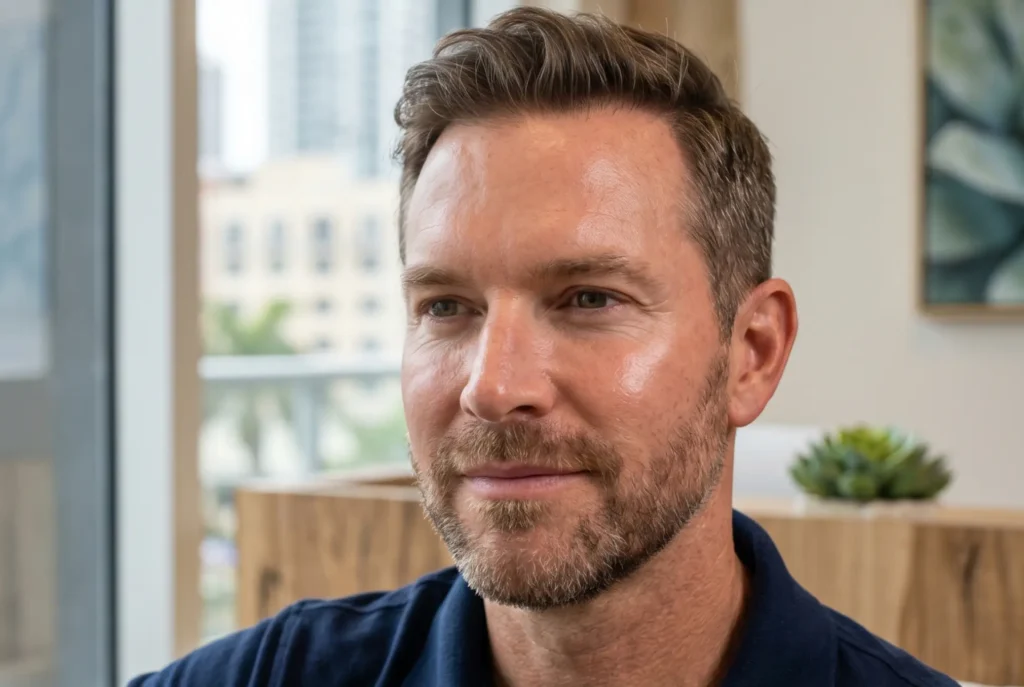
Medium shot of a handsome man with refined facial features after PDO thread lift
Close up shot of a person after PDO threads

How Long Results Actually Last

Expect the mechanical lift to be at its most obvious for six to twelve months, with the collagen contribution carrying a softer version of the result past that. The 12-to-18-month figure printed on nearly every clinic page is the optimistic end of a real range, not the average.

The honest sequence:

  • Day one: the lift is at its sharpest, before swelling arrives.
  • Weeks two to four: swelling clears and you see your true starting point.
  • Months three to six: collagen fills in and skin quality improves.
  • Months six to twelve: most people say the result photographs best here.
  • Past twelve months: gradual softening. Some hold well into a second year. Others do not.

What moves that range is your starting skin quality, thread type, thread count, and technique. Not the brand on the box.

Nobody at Formation will promise you 18 months.

The Risk Most Pages Skip: Threads And Future Surgery

Threads can make a later facelift harder. This is the single biggest omission in thread-lift marketing, and it matters most to exactly the people threads appeal to: patients in their forties who will probably consider surgery eventually.

The mechanism is the same one that makes threads work. The body responds to the material by laying down collagen along the track. That fibrosis can persist after the polydioxanone itself is gone. Surgeons operating later on patients with a thread history report denser, less predictable tissue planes, longer dissection, and more difficulty reaching the result they would expect in untouched tissue.

It is not a barrier and it is not a reason to avoid threads. It is a reason to think about sequence. If a facelift is realistically five or ten years out, that belongs in the conversation before the first thread goes in.

Beyond that, the published complication picture is real but mostly temporary. A meta-analysis of facial thread lifting puts swelling at roughly 35 percent of cases, skin dimpling near 10 percent, altered sensation around 6 percent, visible or palpable threads around 4 percent, and infection near 2 percent. Most of it settles. It is still a longer list than “minimal side effects.”

The two things Formation sees most are the two at the top of that list: temporary swelling, and occasionally a small dimpled area that resolves with hands-on lymphatic work in the first few weeks.

Who Is A Candidate In Lowry Park, And Who Should Skip It

Threads suit mild to moderate laxity in skin that still has recoil, and they are wrong for heavy sagging or a full neck. The distinction is skin versus fat, and it is the first thing evaluated.

You are likely a candidate if:

  • Your jawline has softened but the skin still springs back when you pinch it
  • You have early jowling rather than established jowls
  • You want a sharper profile without weeks away from work
  • You are somewhere from your late thirties into your early fifties

You should skip threads if:

  • There is real fullness under the chin. That is fat, and threads only reposition it.
  • Your skin has lost most of its recoil. Threads will pull and then give out early.
  • You want a facelift result. No thread count produces one.
  • You are hoping to postpone a decision. Waiting is sometimes the right call, and you will be told that.

That is where the one-in-three figure comes from. Roughly a third of the people who book a thread consultation at Formation are told something else fits better, or that nothing needs doing yet. Men in particular come in for jawline and neck definition, where the aim is a clean masculine line rather than a lifted one, which is covered on the thread lift for men page.

One pattern worth naming: most people do not tell the surgeon their real fear. They tell the front desk. The most common one is that it will look done. Formation’s staff pass those concerns through before the consultation starts, so the question gets answered whether or not you say it out loud.

Profile view of a man showing a sharper, more defined jawline and tighter skin after a PDO thread lift.

Threads, Filler, Skin Tightening, Neck Liposuction, Or Surgery

Each of these solves a different problem, and picking wrong is the most common reason people end up disappointed. Match the tool to the mechanism.

  • PDO thread lift. Repositions your own tissue upward and cues collagen. For early jowling and a soft jawline while the skin still has recoil. Not a facelift substitute.
  • Dermal filler. Adds volume where the face lost it. Filler builds outward, threads pull upward. Filler will not fix laxity.
  • Radiofrequency skin tightening. Works under the skin to contract loose tissue without removing anything. It fits when slack skin is the main complaint, and it pairs with threads. Dr. Grandhige already uses radiofrequency tightening in his neck and jawline surgical cases.
  • Neck liposuction. If the problem under the chin is fat rather than skin, neck liposuction removes it. Threads cannot.
  • Facelift or necklift. Removes and repositions tissue for the heavy sagging threads cannot reach.

The decision usually comes down to one question: is what bothers you skin, or is it fat? Answer that and the tool picks itself.

Getting To Formation From Lowry Park

Formation is at 1315 South Howard Avenue in South Tampa’s SoHo district, roughly a 15 to 20 minute drive from Lowry Park down I-275. Lowry Park sits along the Hillsborough River in North Tampa, off Sligh Avenue near ZooTampa, with Riverside Heights and Seminole Heights next door.

Because a thread lift runs on local anesthesia and takes about an hour, the trip works as a single mid-morning appointment. You drive down, you drive home, and your week stays intact. You can review actual outcomes in the before-and-after gallery before deciding anything.

Patients also come from Seminole Heights, Riverside Heights, Tampa Heights, Forest Hills, Hyde Park, Davis Islands, and across Tampa Bay. Consultations are by appointment only and carry a fee, because the visit is a full surgical assessment rather than a sales meeting: anatomy, candidacy, honest alternatives, and timing.

The Bottom Line For Lowry Park

A thread lift is one of the simplest ways to sharpen a softening jawline without surgery, and the outcome comes down to three things: how many threads, who places them, and whether anyone told you the truth about what threads cannot do.

Published data says thread count and age are the two variables that matter most. Formation runs to that data. Most cases stay at or under 10 threads. A board-certified general surgeon evaluates you, places them himself, and manages the weeks afterward. Roughly one in three people who ask about threads hear that something else fits better.

If you are in Lowry Park and want a sharper, more rested profile without weeks of downtime, the 20-minute drive to SoHo starts with a consultation where you find out whether this is actually your procedure.

Frequently Asked Questions

Most jawline and lower face cases at Formation use 8 to 10. Ten is the working ceiling. If your face would need more than that to reach the goal, threads are probably the wrong tool, and Dr. Grandhige will say so at the consultation.

Not much. It is done under local anesthesia, so you feel pressure and tugging rather than sharp pain. A day or two of soreness afterward is normal.

The mechanical lift is at its most obvious for six to twelve months. Collagen carries a softer version past that. The 12-to-18-month number you see everywhere is the optimistic end of the range, not the average.

No. They are FDA-cleared as Class II devices for soft tissue approximation, and for many products on the market the clearance record states the suture is not intended for lifting and supporting tissues. Cosmetic facial lifting is a common off-label use. Any clinic calling threads FDA-approved for lifting is overstating it.

Possibly. Threads leave fibrosis along the tracks that can persist after the material dissolves, and surgeons operating later on thread patients report denser, less predictable tissue planes. It is not a barrier, but if surgery is realistically in your future, raise it before the first thread rather than after.

Age changes the plan, not the answer. Published data shows dissatisfaction odds rising past roughly 43, largely because older skin dimples more easily and holds a lift less predictably. The response is fewer threads and a harder look at skin quality, not a bigger treatment.

Work in a day or two for most people. Gym at about two weeks. In Tampa's heat, hold off on saunas, steam, and hot yoga somewhat longer.

You get told, and you get an alternative. Roughly a third of thread consultations at Formation end with a different recommendation, often neck liposuction, radiofrequency tightening, or simply waiting.

Yes, when the combination adds something. Threads pair reasonably with radiofrequency tightening when slack skin is part of the picture. Combinations are proposed only when they improve the result.

6 months post high-definition liposuction with moderate definition.The goal wasn’t just less fat. It was a leaner, more athletic contour with visible definition through the abdomen and torso, without pushing the result to the highest level of definition.High-definition liposuction strategically sculpts around the underlying anatomy and can be customized based on a patient’s anatomy, muscle structure, and the degree of definition they want to achieve.For this patient, moderate definition created the balance Dr. Gopal was looking for.Results vary by patient and depend on individual anatomy, skin quality, and treatment plan.Considering HD liposuction? Schedule a consultation with Dr. Gopal Grandhige at Formation Tampa. Link in bio.#HDLiposuction #Liposuction #BodyContouring #MaleLiposuction #tampa

10 1
Your lipo results at 2 weeks are not your final results.And sometimes, what you see during those early weeks can be unsettling.Swelling can temporarily make the treated area look larger. The tissue may feel firm, tight or lumpy. The definition you were expecting may not be visible yet.That doesn’t necessarily mean something went wrong. It simply means your body is still healing.After liposuction, recovery happens in stages, from the initial inflammation and swelling to tissue repair, skin contraction and the gradual emergence of the new contour.Significant changes often become more apparent around the 3–6 month mark, with continued refinement as the tissues heal and mature.That’s why comparing yourself a few weeks after surgery to someone’s polished before-and-after photo can create a very unrealistic expectation. Those two photos may represent months of healing in between.The operation creates the contour. The final result reveals itself over time.If you’re considering HD liposuction, schedule a consultation with Dr. Gopal to understand the procedure, recovery, and what to realistically expect from your results (link in bio).#tampa #liposuction #hdliposuction

73 1
Some surgical decisions are much harder to correct than they are to avoid.That’s what Dr. Gopal means when he says, “I wish more patients knew that you pay more to undo a cheaper procedure.”With liposuction and body contouring, removing fat is only one part of the process. Your surgeon has to understand your anatomy, know how much fat to remove and where to preserve it, create smooth transitions between areas, and consider how the final contour fits the rest of your body.But the procedure doesn’t end when you leave the operating room. Recovery and aftercare matter too. The right guidance around compression, lymphatic massage, incision and drainage care, activity and nutrition can help manage swelling and support your body as it heals.When something doesn’t go as planned, correcting dents, irregularities, poor proportions or an unnatural contour can be more complicated than doing the procedure properly the first time. And sometimes, there’s less to work with the second time around.So when you’re comparing surgeons, don’t compare price alone. Look at their training, experience, surgical approach, before-and-after results, and what their care includes before and after surgery.Because a cheaper procedure can become a very expensive one when you have to do it twice.#tampa #HDLiposuction #lipo

13 0
Lipo recovery can be a lot.There can be swelling, drainage, compression garments, limited activity, and a period where your body may look worse before it starts looking better. And when the final result can take months to fully reveal itself, recovery can take an emotional toll too.That’s why Dr. Gopal views a successful surgical experience as three equally important parts: pre-op care, the operation itself, and post-op care.At Formation, that process starts four weeks before surgery. Patients are prepared physically for the procedure and mentally for what they may experience during recovery.That support continues after surgery with a private nurse during the initial recovery period, supplies and education for at-home care, nutritious meals, and in-home lymphatic massage to help manage postoperative swelling and fluid.None of those pieces are considered extras. They’re part of the surgical experience.Because the goal isn’t just to perform the procedure. It’s to make sure you know what to expect, you’re prepared for it, and you’re properly cared for through the recovery that follows.Considering liposuction or body contouring in Tampa? Schedule a consultation with Dr. Gopal Grandhige at Formation Tampa.#tampa #hdLiposuction

68 4
Many surgeons abandon this lipo technique because it’s so physically demanding.The approach to HD liposuction Dr. Gopal uses requires an extraordinary level of detail and precision. Rather than simply etching lines, every contour and transition is shaped around the patient’s underlying anatomy, a process that can take several hours.Dr. Gopal trained in this technique in Barcelona with one of the world’s leaders in HD liposuction and now teaches it to other physicians. It’s a demanding approach, but that level of precision is what allows for definition that looks natural to the individual.Considering HD liposuction in Tampa? Schedule a consultation at Formation Tampa (link in bio).

61 7
“Glad I took my time researching.”That line matters.Choosing to have plastic surgery isn’t just about deciding you want a change. It’s about deciding who you trust to understand the result you’re looking for, especially when the goal isn’t simply removing fat, but creating a shape that still looks natural to you.For our lovely patient, that meant a tighter stomach and waist, feeling more comfortable in fitted clothing, and most importantly, getting the result she wanted “without looking fake.”That’s the goal of thoughtful body contouring: not to make you look like someone else, but to create a result that works with your body and your goals.Dr. Gopal Grandhige specializes in liposuction and body contouring in Tampa, creating treatment plans around each patient’s anatomy, proportions, and goals.Considering liposuction? DM us or Schedule a consultation at Formation to learn what approach may be right for you (link in bio).

6 0
More definition doesn’t automatically mean a better liposuction result.The goal of body contouring is to create definition that makes sense for your anatomy, not to create the most sculpted abdomen possible simply because we can.Low-, medium-, and high-definition liposuction can create very different looks, from subtle contouring to a more athletic or highly sculpted appearance. The right level depends on your existing muscle definition, proportions, surrounding areas of the body, and the result you want to achieve.For Dr. Gopal Grandhige, a board-certified surgeon specializing in body contouring and high-definition liposuction in Tampa, the goal is balance: the abdomen, chest, back, arms and shoulders should look like they belong to the same body.The result should feel cohesive, proportional, and natural to your anatomy.Considering liposuction? DM us or schedule a consultation at Formation to discuss the level of definition that makes sense for your body and your goals (link in bio).

34 2

Take The Next Step

Use the form below to request your consultation, and the team will follow up to schedule your visit. If you are anywhere in Tampa and want a clear read on your candidacy, book a consultation with Gopal Grandhige, MD at Formation. You will leave knowing exactly where you stand, whether that means scheduling a treatment or holding off for now.
