




loader image

PDO Thread Lift In East Lake, FL

A PDO thread lift places barbed sutures made of polydioxanone, an absorbable suture material, under the skin to reposition mild sagging along the jawline, cheeks and upper neck. The lift shows the day it is placed. Behind it, your body builds collagen around each suture over the following weeks, and that collagen is what carries the result after the threads themselves dissolve. It holds for roughly 12 to 18 months. It does not remove fat, and it does not do what a facelift does. If you live in East Lake, Formation sits about 30 road miles southeast on South Howard Avenue in Tampa, close enough that candidacy gets assessed in person before anyone commits to anything.

What A Thread Lift Reaches, And What It Does Not

Threads act on laxity. That is the whole mechanism. Barbs engage tissue from beneath the dermis, tension repositions it, and the suture holds that position while collagen forms around it. Fat is unaffected. Bone position is unaffected. Muscle banding is unaffected.

That matters because most people booking a thread consultation have not worked out which of those three their problem actually is. A soft jawline can come from a fat pad under the chin, from skin that has lost recoil, from platysmal banding in the neck, or from a chin that does not project far enough to give the jaw a clean edge. Threads only address one of those four, and placing them into the wrong one produces a result that fades early and disappoints.

One point on regulatory language, because nearly every page in the Tampa Bay market gets it wrong. Most polydioxanone thread devices are cleared through the 510(k) pathway as Class II absorbable sutures indicated for soft tissue approximation, which is wound closure. A small number of barbed families carry an additional clearance covering mid-face suspension. Cleared is not the same word as approved, and 510(k) clearance is a finding of equivalence to an existing device rather than a finding that the device lifts faces. Using threads cosmetically is legal, common and appropriate with informed consent and a trained hand. It is still worth asking which specific thread a provider stocks and what its cleared indication actually says.

The Three-Route Screen

Formation screens every softening lower face through three routes before anyone discusses threads. Two of the three are not thread problems. Run these in a mirror before your consultation and you will arrive with better questions.

Route One: Subtract

Pinch the tissue below your chin between thumb and forefinger. A thick, soft pad means submental fat, and fat needs removing rather than repositioning. No thread count changes that. This is the route that leads to neck and jawline contouring instead, which Dr. Grandhige performs in office through small incisions under the chin and behind the ears.

Route Two: Suspend

Pinch the skin over your cheekbone, hold two seconds, release. Skin that snaps back has the recoil threads need to hold. Then place two fingers at your temple and draw the skin gently up and back toward your ear. If a light pull sharpens the jawline, you are inside thread territory. Elasticity is the gate here, and the window runs roughly from skin age 25 to 55. Vertical cords running down the front of the neck are a separate finding. Those are platysmal bands, and they call for MyEllevate with platysmaplasty, a permanent suspension suture that stays in place rather than dissolving.

Route Three: Excise

If you had to pull hard and far before anything moved, you are past what a suture can hold. Threads placed into tissue that heavy give short results and raise the odds of retraction and asymmetry. That is a surgical conversation, and Formation refers those patients outward. Dr. Grandhige stays in contact with the surgeons who do skin excision well and points patients to the right one rather than selling a smaller procedure that will not deliver.

There is a fourth possibility that sits outside all three routes. If your jaw angle and chin projection are the real issue, no amount of lifting fixes a frame problem, and structural filler using Radiesse, a calcium hydroxylapatite, is the better conversation. A dedicated page on structural filler for chin and jaw projection is in progress.

What The Published Complication Data Shows

Threads carry lower risk than surgery. They are not risk free, and the published numbers sit higher than the standard bruising and swelling line implies.

A 2026 meta-analysis in Frontiers in Surgery pooled 26 studies covering 2,827 patients, drawn from work published between 2002 and 2021, with follow-up running from four weeks to 30 months. Swelling appeared in about 34 percent of cases, bruising in about 26 percent, visible or palpable threads in about 10 percent, and skin dimpling in about 7 percent. You can read the full pooled analysis yourself.

Two things about those numbers deserve saying out loud, because they almost never appear alongside them.

First, the authors reported high statistical heterogeneity, with I² values of 92 percent for swelling, 88 percent for visible threads and 76 percent for dimpling. In plain terms, results varied enormously between studies. Second, specialist commentary in the aesthetic surgery literature has pushed back on pooling every thread type into one figure, on the grounds that permanent, composite and fully dissolvable threads behave differently and that certain complications belong to specific thread designs. A 26 percent bruising rate drawn across every thread ever studied is a useful ceiling, not a prediction for your face.

Two variables move the odds more than anything else, and both point the same direction. Older tissue with weaker recoil, treated with more threads, produces more retraction, more asymmetry and more regret. Conservative thread counts are not timidity. They are the reason the result still looks like you in month three.

The complication almost everyone panics about is the one that is expected. Gathering or puckering of the skin directly after placement is part of how barbs engage tissue from underneath, and it settles as tissue relaxes around the sutures. Knowing that in advance is the difference between a calm second week and a 2am search spiral. Formation wrote a separate piece on what it means to feel a thread under the skin and when that is worth a phone call.

One longer-range point that belongs in a consultation rather than a brochure. Published complication lists for thread lifting include tissue fibrosis. If you might want surgery in five or ten years, scarring left behind by earlier thread placement is a fair question to raise with whoever is holding the needle. Nobody in this market volunteers it.

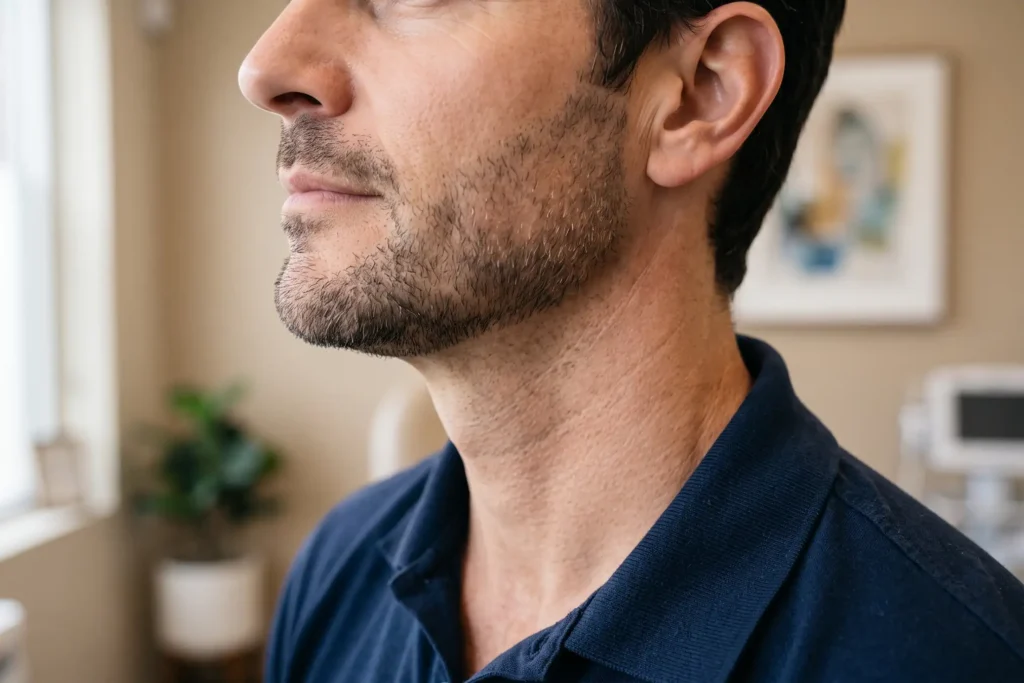
Man wearing black shirt touching his face after PDO thread lift procedure

Preparation And Recovery At Formation

Dr. Grandhige’s stated position on surgery is that the operation accounts for roughly 60 percent of the result and post-operative care accounts for the other 40, and that poor aftercare can undo good technique. The same split governs threads, which is why the appointment does not end when the last suture is trimmed.

The thread itself is the same object in every clinic that stocks it. What changes is the thinking around it. Before placement, health and diet are assessed, and nutrition, supplements and peptides are adjusted in the window immediately before and after so the body builds as much structure as it can around each suture. A thread result is a collagen result. Arriving inflamed, underslept and protein deficient means less collagen, and less collagen means a shorter runway.

Your Milestone Timeline

  • First 72 hours. Tightness, mild swelling, sometimes bruising at entry points. Sleep on your back.
  • Days 3 to 14. Gathering or puckering settles as tissue relaxes around the threads. This is the phase that reads worst and resolves without intervention.
  • About one week. Back to training. Skip strenuous exercise until then, and hold off on facial massage for two weeks.
  • Weeks 2 to 6. Swelling clears and the lift reads cleanly. This is the first honest look at your result.
  • Weeks 6 to 12. The collagen phase. Skin quality and firmness keep changing with nothing further being done.
  • Months 6 to 8. The threads are fully absorbed. Collagen built around them is what holds the lift from here.
  • Months 12 to 18. The point where most people decide whether to repeat.

Sun is the variable that shortens all of it. Ultraviolet light degrades collagen faster than it accumulates, and a thread result is collagen dependent from week six onward. No direct sun for the first two weeks, then daily broad spectrum SPF 30 or higher indefinitely rather than seasonally. For an East Lake patient, that guidance collides with the reasons people live there. Open water on Lake Tarpon doubles your exposure through glare off the surface, and an afternoon at John Chesnut Sr. Park or 18 holes at Lansbrook in July is working directly against the phase you just paid for. Cooler months mean less swelling, less sweating at fresh entry points, and a collagen phase that is not fighting Florida sun.

Getting Here From East Lake

East Lake is a census-designated place rather than an incorporated city. It covers 31.6 square miles in Pinellas County, of which 28.9 square miles is land and 2.7 square miles is water, and it held 32,344 residents at the 2020 census. It has no city government and no ZIP code of its own. Mail for Lansbrook, Tarpon Woods, Ridgemoor, Woodfield, the Woodlands and Boot Ranch carries a Palm Harbor, Tarpon Springs or Oldsmar address.

That single administrative fact explains something you have probably already noticed. Search for a thread lift provider in East Lake and you get Palm Harbor and Tarpon Springs clinics, because no provider carries an East Lake address to list. There is no East Lake outcome series anywhere in the literature, no East Lake specific complication data, and no clinic that can honestly claim to be the East Lake option. Any page telling you otherwise is doing keyword insertion, not geography.

The practical picture is straightforward. From most of East Lake the route runs south on East Lake Road to Tampa Road, east across the Courtney Campbell Causeway, then south through Westshore to South Howard Avenue. Formation is at 1315 South Howard Avenue in Tampa, roughly 30 road miles, and the causeway decides whether that is a pleasant drive or not. Patients also come to Formation from Palm Harbor, Clearwater, St. Petersburg and Westchase, plus travel patients from across Florida and the Southeast.

Because the drive is real, the first step does not have to be. Formation offers a complimentary virtual evaluation with patient coordinator Hanna, who reviews your goals and outlines a plan before you decide whether to make the trip. The in-office consultation with Dr. Grandhige carries a fee and is a full surgical assessment covering anatomy, candidacy, options and limits, and that fee can be applied toward any procedure or product at the practice. For patients traveling further, Formation holds relationships with nearby hotels at discounted rates, and Dr. Grandhige visits patients in their rooms during the early recovery days rather than making them come back in. You can reach the practice directly or call (813) 922-2920.

Who Places The Threads

Dr. Gopal Grandhige is a board-certified general surgeon who specializes in aesthetic surgery. He attended medical school at the University of Michigan, initially matched into the six-year combined plastic surgery residency at Yale, then completed a full general surgery residency followed by fellowship training in burn surgery, critical care, and minimally invasive metabolic and foregut surgery. His certification is through the American Board of Surgery.

That is an unusual route into aesthetics, and it shapes how he weighs a thread case. Burn and critical care training is training in how tissue behaves under injury and how it heals afterward, which is precisely the question a thread lift asks. He has practiced in Tampa for over 15 years and limits volume deliberately so he stays involved before, during and after every case.

He is also willing to tell you no. His stated role is to guide patients toward the right decision even when that decision is to wait, change course, or address something else first. If the pinch test found fat, you will hear that. If a light pull did nothing, you will hear that too. Results across the non-surgical neck and jawline gallery show what restraint looks like at this scale. If threads are not the instrument, FaceTite, a radiofrequency-assisted contouring device, or in-office contouring may be the better route, and the broader PDO thread lift page covers the procedure in more depth.

Man's firm jawline showing PDO thread results over time at a Tampa clinic
Front view man posing in bath towel

Frequently Asked Questions About PDO Thread Lifts

Roughly 12 to 18 months for most patients. The threads themselves absorb around months six to eight. What holds the lift after that is collagen formed around them, which is why sun protection and recovery habits change the number meaningfully.

No. Most polydioxanone thread devices are cleared through the 510(k) pathway as Class II absorbable sutures for soft tissue approximation. A small number of barbed families carry an additional clearance covering mid-face suspension. Clearance establishes equivalence to an existing device. It is not a finding that the device lifts faces.

No. Threads reposition tissue and do not remove fat. If the pinch under your chin found a thick soft pad, that is a contouring question. Many people arrive asking about threads and leave discussing neck and jawline contouring instead.

Placement is done under local anesthesia and most patients describe pressure and tugging rather than pain. The first 72 hours bring tightness and mild soreness that generally sits in over-the-counter territory.

Gathering or puckering of skin directly after placement is part of how barbs engage tissue from beneath the dermis. It settles as tissue relaxes around the sutures. A dimple that persists past week four is worth a call.

Training resumes at about one week. Direct sun is off the table for the first two weeks, which for most East Lake patients is the harder instruction. After that, daily broad spectrum SPF 30 or higher, year round.

Yes, and combinations are common. Threads address laxity, contouring addresses fat, structural filler addresses frame, and MyEllevate with platysmaplasty addresses platysmal banding. Which combination applies is what the consultation determines.

That depends on what the screen finds, which is why the complimentary virtual evaluation with Hanna exists. If your problem turns out to be fat or frame rather than laxity, you will know before you spend an hour on the causeway.

The Short Version

If your jaw has softened, your skin still snaps back, and a light two-finger pull improves the line, a PDO thread lift is a reasonable next step, and Formation is about 30 road miles from East Lake. If the pinch under your chin found fat, or a hard pull was needed before anything moved, threads are the wrong instrument and you should hear that during an assessment rather than discover it eight months later.

The published complication data exists and carries its own published caveats. The regulatory language has real limits that most pages in this market flatten into a marketing word. Florida sun shortens the runway on any collagen-dependent result, and open water off Lake Tarpon shortens it faster. Any provider willing to walk through all three with you before booking is a provider worth booking with.

6 months post high-definition liposuction with moderate definition.The goal wasn’t just less fat. It was a leaner, more athletic contour with visible definition through the abdomen and torso, without pushing the result to the highest level of definition.High-definition liposuction strategically sculpts around the underlying anatomy and can be customized based on a patient’s anatomy, muscle structure, and the degree of definition they want to achieve.For this patient, moderate definition created the balance Dr. Gopal was looking for.Results vary by patient and depend on individual anatomy, skin quality, and treatment plan.Considering HD liposuction? Schedule a consultation with Dr. Gopal Grandhige at Formation Tampa. Link in bio.#HDLiposuction #Liposuction #BodyContouring #MaleLiposuction #tampa

9 1
Your lipo results at 2 weeks are not your final results.And sometimes, what you see during those early weeks can be unsettling.Swelling can temporarily make the treated area look larger. The tissue may feel firm, tight or lumpy. The definition you were expecting may not be visible yet.That doesn’t necessarily mean something went wrong. It simply means your body is still healing.After liposuction, recovery happens in stages, from the initial inflammation and swelling to tissue repair, skin contraction and the gradual emergence of the new contour.Significant changes often become more apparent around the 3–6 month mark, with continued refinement as the tissues heal and mature.That’s why comparing yourself a few weeks after surgery to someone’s polished before-and-after photo can create a very unrealistic expectation. Those two photos may represent months of healing in between.The operation creates the contour. The final result reveals itself over time.If you’re considering HD liposuction, schedule a consultation with Dr. Gopal to understand the procedure, recovery, and what to realistically expect from your results (link in bio).#tampa #liposuction #hdliposuction

73 1
Some surgical decisions are much harder to correct than they are to avoid.That’s what Dr. Gopal means when he says, “I wish more patients knew that you pay more to undo a cheaper procedure.”With liposuction and body contouring, removing fat is only one part of the process. Your surgeon has to understand your anatomy, know how much fat to remove and where to preserve it, create smooth transitions between areas, and consider how the final contour fits the rest of your body.But the procedure doesn’t end when you leave the operating room. Recovery and aftercare matter too. The right guidance around compression, lymphatic massage, incision and drainage care, activity and nutrition can help manage swelling and support your body as it heals.When something doesn’t go as planned, correcting dents, irregularities, poor proportions or an unnatural contour can be more complicated than doing the procedure properly the first time. And sometimes, there’s less to work with the second time around.So when you’re comparing surgeons, don’t compare price alone. Look at their training, experience, surgical approach, before-and-after results, and what their care includes before and after surgery.Because a cheaper procedure can become a very expensive one when you have to do it twice.#tampa #HDLiposuction #lipo

13 0
Lipo recovery can be a lot.There can be swelling, drainage, compression garments, limited activity, and a period where your body may look worse before it starts looking better. And when the final result can take months to fully reveal itself, recovery can take an emotional toll too.That’s why Dr. Gopal views a successful surgical experience as three equally important parts: pre-op care, the operation itself, and post-op care.At Formation, that process starts four weeks before surgery. Patients are prepared physically for the procedure and mentally for what they may experience during recovery.That support continues after surgery with a private nurse during the initial recovery period, supplies and education for at-home care, nutritious meals, and in-home lymphatic massage to help manage postoperative swelling and fluid.None of those pieces are considered extras. They’re part of the surgical experience.Because the goal isn’t just to perform the procedure. It’s to make sure you know what to expect, you’re prepared for it, and you’re properly cared for through the recovery that follows.Considering liposuction or body contouring in Tampa? Schedule a consultation with Dr. Gopal Grandhige at Formation Tampa.#tampa #hdLiposuction

68 4
Many surgeons abandon this lipo technique because it’s so physically demanding.The approach to HD liposuction Dr. Gopal uses requires an extraordinary level of detail and precision. Rather than simply etching lines, every contour and transition is shaped around the patient’s underlying anatomy, a process that can take several hours.Dr. Gopal trained in this technique in Barcelona with one of the world’s leaders in HD liposuction and now teaches it to other physicians. It’s a demanding approach, but that level of precision is what allows for definition that looks natural to the individual.Considering HD liposuction in Tampa? Schedule a consultation at Formation Tampa (link in bio).

61 7
“Glad I took my time researching.”That line matters.Choosing to have plastic surgery isn’t just about deciding you want a change. It’s about deciding who you trust to understand the result you’re looking for, especially when the goal isn’t simply removing fat, but creating a shape that still looks natural to you.For our lovely patient, that meant a tighter stomach and waist, feeling more comfortable in fitted clothing, and most importantly, getting the result she wanted “without looking fake.”That’s the goal of thoughtful body contouring: not to make you look like someone else, but to create a result that works with your body and your goals.Dr. Gopal Grandhige specializes in liposuction and body contouring in Tampa, creating treatment plans around each patient’s anatomy, proportions, and goals.Considering liposuction? DM us or Schedule a consultation at Formation to learn what approach may be right for you (link in bio).

6 0
More definition doesn’t automatically mean a better liposuction result.The goal of body contouring is to create definition that makes sense for your anatomy, not to create the most sculpted abdomen possible simply because we can.Low-, medium-, and high-definition liposuction can create very different looks, from subtle contouring to a more athletic or highly sculpted appearance. The right level depends on your existing muscle definition, proportions, surrounding areas of the body, and the result you want to achieve.For Dr. Gopal Grandhige, a board-certified surgeon specializing in body contouring and high-definition liposuction in Tampa, the goal is balance: the abdomen, chest, back, arms and shoulders should look like they belong to the same body.The result should feel cohesive, proportional, and natural to your anatomy.Considering liposuction? DM us or schedule a consultation at Formation to discuss the level of definition that makes sense for your body and your goals (link in bio).

34 2
