


loader image

FaceTite In Lake Magdalene, FL

FaceTite tightens loose skin and removes fat under the jaw and neck without a facelift incision. It runs in the office while you stay awake, through punctures small enough to hide under the chin and behind the ears. Most patients are back at work in about a week. Formation sits roughly 13 miles south of Lake Magdalene, down either of the two roads that border your neighborhood.

What FaceTite Does Beneath The Skin

FaceTite is radiofrequency-assisted lipolysis. What separates it from the treatments you have probably already tried is how deep it reaches.

The handpiece works as a pair. A thin probe slides under the skin while an electrode rides on the surface above it, and the current runs between the two. That puts the heat at the fibroseptal network, the connective tissue foundation between skin and muscle that gives the neck its shape. The surface electrode reads temperature the whole time, which is what keeps the energy high enough to contract tissue and low enough to leave the skin intact.

Surface devices cannot get there. Lasers and microneedling start at the top and work down, which is fine for texture and tone, and for some people texture and tone is the whole complaint. The foundation sits below the point where they stop. If you have stacked surface treatments and the jawline still reads soft, that depth gap is the reason.

One appointment does two jobs on two clocks. Fat in the treated pocket is emulsified and suctioned, and you see that within weeks. The skin above it contracts and keeps laying down collagen, and you see that over months.

The device is 510(k)-cleared. Clearance and approval are different pathways, and plenty of sites use the two words as if they meant the same thing.

None of this makes FaceTite a facelift. It covers the ground between “the facials stopped working” and “I am not ready to be cut.” Past that ground, radiofrequency underdelivers, and Dr. Grandhige will tell you so in the room. The main FaceTite in Tampa page covers the procedure across every treatment area.

Liposuction can change more than the body.I’ve watched patients become more confident, make changes in their careers, show up differently in their relationships, and start making different choices for themselves.That’s when I know I’ve done my job well.Because high-definition liposuction isn’t only about creating a leaner, more defined physique. Sometimes the physical transformation becomes the catalyst for changes that reach far beyond the operating room.Dr. Gopal GrandhigeConsidering HD liposuction in Tampa? Schedule a consultation with Dr. Gopal Grandhige at Formation Tampa.#BodyContouring #HDLiposuction #tampa #Liposuction

22 2
Male liposuction requires a different approach.The contours that create a more feminine shape aren’t necessarily the same ones that create a strong, athletic male physique.With male high-definition liposuction, Dr. Gopal considers how the chest, abdomen, waist, ribs and back work together—and how the underlying muscle anatomy should guide where definition and shadow are created.That’s also why the chest matters. A highly defined abdomen and back paired with a rounder, less-defined chest can make the overall result feel out of proportion.The goal is a cohesive, athletic contour that works with the patient’s natural anatomy.Considering male HD liposuction? Schedule a consultation with Dr. Gopal Grandhige at Formation Tampa.

30 0
6 months post high-definition liposuction with moderate definition.The goal wasn’t just less fat. It was a leaner, more athletic contour with visible definition through the abdomen and torso, without pushing the result to the highest level of definition.High-definition liposuction strategically sculpts around the underlying anatomy and can be customized based on a patient’s anatomy, muscle structure, and the degree of definition they want to achieve.For this patient, moderate definition created the balance Dr. Gopal was looking for.Results vary by patient and depend on individual anatomy, skin quality, and treatment plan.Considering HD liposuction? Schedule a consultation with Dr. Gopal Grandhige at Formation Tampa. Link in bio.#HDLiposuction #Liposuction #BodyContouring #MaleLiposuction #tampa

10 1
Your lipo results at 2 weeks are not your final results.And sometimes, what you see during those early weeks can be unsettling.Swelling can temporarily make the treated area look larger. The tissue may feel firm, tight or lumpy. The definition you were expecting may not be visible yet.That doesn’t necessarily mean something went wrong. It simply means your body is still healing.After liposuction, recovery happens in stages, from the initial inflammation and swelling to tissue repair, skin contraction and the gradual emergence of the new contour.Significant changes often become more apparent around the 3–6 month mark, with continued refinement as the tissues heal and mature.That’s why comparing yourself a few weeks after surgery to someone’s polished before-and-after photo can create a very unrealistic expectation. Those two photos may represent months of healing in between.The operation creates the contour. The final result reveals itself over time.If you’re considering HD liposuction, schedule a consultation with Dr. Gopal to understand the procedure, recovery, and what to realistically expect from your results (link in bio).#tampa #liposuction #hdliposuction

79 2
Some surgical decisions are much harder to correct than they are to avoid.That’s what Dr. Gopal means when he says, “I wish more patients knew that you pay more to undo a cheaper procedure.”With liposuction and body contouring, removing fat is only one part of the process. Your surgeon has to understand your anatomy, know how much fat to remove and where to preserve it, create smooth transitions between areas, and consider how the final contour fits the rest of your body.But the procedure doesn’t end when you leave the operating room. Recovery and aftercare matter too. The right guidance around compression, lymphatic massage, incision and drainage care, activity and nutrition can help manage swelling and support your body as it heals.When something doesn’t go as planned, correcting dents, irregularities, poor proportions or an unnatural contour can be more complicated than doing the procedure properly the first time. And sometimes, there’s less to work with the second time around.So when you’re comparing surgeons, don’t compare price alone. Look at their training, experience, surgical approach, before-and-after results, and what their care includes before and after surgery.Because a cheaper procedure can become a very expensive one when you have to do it twice.#tampa #HDLiposuction #lipo

16 0
Lipo recovery can be a lot.There can be swelling, drainage, compression garments, limited activity, and a period where your body may look worse before it starts looking better. And when the final result can take months to fully reveal itself, recovery can take an emotional toll too.That’s why Dr. Gopal views a successful surgical experience as three equally important parts: pre-op care, the operation itself, and post-op care.At Formation, that process starts four weeks before surgery. Patients are prepared physically for the procedure and mentally for what they may experience during recovery.That support continues after surgery with a private nurse during the initial recovery period, supplies and education for at-home care, nutritious meals, and in-home lymphatic massage to help manage postoperative swelling and fluid.None of those pieces are considered extras. They’re part of the surgical experience.Because the goal isn’t just to perform the procedure. It’s to make sure you know what to expect, you’re prepared for it, and you’re properly cared for through the recovery that follows.Considering liposuction or body contouring in Tampa? Schedule a consultation with Dr. Gopal Grandhige at Formation Tampa.#tampa #hdLiposuction

70 4
Many surgeons abandon this lipo technique because it’s so physically demanding.The approach to HD liposuction Dr. Gopal uses requires an extraordinary level of detail and precision. Rather than simply etching lines, every contour and transition is shaped around the patient’s underlying anatomy, a process that can take several hours.Dr. Gopal trained in this technique in Barcelona with one of the world’s leaders in HD liposuction and now teaches it to other physicians. It’s a demanding approach, but that level of precision is what allows for definition that looks natural to the individual.Considering HD liposuction in Tampa? Schedule a consultation at Formation Tampa (link in bio).
61 7

The Four-Layer Neck Read

Most necks show aging in more than one layer at once. One treatment applied to everybody is why so many people end up disappointed. Before Dr. Grandhige recommends anything, he reads four layers and matches each one to its own answer.

Layer One, Fat

Submental fat is the pad under the chin, and it is the layer that moves first. It is usually genetic rather than dietary, which is why it outlasts every round of weight loss you have run. Targeted neck liposuction takes it out, and that removal is what creates the shape. Tighten skin over fat you left in place and you get a smoother version of the same silhouette.

Layer Two, The Platysma And Platysmal Bands

The platysma is a broad sheet of muscle across the front of the neck. Its edges separate with age, and the vertical cords that stand up when you clench your jaw are platysmal bands. Heat will not touch them. The answer at this layer is MyEllevate, a permanent suspension suture, combined with platysmaplasty, and it comes up only when bands are actually there. The suture is nonabsorbable and can be removed later, which barbed threads that dissolve cannot offer, and the lift is visible the day it goes in. A dedicated MyEllevate page is in progress.

Layer Three, Skin And The Fibroseptal Network

Elasticity is the gate for FaceTite, and the working window runs roughly from skin age 25 to 55. Test it yourself. Pinch the skin under your chin, hold a second, let go. A quick snap back means radiofrequency has something to pull on. If it stays tented, or if you can gather a thick fold between your fingers, the honest answer is surgical neck and jawline contouring. Past what tightening or contouring reaches, Formation sends patients to the surgeons who do that work well instead of stretching a treatment beyond what it can do.

Layer Four, Chin Projection And Jaw Angle

A few people clear the first three layers and still miss the line they pictured, because the bone underneath does not come forward far enough. That is a question of frame, and structural filler is what addresses it. Radiesse, a calcium hydroxylapatite, and Juvederm, a hyaluronic acid, add projection at the chin and along the jaw angle. A superhero jawline is a frame problem before it is a fat problem, and tightening does not build a frame that was never there. A page covering structural filler for chin and jaw projection is in progress.

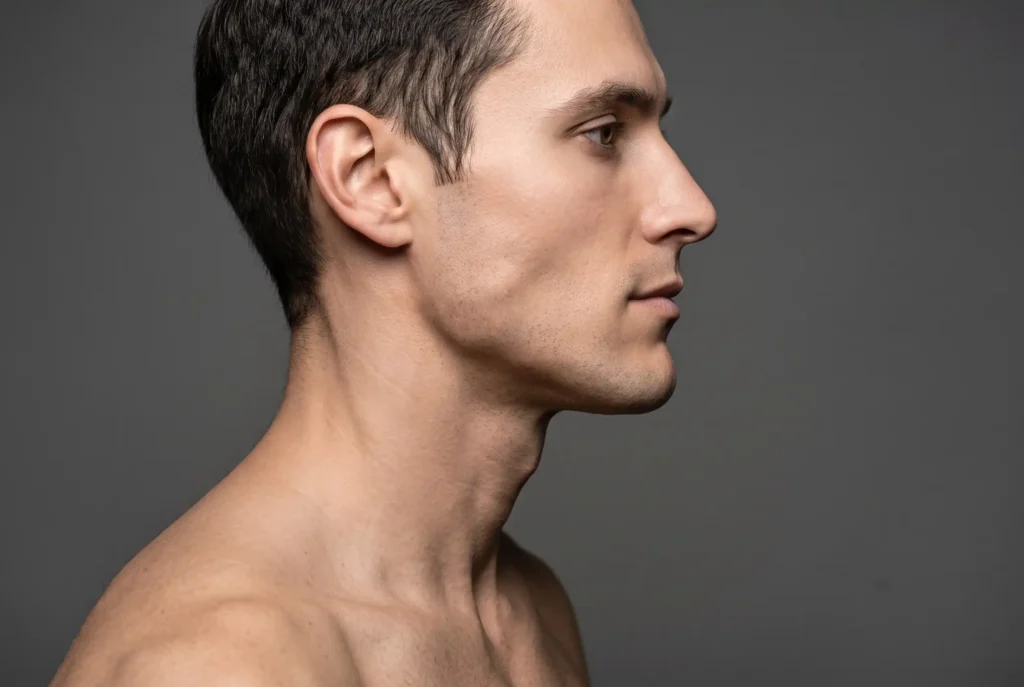
Close-up of a defined male jawline and firm neck, FaceTite result profile

Who FaceTite Suits, And Who Should Wait

The people who do best are at or near a stable weight, with mild to moderate laxity and skin that still recoils. How your skin behaves predicts the result more reliably than your birth year does. Thin, sun-damaged skin tightens less, though it usually still improves.

Dr. Grandhige’s patients skew fit and healthy. Most are not trying to lose weight. They are working on something healthy living cannot reach, and skin laxity is the clearest example.

Reasons to hold off are just as specific:

  • Active smoking, which suppresses collagen production and slows healing
  • A weight that is still moving in either direction
  • Recent injections in the treatment area
  • Any active skin infection
  • A wedding, a cruise or a shoot inside the next three months, because swelling resolves over months and not days

Sometimes nothing is offered at all. Dr. Grandhige describes his role as guiding a patient to the right decision, and that includes waiting or sorting out foundational health first. If the read comes back “your skin is fine, come back in a few years,” that is the answer you get. If the jaw rather than the neck is what bothers you, FaceTite for the jawline goes deeper on that area.

A Formation patient in his forties had stopped letting anyone photograph him. He was fit everywhere else. His neck and jaw made him look heavier and older than he felt, and he said he had looked that way his whole life. After targeted fat removal and tightening, colleagues started telling him he seemed more rested. He got back in the pictures.

What The Evidence Shows, And What Clinic Pages Leave Out

The largest published series on this technology is a multicenter retrospective review of 247 patients treated for lower face and neck laxity, 234 women and 13 men, mean age 55.1. Baker Face/Neck scores improved by an average of 1.4 points, and 93 percent of patients said they were pleased and would do it again. Complications were counted rather than glossed over: prolonged swelling past six weeks in 4.8 percent, a hardened area past twelve weeks in 3.2 percent, and temporary weakness of the marginal mandibular nerve, which controls the corner of the mouth, in 1.2 percent. All of them resolved without further intervention.

Three more numbers sit inside that paper and almost never reach a clinic page. Each one changes how you read the rest.

The first is 97.2 percent, the share of cases, 240 of 247, performed under local anesthesia. Staying awake for this is not a shortcut somebody invented for convenience. It is the format the evidence was generated in.

The second is 9 percent. Twenty-three of those patients were active smokers on the day of treatment, and the favorable satisfaction figure includes them. Formation will still ask you to stop first, because smoking suppresses collagen production and slows healing. The distinction is that smoking is a variable to fix in the weeks beforehand, not a permanent bar.

The third is 13, the number of men in the series. Surgeon judgment outweighs any published figure when the jawline is male, which the FaceTite for men page covers in more depth.

Two limits belong next to all of it. The series is retrospective rather than a controlled trial, and a systematic review of subsurface radiofrequency has argued that the safety and efficacy picture remains unsettled because most published series are uncontrolled. It also tested bipolar radiofrequency paired with fractional radiofrequency, not FaceTite on its own. That is why “microneedling” has to be split in two. Surface microneedling stays above the foundation. Radiofrequency microneedling drives energy into the dermis through needles and was the companion device in that study, not the competitor.

The real risks in this category are irregularities, banding, numbness, asymmetry, incomplete correction and residual laxity. They belong in the conversation before you book, not after.

What The Lake Magdalene Numbers Say About Timing

Lake Magdalene is an unincorporated census-designated place in Hillsborough County, and the Census Bureau counted 30,742 residents here at the 2020 census. American Community Survey estimates put the local median age near 41, against about 38 for the county as a whole. Of the community’s 11.6 square miles, roughly 1.4 are water.

Those numbers do something useful when you set them against the research.

The studied cohort averaged 55.1 years with a standard deviation of about eight, so most patients in that paper sat somewhere between their late forties and early sixties. A neighborhood median near 41 falls well below that. Statistically, you are younger than the evidence base.

That cuts both ways, and only one direction usually gets talked about. In your favor: more remaining elasticity, which is the single variable that predicts how much skin will contract. Against it: the same study found older patients recorded a larger magnitude of Baker-score improvement, because older tissue had more to correct. Both groups improved. A younger patient should expect a smaller measured change from a better starting point, which is the argument for doing less rather than more.

The water is a separate matter. A lake neighborhood is an outdoor neighborhood. Sun exposure in the first two weeks after radiofrequency slows healing and raises the risk of pigment change in treated skin. If your weekends run through the water or a tee time, put those fourteen days in a quieter stretch and stay in shade and sunscreen when you are out.

Chronological age is the number that gets quoted most and predicts least. A 61-year-old whose skin snaps back is a candidate. A 44-year-old with a thick standing fold is not. Which is why the read happens in person, with hands on the skin.

The Window Formation Manages Around The Appointment

The same device sits in offices up and down Dale Mabry. What separates one result from another is everything on either side of the appointment.

Health and diet are assessed before treatment rather than after. In the window immediately before and immediately after, nutrition, supplements and peptides are adjusted so the body builds as much structure as it can while collagen is remodeling. Protein intake, inflammation control and lymphatic flow get dialed in rather than handed over on a printed sheet.

Dr. Grandhige’s background is why that side of it gets attention. He is a board-certified general surgeon who specializes in aesthetic surgery, certified by the American Board of Surgery and fellowship-trained in burn surgery, critical care, and minimally invasive metabolic and foregut surgery, after medical school at the University of Michigan. Burn and critical care work is wound-healing work, and controlled wound healing under the skin is exactly what radiofrequency creates.

The lymphatic care, nutrition guidance and coaching come from providers he has vetted himself over years and watched produce results, not a list handed out at the front desk.

The instrument is identical at every practice. The thinking around it is not.

The 60/40 Recovery Standard And Your Timeline

Dr. Grandhige counts the procedure as 60 percent of the result and the post-operative care as the other 40. Bad aftercare can undo good work. That is the 60/40 standard, and it is why recovery here gets run rather than handed off.

The arc for a neck and jawline case:

  • First few days. Mild swelling, bruising and tightness, with the chin compression garment on.
  • One week. Back to work and social activities, garment worn 12 to 24 hours a day. Training resumes around this point as well.
  • Two to four weeks. Swelling keeps settling and the fat removal becomes clearly visible.
  • Three months. Skin tightening shows up, with obvious jawline improvement.
  • Six to nine months. Final result, once skin tightening has finished.

Run that clock backwards before you pick a date. A September appointment matures through spring. A February appointment lands its final result in late summer. Wearing a chin garment 12 to 24 hours a day is also a different proposition in January than in August, so moving a date is a reasonable call rather than something to push through. Dr. Grandhige follows patients for a full year, and nearly all of them stay the full year. The before and after gallery for non-surgical neck and jawline contouring shows how the arc lands on real faces.

woman with FaceTite procedure, patient at a Tampa consultation

Getting To South Tampa From Lake Magdalene

Formation is at 1315 South Howard Avenue in South Tampa, about 13 miles south of Lake Magdalene. Off-peak that is roughly 25 minutes.

The geography is convenient in a way most people never think about. Interstate 275 forms the eastern boundary of Lake Magdalene and Dale Mabry Highway forms the western one, so both main southbound routes into Tampa begin at your property line. If one is stacked up, you already live on the other. Choose by time of day rather than habit, because Dale Mabry between Bearss Avenue and Kennedy is a different road at 9 a.m. than at 5 p.m.

Three things about being a Lake Magdalene patient matter clinically.

First, the ride, and the short drive is precisely why people get this wrong. You will take an oral sedative along with local anesthesia, which means you are awake and talking through the procedure and you are not driving yourself home from it. Thirteen miles feels close enough to manage alone. It is not. Book the ride when you book the appointment.

Second, follow-up, where proximity stops being a convenience and becomes a clinical asset. This carries real visits across a full year, not one appointment and a wave goodbye. Patients driving in from two counties away start dropping the later ones. At 25 minutes, nothing justifies that.

Third, sun. With roughly 1.4 square miles of water inside the neighborhood, outdoor time is the default here, and this is the point local patients underestimate most. It lands entirely inside the first two weeks.

For anyone who would rather not make the return drive the same day, Formation has relationships with nearby hotels at discounted rates.

How Consultations Work At Formation

There are two ways in and they are not the same thing.

The in-office consultation with Dr. Grandhige carries a fee. It is a full surgical assessment: anatomy evaluated, candidacy assessed, options and limits laid out, and a plan you walk out with whether or not you book anything. That fee can be applied toward any procedure or product at the practice.

Ahead of that, Formation offers a complimentary virtual evaluation with patient coordinator Hanna. She goes through your goals, tells you what applies and what does not, and outlines a plan so you can decide whether the drive south is worth making.

Frequently Asked Questions About FaceTite

 About 13 miles, roughly 25 minutes off-peak, down either I-275 or Dale Mabry. The in-office consultation with Dr. Grandhige carries a fee that can be applied toward any procedure or product at the practice. The virtual evaluation with patient coordinator Hanna is complimentary.

 No. The procedure runs with an oral sedative alongside local anesthesia, so you are awake during it but not cleared to drive afterward. Arrange the ride when you book, not the morning of.

 The gate is how your skin behaves, not your birth year. The working window is skin age 25 to 55. The largest published series averaged 55.1 years, so plenty of people are treated at the upper end of that range and do well. Skin that snaps back after a pinch under the chin has something for radiofrequency to pull on.

 About a week for both, with the chin compression garment worn 12 to 24 hours a day through that stretch. Swelling keeps settling for another two to four weeks after that.

 Then radiofrequency is the wrong tool and you will be told so. Skin that stays tented after a pinch, or gathers into a thick fold, points toward surgical neck and jawline contouring. Past what contouring reaches, Formation refers you outward to a surgeon who does that work well.

 Usually not. The pattern patients report is colleagues saying they look more rested without identifying what changed. Results arrive over months rather than overnight, which is part of why the change reads as natural.

 Access is through very small punctures under the chin and behind the ears, placed where the shadow of the jaw and the ear hide them. They are not the incisions a facelift requires.

 Fat cells removed do not come back, and the tightening holds well when weight stays stable. Aging continues, but clearing fat from this area can reset the clock and slow the return of laxity when the work is done at the right time.

Deciding On FaceTite

FaceTite is a depth tool. It reaches the connective foundation that lasers and surface microneedling cannot, clears the fat sitting over it in the same appointment, and does both in the office while you stay awake. It works when skin still recoils and the problem is mild to moderate. It underdelivers when skin has stopped recoiling, and you will be told that rather than sold the appointment you walked in asking for.

For Lake Magdalene: you are 13 miles out with a southbound route on either side of the neighborhood, which makes a year of follow-up visits realistic in a way it is not for patients coming from another county. Your local median age sits below the age of the cohort the research was built on, which usually means more elasticity to work with and less correction needed. And the sedation means you need a ride even though the drive is short.

Book the read. The answer might be to wait, and that is still an answer worth having.