
Written By: Jeffrey Atlas, PA-C, Health Content Writer
Medically Reviewed By: Dr. Gopal Grandhige, MD, FACS, Board-Certified Surgeon
Last Reviewed: June 2, 2026
PDO threads aren’t dangerous. But the wrong person inserting them absolutely is.
That’s the short answer, and I’ve seen enough botched thread lifts walk into our Tampa clinic to say it with confidence. Polydioxanone (the material itself) has been used in surgery for decades. It’s biodegradable, biocompatible, and the body absorbs it completely over six to nine months. The FDA has cleared PDO threads as Class II medical devices for soft tissue approximation. A 2025 multicenter review published in Plastic and Reconstructive Surgery Global Open analyzed more than 110,000 facial thread lifting cases and found that serious complications remain uncommon when performed by experienced practitioners.
PDO thread lifts are minimally invasive procedures that reposition sagging skin using absorbable sutures placed beneath the surface. They work in two ways: an immediate mechanical lift that repositions tissue, and a longer-term collagen response that improves skin quality over the following months. For patients with mild to moderate laxity who aren’t ready for surgery, threads fill a real gap. But the gap between a good result and a complication is almost entirely about who’s holding the needle.
This article won’t cover surgical facelifts or deep-plane techniques. If your laxity is advanced, that’s a different conversation entirely. We’re staying focused on thread safety, real complication rates, and how to protect yourself.
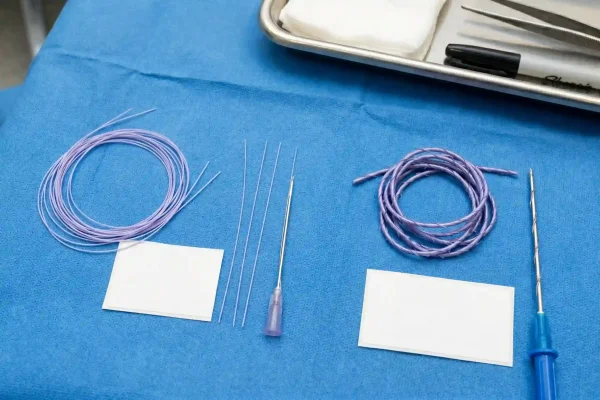
A PDO thread lift places biodegradable sutures into the skin’s deeper layers using a fine needle or blunt-tipped cannula. Those threads act like scaffolding. They physically hold tissue in a lifted position while your body mounts a healing response around them.
That healing response is the real payoff. The threads trigger your fibroblasts (the cells that produce collagen) to build new collagen around the suture material. This process, called neocollagenesis, continues for roughly six to nine months as the threads dissolve. What’s left behind is a network of new collagen that continues supporting the skin after the threads are gone.
I’ve watched patients fixate on the “lift” part and overlook the collagen part. The lift is immediate but temporary. The collagen remodeling is what gives you lasting improvement in skin texture and firmness.
Not all threads do the same job, and using the wrong type for the wrong goal is one of the most common mistakes I’ve seen from less experienced providers.
Mono threads are smooth, single filaments. They’re placed in a mesh-like pattern to stimulate collagen across a broader area. They’re best for overall skin tightening and texture improvement, not for heavy lifting.
Barbed or cog threads have tiny projections along their length that grip the underside of the tissue. These provide the actual mechanical lift. They’re what you’d use for jawline definition, sagging cheeks, or jowls.
Using barbed threads where mono threads belong (or vice versa) can cause dimpling, puckering, or a result that looks pulled and unnatural. I bring this up because it’s a safety issue, not just a cosmetic one. Wrong thread selection is a leading cause of revision procedures.
You’re likely a good fit if you’re between 30 and 65, have mild to moderate skin laxity, and want improvement without surgery. Patients who want a subtle lift along the jawline and neck tend to be the sweet spot for threads.
But I want to be honest about limitations. If your skin is very thin or fragile, threads carry higher risks. The sutures can become visible under the surface or cause dimpling that doesn’t resolve on its own. Similarly, patients with active skin infections, autoimmune conditions, or who are pregnant should avoid threads entirely.
One thing the industry doesn’t say enough: if you’ve lost significant volume in your face, threads alone won’t fix it. They reposition tissue. They don’t add volume. For volume loss, you’re looking at fillers or fat transfer. Combining a thread lift with a treatment like FaceTite can make sense for certain patients, but that decision needs to happen during a proper evaluation, not from a treatment menu.
Yes. And I’ll go further: roughly 75% of RealSelf reviews rate PDO thread lifts as “worth it,” but the 25% who had bad experiences almost always point to provider issues, not thread failure.
A 2025 meta-analysis on thread lift complications found that swelling occurs in about 16% of cases, pain in about 11%, paresthesia (tingling or numbness) in around 10%, and asymmetry or dimpling in about 7%. Infection sits near 2%. These numbers sound high until you realize most of these are minor and temporary. The serious stuff (nerve injury, prolonged numbness, thread migration requiring surgical removal) is almost entirely avoidable with proper technique.
Here’s what goes wrong with inexperienced providers:
At Formation, Dr. Grandhige evaluates every thread lift candidate personally. His background in aesthetic surgery means he isn’t guessing about facial planes. He’s working from a surgical understanding of anatomy, and that difference matters more than any brand of thread on the market.
Let me break these down by how common they are and how serious.
Common (and usually temporary): Bruising, swelling, and mild soreness are expected. They typically resolve within a week, sometimes two. This isn’t really a “complication” so much as a normal response to having needles placed under your skin.
Uncommon but manageable: Asymmetry can happen if threads are placed unevenly. A skilled provider can adjust. Dimpling or puckering occurs when a thread sits too close to the surface or when tissue bunches around the barbs. It often settles on its own over two to four weeks. If it doesn’t, your provider can massage the area or, rarely, remove the thread.
Rare but serious: Nerve damage is the one that keeps patients up at night, and for good reason. It can cause numbness, tingling, weakness in facial muscles, or chronic pain. A meta-analysis found paresthesia in about 10% of cases, though most resolve within weeks. Permanent nerve injury is possible but extremely rare when the provider understands facial anatomy at a surgical level. One study noted that about 16% of patients required some form of revision, often for minor thread adjustments rather than serious complications.
Infection: Rare in a proper clinical setting. Near-zero risk when sterile technique and aftercare protocols are followed correctly.
I think the most honest way to frame this: PDO threads fill a specific gap that nothing else quite covers.
Dermal fillers add volume. They don’t lift. If your issue is sagging (not hollowness), fillers won’t solve it. They might even make it worse by adding weight to skin that’s already losing its battle with gravity.
HIFU (high-intensity focused ultrasound) tightens by delivering energy deep into the skin. It works for early laxity and overall firming, but it doesn’t physically reposition tissue the way threads do. Think of HIFU as a tightening treatment and threads as a repositioning treatment.
A surgical facelift is the gold standard for significant laxity. Results last 10+ years. But the recovery is measured in weeks, not days, and the cost reflects that. If your laxity is mild to moderate and you want improvement without going under general anesthesia, threads make more sense. If you’re past the point where threads can deliver a meaningful result, a consult with Dr. Ahmad Saad (Formation’s plastic surgeon) is the better move.
PDO threads deliver results that typically last 12 to 18 months, with the collagen benefits extending somewhat beyond that. That’s shorter than a facelift but longer than most filler treatments and with significantly less downtime (most patients are back to normal activity within two to three days).
Aftercare isn’t optional. It directly affects your complication risk.
For the first 48 hours, don’t touch or massage the treated area. Your hands introduce bacteria, and pressure can shift threads before they’ve anchored.
Sleep on your back with your head slightly elevated for five to seven nights. This reduces swelling and prevents you from accidentally pressing your face into a pillow and displacing the sutures.
Avoid hard workouts, saunas, and steam rooms for seven to ten days. Increased blood flow and heat both increase swelling and bruising risk.
Skip dental work and aggressive facials for at least two weeks. The jaw movements from dental procedures and the pressure from facials can interfere with thread positioning.
Ice packs are fine for swelling. Apply gently. Don’t press hard.
These aren’t suggestions. They’re the minimum for a safe recovery. We go through all of this in detail at Formation during the post-procedure consultation, and our team follows up to make sure everything’s on track.
If your provider can’t answer these comfortably, walk out.
The global aesthetic threads market was valued at roughly $139 million in 2023 and is projected to reach $218 million by 2030, according to Grand View Research. That growth is attracting providers who don’t have the training to do this safely. ASPS-related data showed a 22% rise in U.S. thread lift procedures from 2022 to 2023 alone. More demand means more unqualified people offering threads at cut-rate prices. The patient pays for that, often literally, with revision costs that can run several times more than the original procedure.
They can be. Thin or fragile skin makes threads more likely to become visible beneath the surface, cause dimpling, or produce uneven results. A 2025 meta-analysis found that dimpling and asymmetry occur in approximately 7% of thread lift patients. A thorough in-person assessment is the only way to determine whether your skin thickness is adequate for a safe result. At Formation, Dr. Grandhige evaluates skin quality as part of every aesthetic surgery consultation.
It's rare but possible. Nerve-related symptoms like numbness and tingling occur in about 10% of cases based on recent complication data, though most resolve within days to weeks. Permanent nerve injury (lasting facial weakness or chronic pain) is extremely uncommon and almost always linked to a provider placing threads too deep or in nerve-dense zones. Surgical-level anatomy knowledge dramatically reduces this risk.
For most patients, it resolves within a few days to a few weeks as initial inflammation subsides. In rare cases, it can persist for several months. If numbness worsens after the first week or if you notice facial muscle weakness, contact your clinic immediately.
Follow all post-operative instructions, wear compression garments, take light daily walks, eat nutritious meals, and avoid smoking, alcohol, and excessive sun exposure to heal faster.
Contact your treating clinic immediately. Don't wait. A qualified provider will have protocols for managing complications, whether that means antibiotics for a rare infection, gentle manipulation to address asymmetry, or in severe cases, thread removal. This is exactly why getting threads at a board-certified surgical clinic matters. Med spas without physician oversight often don't have complication-management protocols in place.
Surgeon training includes years of studying facial anatomy, nerve pathways, and tissue planes that med spa providers may not have. The multicenter review of over 110,000 thread lift cases published in PRS Global Open found that procedural outcomes improved with practitioner experience and proper anatomical understanding. That doesn't mean every med spa is unsafe, but the baseline knowledge at a surgical clinic is higher. At Formation, Dr. Grandhige brings a board-certified surgeon's understanding of anatomy to every thread procedure.
PDO threads are FDA-cleared as Class II medical devices for soft tissue approximation. "Cleared" and "approved" are different regulatory categories. Cleared means the FDA reviewed the device and found it to be substantially equivalent to existing devices already on the market. No major FDA safety alerts specific to PDO threads have been issued in the last two years.
6 months post high-definition liposuction with moderate definition.
The goal wasn’t just less fat. It was a leaner, more athletic contour with visible definition through the abdomen and torso, without pushing the result to the highest level of definition.
High-definition liposuction strategically sculpts around the underlying anatomy and can be customized based on a patient’s anatomy, muscle structure, and the degree of definition they want to achieve.
For this patient, moderate definition created the balance Dr. Gopal was looking for.
Results vary by patient and depend on individual anatomy, skin quality, and treatment plan.
Considering HD liposuction? Schedule a consultation with Dr. Gopal Grandhige at Formation Tampa. Link in bio.
#HDLiposuction #Liposuction #BodyContouring #MaleLiposuction #tampa
6 months post high-definition liposuction with moderate definition.
The goal wasn’t just less fat. It was a leaner, more athletic contour with visible definition through the abdomen and torso, without pushing the result to the highest level of definition.
High-definition liposuction strategically sculpts around the underlying anatomy and can be customized based on a patient’s anatomy, muscle structure, and the degree of definition they want to achieve.
For this patient, moderate definition created the balance Dr. Gopal was looking for.
Results vary by patient and depend on individual anatomy, skin quality, and treatment plan.
Considering HD liposuction? Schedule a consultation with Dr. Gopal Grandhige at Formation Tampa. Link in bio.
#HDLiposuction #Liposuction #BodyContouring #MaleLiposuction #tampa
Your lipo results at 2 weeks are not your final results.
And sometimes, what you see during those early weeks can be unsettling.
Swelling can temporarily make the treated area look larger. The tissue may feel firm, tight or lumpy. The definition you were expecting may not be visible yet.
That doesn’t necessarily mean something went wrong. It simply means your body is still healing.
After liposuction, recovery happens in stages, from the initial inflammation and swelling to tissue repair, skin contraction and the gradual emergence of the new contour.
Significant changes often become more apparent around the 3–6 month mark, with continued refinement as the tissues heal and mature.
That’s why comparing yourself a few weeks after surgery to someone’s polished before-and-after photo can create a very unrealistic expectation. Those two photos may represent months of healing in between.
The operation creates the contour. The final result reveals itself over time.
If you’re considering HD liposuction, schedule a consultation with Dr. Gopal to understand the procedure, recovery, and what to realistically expect from your results (link in bio).
#tampa #liposuction #hdliposuction
Your lipo results at 2 weeks are not your final results.
And sometimes, what you see during those early weeks can be unsettling.
Swelling can temporarily make the treated area look larger. The tissue may feel firm, tight or lumpy. The definition you were expecting may not be visible yet.
That doesn’t necessarily mean something went wrong. It simply means your body is still healing.
After liposuction, recovery happens in stages, from the initial inflammation and swelling to tissue repair, skin contraction and the gradual emergence of the new contour.
Significant changes often become more apparent around the 3–6 month mark, with continued refinement as the tissues heal and mature.
That’s why comparing yourself a few weeks after surgery to someone’s polished before-and-after photo can create a very unrealistic expectation. Those two photos may represent months of healing in between.
The operation creates the contour. The final result reveals itself over time.
If you’re considering HD liposuction, schedule a consultation with Dr. Gopal to understand the procedure, recovery, and what to realistically expect from your results (link in bio).
#tampa #liposuction #hdliposuction
Some surgical decisions are much harder to correct than they are to avoid.
That’s what Dr. Gopal means when he says, “I wish more patients knew that you pay more to undo a cheaper procedure.”
With liposuction and body contouring, removing fat is only one part of the process. Your surgeon has to understand your anatomy, know how much fat to remove and where to preserve it, create smooth transitions between areas, and consider how the final contour fits the rest of your body.
But the procedure doesn’t end when you leave the operating room. Recovery and aftercare matter too. The right guidance around compression, lymphatic massage, incision and drainage care, activity and nutrition can help manage swelling and support your body as it heals.
When something doesn’t go as planned, correcting dents, irregularities, poor proportions or an unnatural contour can be more complicated than doing the procedure properly the first time. And sometimes, there’s less to work with the second time around.
So when you’re comparing surgeons, don’t compare price alone. Look at their training, experience, surgical approach, before-and-after results, and what their care includes before and after surgery.
Because a cheaper procedure can become a very expensive one when you have to do it twice.
#tampa #HDLiposuction #lipo
Some surgical decisions are much harder to correct than they are to avoid.
That’s what Dr. Gopal means when he says, “I wish more patients knew that you pay more to undo a cheaper procedure.”
With liposuction and body contouring, removing fat is only one part of the process. Your surgeon has to understand your anatomy, know how much fat to remove and where to preserve it, create smooth transitions between areas, and consider how the final contour fits the rest of your body.
But the procedure doesn’t end when you leave the operating room. Recovery and aftercare matter too. The right guidance around compression, lymphatic massage, incision and drainage care, activity and nutrition can help manage swelling and support your body as it heals.
When something doesn’t go as planned, correcting dents, irregularities, poor proportions or an unnatural contour can be more complicated than doing the procedure properly the first time. And sometimes, there’s less to work with the second time around.
So when you’re comparing surgeons, don’t compare price alone. Look at their training, experience, surgical approach, before-and-after results, and what their care includes before and after surgery.
Because a cheaper procedure can become a very expensive one when you have to do it twice.
#tampa #HDLiposuction #lipo
Lipo recovery can be a lot.
There can be swelling, drainage, compression garments, limited activity, and a period where your body may look worse before it starts looking better. And when the final result can take months to fully reveal itself, recovery can take an emotional toll too.
That’s why Dr. Gopal views a successful surgical experience as three equally important parts: pre-op care, the operation itself, and post-op care.
At Formation, that process starts four weeks before surgery. Patients are prepared physically for the procedure and mentally for what they may experience during recovery.
That support continues after surgery with a private nurse during the initial recovery period, supplies and education for at-home care, nutritious meals, and in-home lymphatic massage to help manage postoperative swelling and fluid.
None of those pieces are considered extras. They’re part of the surgical experience.
Because the goal isn’t just to perform the procedure. It’s to make sure you know what to expect, you’re prepared for it, and you’re properly cared for through the recovery that follows.
Considering liposuction or body contouring in Tampa? Schedule a consultation with Dr. Gopal Grandhige at Formation Tampa.
#tampa #hdLiposuction
Lipo recovery can be a lot.
There can be swelling, drainage, compression garments, limited activity, and a period where your body may look worse before it starts looking better. And when the final result can take months to fully reveal itself, recovery can take an emotional toll too.
That’s why Dr. Gopal views a successful surgical experience as three equally important parts: pre-op care, the operation itself, and post-op care.
At Formation, that process starts four weeks before surgery. Patients are prepared physically for the procedure and mentally for what they may experience during recovery.
That support continues after surgery with a private nurse during the initial recovery period, supplies and education for at-home care, nutritious meals, and in-home lymphatic massage to help manage postoperative swelling and fluid.
None of those pieces are considered extras. They’re part of the surgical experience.
Because the goal isn’t just to perform the procedure. It’s to make sure you know what to expect, you’re prepared for it, and you’re properly cared for through the recovery that follows.
Considering liposuction or body contouring in Tampa? Schedule a consultation with Dr. Gopal Grandhige at Formation Tampa.
#tampa #hdLiposuction
Your body decides where fat comes off, and it doesn’t always come from the area you want it to.
For someone who is already at a stable weight, continuing to lose weight can mean getting leaner in the face, arms, legs or other areas while localized abdominal fat remains.
That’s where the difference between weight loss and body contouring matters.
Liposuction isn’t designed to make the number on the scale significantly lower. It’s designed to address localized fat and change contour and proportion.
So if you’ve reached a weight you feel good at, but there’s still an area that doesn’t seem to change no matter what you do, you may not need to keep chasing a lower number on the scale.
It may be worth finding out whether liposuction is appropriate for your body and the result you’re trying to achieve.
DM us or schedule a consultation with Dr. Gopal Grandhige at Formation Tampa (link in bio).
Your body decides where fat comes off, and it doesn’t always come from the area you want it to.
For someone who is already at a stable weight, continuing to lose weight can mean getting leaner in the face, arms, legs or other areas while localized abdominal fat remains.
That’s where the difference between weight loss and body contouring matters.
Liposuction isn’t designed to make the number on the scale significantly lower. It’s designed to address localized fat and change contour and proportion.
So if you’ve reached a weight you feel good at, but there’s still an area that doesn’t seem to change no matter what you do, you may not need to keep chasing a lower number on the scale.
It may be worth finding out whether liposuction is appropriate for your body and the result you’re trying to achieve.
DM us or schedule a consultation with Dr. Gopal Grandhige at Formation Tampa (link in bio).
The abdomen can be one of the most stubborn areas to change, even with consistent diet and exercise.
For this patient, HD liposuction addressed the persistent abdominal fullness while creating more definition through the waist and midsection.
At 10 months post-op, you can see how much that one area affected the proportions of her entire torso.
If you’re dealing with stubborn abdominal fat despite diet and exercise, schedule a consultation with Dr. Gopal at Formation Tampa to learn whether liposuction may be appropriate for you.
#HDLiposuction #LiposuctionTampa #FemaleLiposuction #BodyContouring
The abdomen can be one of the most stubborn areas to change, even with consistent diet and exercise.
For this patient, HD liposuction addressed the persistent abdominal fullness while creating more definition through the waist and midsection.
At 10 months post-op, you can see how much that one area affected the proportions of her entire torso.
If you’re dealing with stubborn abdominal fat despite diet and exercise, schedule a consultation with Dr. Gopal at Formation Tampa to learn whether liposuction may be appropriate for you.
#HDLiposuction #LiposuctionTampa #FemaleLiposuction #BodyContouring
Many surgeons abandon this lipo technique because it’s so physically demanding.
The approach to HD liposuction Dr. Gopal uses requires an extraordinary level of detail and precision.
Rather than simply etching lines, every contour and transition is shaped around the patient’s underlying anatomy, a process that can take several hours.
Dr. Gopal trained in this technique in Barcelona with one of the world’s leaders in HD liposuction and now teaches it to other physicians. It’s a demanding approach, but that level of precision is what allows for definition that looks natural to the individual.
Considering HD liposuction in Tampa? Schedule a consultation at Formation Tampa (link in bio).
Many surgeons abandon this lipo technique because it’s so physically demanding.
The approach to HD liposuction Dr. Gopal uses requires an extraordinary level of detail and precision.
Rather than simply etching lines, every contour and transition is shaped around the patient’s underlying anatomy, a process that can take several hours.
Dr. Gopal trained in this technique in Barcelona with one of the world’s leaders in HD liposuction and now teaches it to other physicians. It’s a demanding approach, but that level of precision is what allows for definition that looks natural to the individual.
Considering HD liposuction in Tampa? Schedule a consultation at Formation Tampa (link in bio).
“Glad I took my time researching.”
That line matters.
Choosing to have plastic surgery isn’t just about deciding you want a change. It’s about deciding who you trust to understand the result you’re looking for, especially when the goal isn’t simply removing fat, but creating a shape that still looks natural to you.
For our lovely patient, that meant a tighter stomach and waist, feeling more comfortable in fitted clothing, and most importantly, getting the result she wanted “without looking fake.”
That’s the goal of thoughtful body contouring: not to make you look like someone else, but to create a result that works with your body and your goals.
Dr. Gopal Grandhige specializes in liposuction and body contouring in Tampa, creating treatment plans around each patient’s anatomy, proportions, and goals.
Considering liposuction? DM us or Schedule a consultation at Formation to learn what approach may be right for you (link in bio).
“Glad I took my time researching.”
That line matters.
Choosing to have plastic surgery isn’t just about deciding you want a change. It’s about deciding who you trust to understand the result you’re looking for, especially when the goal isn’t simply removing fat, but creating a shape that still looks natural to you.
For our lovely patient, that meant a tighter stomach and waist, feeling more comfortable in fitted clothing, and most importantly, getting the result she wanted “without looking fake.”
That’s the goal of thoughtful body contouring: not to make you look like someone else, but to create a result that works with your body and your goals.
Dr. Gopal Grandhige specializes in liposuction and body contouring in Tampa, creating treatment plans around each patient’s anatomy, proportions, and goals.
Considering liposuction? DM us or Schedule a consultation at Formation to learn what approach may be right for you (link in bio).
More definition doesn’t automatically mean a better liposuction result.
The goal of body contouring is to create definition that makes sense for your anatomy, not to create the most sculpted abdomen possible simply because we can.
Low-, medium-, and high-definition liposuction can create very different looks, from subtle contouring to a more athletic or highly sculpted appearance.
The right level depends on your existing muscle definition, proportions, surrounding areas of the body, and the result you want to achieve.
For Dr. Gopal Grandhige, a board-certified surgeon specializing in body contouring and high-definition liposuction in Tampa, the goal is balance: the abdomen, chest, back, arms and shoulders should look like they belong to the same body.
The result should feel cohesive, proportional, and natural to your anatomy.
Considering liposuction? DM us or schedule a consultation at Formation to discuss the level of definition that makes sense for your body and your goals (link in bio).
More definition doesn’t automatically mean a better liposuction result.
The goal of body contouring is to create definition that makes sense for your anatomy, not to create the most sculpted abdomen possible simply because we can.
Low-, medium-, and high-definition liposuction can create very different looks, from subtle contouring to a more athletic or highly sculpted appearance.
The right level depends on your existing muscle definition, proportions, surrounding areas of the body, and the result you want to achieve.
For Dr. Gopal Grandhige, a board-certified surgeon specializing in body contouring and high-definition liposuction in Tampa, the goal is balance: the abdomen, chest, back, arms and shoulders should look like they belong to the same body.
The result should feel cohesive, proportional, and natural to your anatomy.
Considering liposuction? DM us or schedule a consultation at Formation to discuss the level of definition that makes sense for your body and your goals (link in bio).
One of the biggest misconceptions about liposuction? That the fat either “comes back” or simply moves somewhere else.
Liposuction permanently removes fat cells from the treated area. But it doesn’t remove every fat cell, and the cells that remain can still grow larger with weight gain.
That’s why long-term results aren’t just about what happens during the procedure. Maintaining a relatively stable weight helps preserve the contour created through liposuction.
Dr. Gopal Grandhige specializes in advanced high definition liposuction and body contouring, with an emphasis on creating results that complement each patient’s natural anatomy.
If you’re considering liposuction in Tampa, schedule a consultation at Formation to learn what approach makes sense for your body and goals (Link in bio).

One of the biggest misconceptions about liposuction? That the fat either “comes back” or simply moves somewhere else.
Liposuction permanently removes fat cells from the treated area. But it doesn’t remove every fat cell, and the cells that remain can still grow larger with weight gain.
That’s why long-term results aren’t just about what happens during the procedure. Maintaining a relatively stable weight helps preserve the contour created through liposuction.
Dr. Gopal Grandhige specializes in advanced high definition liposuction and body contouring, with an emphasis on creating results that complement each patient’s natural anatomy.
If you’re considering liposuction in Tampa, schedule a consultation at Formation to learn what approach makes sense for your body and goals (Link in bio).