





loader image

PDO Thread Lift In Parkland Estates, FL

A PDO thread lift places absorbable sutures made of polydioxanone under the skin to lift mild sagging along the jawline, cheeks and upper neck. You see the lift the day it’s placed. Over the next few months your body builds collagen along each thread, and that collagen carries the result after the threads dissolve. It won’t remove fat, and it isn’t a facelift.

Formation sits on South Howard Avenue, the street that forms Parkland Estates’ eastern boundary. If you live between Swann and Morrison, the assessment, the placement and every follow-up visit are a short drive from home.

What A Thread Lift Does, And What It Leaves Alone

A thread lift moves loose tissue, and that’s the whole mechanism. Small barbs grip tissue from beneath the skin, light tension repositions it, and the thread holds that position while collagen forms along it. Fat stays where it is. So does bone position, and so does muscle banding.

That matters because a softened jawline can come from four places: a fat pad under the chin, skin that has lost its spring, platysmal bands in the neck, or a chin that doesn’t project far enough to give the jaw a clean edge. Threads answer one of the four. Placed into the wrong one, they fade early and disappoint. So every thread conversation at Formation starts with a screen rather than a thread count.

The Three-Route Screen

Formation sorts every softening lower face through three routes before threads come up. Two of the three aren’t thread problems. You can run the first two checks in a mirror tonight and walk into your assessment with sharper questions.

Route One: Subtract

Pinch the tissue under your chin between thumb and forefinger. A thick, soft pad is submental fat, and fat needs removing rather than repositioning. No thread count changes that. This route leads to neck and jawline contouring, which Dr. Grandhige performs in the office through small incisions under the chin and behind the ears.

One Formation patient, a fit professional in his 40s, had carried that fullness his whole life and hated how he looked in photos. It was fat, so threads were never the answer. After targeted neck liposuction and jawline contouring, he said his face finally matched the rest of his body, and he started stepping into pictures again.

Route Two: Suspend

Pinch the skin over your cheekbone, hold it for two seconds and let go. Skin that springs back has the recoil a thread needs to hold. Then set two fingers at your temple and draw the skin gently up and back toward your ear. If a light pull sharpens your jawline, you’re in thread territory. Elasticity is the gate, and the window runs roughly from skin age 25 to 55.

Vertical cords down the front of the neck are a separate finding. Those are platysmal bands, and they call for MyEllevate, a permanent suspension suture, paired with platysmaplasty.

Route Three: Excise

If you had to pull hard and far before anything moved, you’re past what a suture can hold. Threads placed into tissue that heavy give short results and raise the odds of retraction and asymmetry. That’s a skin-removal conversation. Formation refers those patients outward. It stays in contact with surgeons who do that work well and points you to the right one, instead of selling a smaller procedure that won’t deliver.

When The Frame Is The Problem

Sometimes the jaw angle and chin projection are the real issue, and no lift fixes a frame. Structural filler does. Radiesse, a calcium hydroxylapatite, or Juvederm, a hyaluronic acid, placed along the chin and jaw builds the projection that gives a jawline its edge.

If the mirror checks leave you unsure, the assessment settles it.

Man wondering if puckering goes away after PDO thread lift procedure

What The Published Complication Data Shows

Threads carry less risk than surgery. They aren’t risk-free, and the published rates run higher than the usual line about a little bruising and swelling.

A meta-analysis of 26 studies in Aesthetic Plastic Surgery found:

  • Swelling in about 35 percent of thread lifts
  • Skin dimpling in about 10 percent
  • Sensation changes (paresthesia) in about 6 percent
  • Visible or palpable threads in about 4 percent
  • Infection and thread extrusion each near 2 percent

Two subgroup findings matter more for your decision than the headline rates.

  • Absorbable threads, the PDO category, had lower rates of paresthesia (3.1 versus 11.7 percent) and extrusion (1.6 versus 7.6 percent) than non-absorbable threads.
  • Patients over 50 had more dimpling (16 versus 5.6 percent) and more infection (5.9 versus 0.7 percent) than younger patients.

The limitation sits in the design. The analysis pools many thread types and techniques, so read the figures as a planning ceiling, not a forecast for your face.

One longer-range point belongs in the consultation rather than a brochure. Published complication lists for thread lifting include tissue fibrosis along the thread tracks. If a surgical facelift is anywhere in your five-to-ten-year plan, raise it before the first thread goes in.

The Two Clocks Behind A Thread Result

A thread result runs on two clocks, and most marketing collapses them into one number.

The first clock is mechanical. The thread holds the lift, and PDO threads are fully absorbed at around six to eight months. The second clock is biological. Collagen built along each thread carries the result after the thread is gone, which is why most results hold for roughly 12 to 18 months.

Expect a gradual softening rather than a cliff. In the same meta-analysis, satisfaction slipped from 98 percent right after treatment to 88 percent at six months.

Age and thread count both press on that curve. A multicenter analysis of 1,500 PDO thread patients found that older age and a higher thread count each independently predicted a return visit for an insufficient result. It’s a retrospective study from cosmetic surgery clinics in Japan, so it shows a direction rather than setting a rule.

That direction matches how Dr. Grandhige works across every procedure: “do only what is necessary, but do it exceptionally well.” A conservative thread count is how the result still looks like you in month three. Results in Formation’s non-surgical neck and jawline gallery show what that restraint looks like on the lower face.

Preparation And Recovery At Formation

Formation applies its 60/40 Recovery Standard to threads the same way it does to surgery. Roughly 60 percent of a result comes from the procedure and 40 percent from what happens afterward, and poor aftercare can undo good technique. Your visit doesn’t end when the last thread is trimmed.

Before placement, your health and diet are assessed. Nutrition, supplements and peptides are adjusted in the window just before and after, so your body builds as much collagen along each thread as it can. Arriving inflamed, underslept and short on protein means less collagen, and less collagen means a shorter second clock. That thinking sits at the center of Formation’s philosophy. The thread is the same object at every practice that stocks it. The thinking around it isn’t.

Your Milestone Timeline

First 72 hours. Tightness, mild swelling and sometimes bruising at the entry points. Sleep on your back.

Days 3 to 14. Gathering or puckering settles as tissue relaxes around the threads. This phase reads worst and resolves on its own.

About one week. Back to training. Hold off on strenuous exercise until then, and skip facial massage for two weeks.

Weeks 2 to 6. Swelling clears and the lift reads cleanly. This is your first honest look.

Weeks 6 to 12. The collagen phase. Firmness and skin quality keep changing with nothing more done.

Months 6 to 8. The threads are fully absorbed, and collagen holds the lift from here.

Months 12 to 18. Most people decide around now whether to repeat.

Sun, Bayshore And The Second Clock

UV light breaks down collagen, and a thread result depends on collagen from week six onward. Skip direct sun for the first two weeks, then wear broad-spectrum SPF 30 or higher every day of the year.

In Parkland Estates, that runs into a common South Tampa routine: the run or walk along Bayshore Boulevard, where the path follows open water with little shade overhead. Move those miles to early morning or evening for the first few weeks and wear a brimmed hat.

If you can choose your placement date, the cooler months mean less sweating at fresh entry points. They also give you a collagen phase that isn’t fighting Tampa’s summer sun.

From Parkland Estates To South Howard Avenue

Parkland Estates is the South Tampa neighborhood bounded by Swann Avenue to the north, Morrison Avenue to the south, Lincoln Avenue to the west and Howard Avenue to the east. Formation is at 1315 South Howard Avenue, on the street that forms that eastern edge.

One naming note if you’re comparing providers: Parkland Estates is not the City of Parkland in Broward County, so check that any address you’re weighing is in Tampa.

Living this close changes the follow-up math. Any visit Dr. Grandhige schedules in the first weeks costs you a short drive, not a half day off.

You can also start without the drive. Formation’s complimentary virtual evaluation with patient coordinator Hanna reviews your goals and outlines a plan before you decide to come in. The in-office consultation with Dr. Grandhige carries a fee and is a full surgical assessment of anatomy, candidacy, options and limits. That fee applies toward any procedure or product at the practice.

Many of Formation’s patients come from South Tampa and Hyde Park, and you can reach the practice by phone at (813) 922-2920.

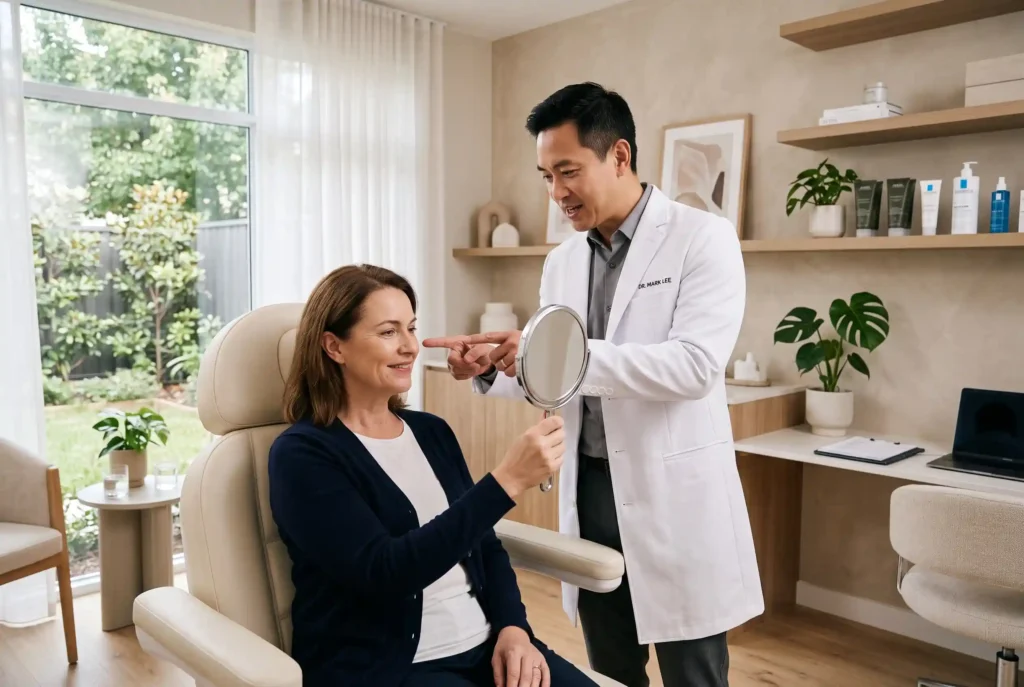
PDO thread lift consultation at a clinic with patient and provider talking
Man looking very manly after getting PDO threads

The Surgeon Behind Your Assessment

Dr. Gopal Grandhige is a board-certified general surgeon who specializes in aesthetic surgery. His training path:

  • Medical degree from the University of Michigan Medical School
  • An initial match into Yale’s six-year combined plastic surgery residency
  • A full general surgery residency
  • Fellowship training in burn surgery, critical care, and minimally invasive metabolic and foregut surgery

His board certification is through the American Board of Surgery, and he has practiced in Tampa for over 15 years.

Burn and critical care training is training in how tissue behaves after injury and how it heals, which is the exact question a thread lift asks. He personally evaluates every patient and designs each plan himself. Patients often tell the staff about worries they don’t raise with him, so the staff passes those along and he answers them before you have to ask. He’ll also tell you no. If the pinch check found fat, you’ll hear it.

Frequently Asked Questions About PDO Thread Lifts

Most results hold for roughly 12 to 18 months. The threads are absorbed at around six to eight months, and the collagen your body builds along them carries the lift after that. Daily sun exposure shortens the result, so SPF and timing matter.

They’re cleared, not approved. PDO threads reach the US market through the FDA’s 510(k) premarket notification pathway, which finds a device substantially equivalent to one already sold. Cleared indications vary by product, so ask which thread is being used and what its label covers.

No. A soft double chin is usually submental fat, and threads reposition tissue rather than remove it. If the pinch check under your chin finds a thick pad, neck liposuction and jawline contouring is the route that addresses it.

Yes. Gathering or small puckers right after placement come from the barbs engaging tissue from underneath. They settle over roughly the first two weeks as the tissue relaxes around the threads. Bring up anything that hasn’t settled by then at your follow-up.

Training resumes at about one week. Hold off on strenuous exercise before then and skip facial massage for two weeks. Keep runs out of direct sun for the first two weeks, then go early or late with SPF 30 or higher and a brimmed hat.

Yes, when your face has more than one issue. Threads handle laxity. Fat calls for liposuction, and a weak chin or jaw angle calls for jawline fillers such as Radiesse or Juvederm. Dr. Grandhige builds one plan from the routes your assessment turns up rather than stacking treatments by default.

It’s a fair concern. Thread tracks heal with some fibrosis, and published complication lists for thread lifting include it. If surgery is a real possibility in the next five to ten years, raise it at your consultation so the plan accounts for it.

This page covers Parkland Estates, the South Tampa neighborhood between Swann and Morrison Avenues. Formation is at 1315 South Howard Avenue, on the street that forms its eastern edge. The City of Parkland is a separate city in Broward County.

The Short Version

A PDO thread lift is a reasonable next step if three things are true: your jaw has softened, your skin springs back from a pinch, and a light two-finger pull sharpens the line. Formation sits on the avenue that bounds your neighborhood.

If the pinch under your chin found fat, or a hard pull was needed before anything moved, threads are the wrong instrument. You should hear that in an assessment, not discover it eight months later. If a pinch shows skin that needs tightening more than lifting, ask about FaceTite, a radiofrequency-assisted contouring device.

Whatever route you’re on, plan around both clocks. That means a conservative thread count, collagen support before and after placement, and keeping the second clock out of the midday sun on Bayshore.

Our first four-legged patient. 🐾Dr. Gopal takes his liposuction and body contouring very seriously.Even when his patients have four legs.From loose skin and neck liposuction to a jawline that deserves its own before-and-after reveal, this might be his most dramatic transformation yet.And yes, he even got the patient’s permission to share the results. 😂A little Halloween fun from Dr. Gopal and his two very patient pups! 🎃🐶No dogs underwent surgery. Just two willing participants and one very committed surgeon.#SurgeonLife #tampa #necklipo

46 8
What weight loss can’t fix.After losing over 100 pounds, this patient had achieved significant weight loss, but was left with excess skin around his abdomen and back that weight loss alone couldn’t address.During an 8-hour surgery, Dr. Gopal performed a circumferential body lift, a procedure that removes excess skin around the entire midsection to improve body contour.In this video, Dr. Gopal walks through the procedure, explaining how he removed approximately 3 pounds of skin from the back and estimated another 4–5 pounds would be removed from the abdomen.He’s also using a small amount of fat collected during the procedure to add volume to the upper chest, improving its contour without performing a separate chest lift.For patients who have experienced major weight loss, body contouring can help address the excess skin that remains after the weight is gone.Considering surgery after weight loss? Schedule a consultation with Dr. Gopal at Formation in Tampa to explore your options.Actual patient footage. Individual results vary.#BodyContouring #BodyLift #ExcessSkinRemoval

46 0
Your fat is liquid gold.The fat you don’t want might be exactly what another part of your body needs.During liposuction, the fat we remove doesn’t always have to be discarded. In fact, Dr. Gopal refers to it as “liquid gold.”Why? Because that fat can sometimes be transferred to another area of the body to add volume, enhance natural contours, and create a more balanced shape.For women, that might mean adding volume to the breasts, hips, or buttocks. For men, fat transfer can help enhance the chest or shoulders.And because we’re using your own fat, we can potentially improve two areas during the same surgery.Of course, fat transfer isn’t right for everyone. It’s something Dr. Gopal discusses with patients beforehand and incorporates into the surgical plan when appropriate.Considering liposuction in Tampa? Schedule a consultation with Dr. Gopal at Formation to explore your body contouring options.#TampaLiposuction #FatTransfer #BodyContouring

27 0
A flatter stomach without a tummy tuck? 👀Pregnancy, and sometimes increased pressure from fat deep inside the abdomen, can cause the abdominal muscles to separate down the middle. This is called diastasis recti, and it can make your belly stick out even if you’re otherwise lean.Traditionally, repairing that separation often meant undergoing a tummy tuck. But what if you don’t have much loose skin to remove?For the right patient, Dr. Gopal can use robotic-assisted surgery to bring those separated muscles back together through three small incisions, without the long scar associated with a traditional tummy tuck.That’s exactly what he did for the patient in these before-and-after photos. No tummy tuck. No additional procedures.**But this approach isn’t for everyone.** If you have significant loose skin or excess fat, a different treatment may be more appropriate. That’s why understanding what’s causing your belly to protrude matters before deciding on surgery.Curious whether you’re a candidate? DM us or schedule a consultation with Dr. Gopal at Formation Tampa. Link in bio.Actual patient results. Individual results vary.#DiastasisRecti #MuscleSeparation #DiastasisRectiRepair #RoboticSurgery #Tampa

18 0
Why does fluid sometimes collect after surgery?After certain surgical procedures, fluid can accumulate beneath the skin, forming what’s called a seroma.In this video, Dr. Gopal demonstrates how he drains a seroma in a patient recovering from diastasis recti repair.This is one of the reasons postoperative follow-up matters. It allows Dr. Gopal to monitor healing, identify any issues, and address them when necessary.Considering surgery? DM us to schedule a consultation with Dr. Gopal at Formation Tampa.#DiastasisRecti #Seroma #TampaSurgeon #AbdominalMuscleRepair

35 2
The fat is gone. But what takes its place?When fat is removed during liposuction, it leaves behind space beneath the skin. As the body heals, fluid can sometimes collect in that space, creating what’s called a seroma.And here’s why that matters.If fluid continues to collect, it can potentially affect the final contour.That’s why Dr. Gopal pays close attention to fluid buildup during recovery. His approach is to identify seromas early and address them quickly.Considering liposuction in Tampa? Schedule a consultation with Dr. Gopal at Formation to learn more.#Liposuction #Seroma #BodyContouring

56 5
From medical weight loss to body contouring, her transformation was approached as a journey, not just a single procedure.This patient started with a personalized medical weight loss program at Formation, working with Dr. Gopal to achieve significant weight loss. Once she reached her goal, Dr. Gopal performed a tummy tuck to remove excess abdominal skin and refine her contour.Considering medical weight loss or a tummy tuck? Schedule a consultation with Dr. Gopal at Formation Tampa. Link in bio.Actual patient results. Individual results vary.

9 2
Not every patient who wants surgery is ready for it.One patient came to Dr. Gopal wanting a tummy tuck. Over the next 18 months, she returned multiple times, having lost more weight each time. And each time, the answer was still no.Not because she couldn’t have the surgery, but because she wasn’t where she wanted to be yet.Instead of rushing into surgery, the focus was on helping her reach a healthier, more sustainable weight through nutritional counseling, lifestyle support, and medical weight management.By the time she had lost 80 pounds, she was ready, both physically and mentally.For Dr. Gopal, being a good surgeon isn’t just about knowing how to perform a procedure. It’s also about knowing when not to perform one.Sometimes the best result starts long before the operating room.Considering a tummy tuck? DM us to schedule a consultation with Dr. Gopal at Formation Tampa.#Tampa #TummyTuck #BodyContouring

71 5
