





loader image

Liposuction In River Grove, FL

Liposuction removes stubborn fat that training and diet leave behind, so the shape underneath reads clearly. At Formation, Dr. Gopal Grandhige plans and performs every case himself, then follows each patient for a full year. River Grove sits about nine miles north of the South Howard Avenue office. That drive shapes how you’ll plan surgery day, the first week and every follow-up visit after it. Below: what liposuction in Tampa can and can’t fix at Formation, how larger plans get staged, and what recovery looks like from River Grove.

Smooth settled contour showing a twelve month high-definition liposuction result

Getting To Formation From River Grove

Formation’s office at 1315 South Howard Avenue is roughly nine miles from River Grove, and most of that drive is interstate. A common route runs west on Hillsborough Avenue to I-275, south to the Howard and Armenia Avenue exit, then south on Howard into SoHo. Outside rush hour, it’s typically under half an hour.

River Grove is a small, established neighborhood along the Hillsborough River, which forms its northern edge. 30th Street runs along its western side, and Northeast Community sits to the east. It’s served by ZIP codes 33604 and 33610, and many of the homes along River Grove Drive date to the late 1950s.

That distance shows up three times in a liposuction plan. On surgery day, general anesthesia means someone else drives you home. In week one, your first post-op visit is where lymphatic treatment starts, so plan that trip before surgery. After that, Formation follows you for a full year. If you’d rather spend the first days closer to the office, Formation works with nearby hotels, and Dr. Grandhige visits patients there in those early days so they don’t have to come in.

What Liposuction Changes And What It Can’t

Liposuction changes shape, and it won’t change the number on the scale. It works best for people at or near their goal weight who train and eat well but still carry a stubborn layer of fat that blurs their definition. That fat is often genetic. Dieting hard enough to lose it tends to cost muscle and sets up a yo-yo cycle. Removing it lets you go back to building.

Dr. Grandhige treats liposuction as sculpture. Each contour is planned around what sits underneath: muscle shape, skeletal structure, fat quality and how light falls across the body. In high-definition liposuction, that means keeping natural transitions and skipping the over-etched lines that only work in a posed photo.

The fat cells removed don’t come back. Results hold as long as your weight stays stable, since weight gain can still enlarge the fat cells that remain.

Areas Dr. Grandhige Contours Most Often

He most often treats the abdomen, flanks, back, chest, arms and thighs, usually as one plan across several areas. Male body contouring is one of his focus areas. Chest, abdomen and flank work have to balance together, because small errors on a man’s torso can look artificial or feminized. Every plan accounts for skeletal structure, fat distribution, skin elasticity, training goals and how the area will age.

The Formation Tighten-Or-Remove Line

Three checks decide whether liposuction alone will get you the result or whether loose skin needs to come out. Dr. Grandhige runs them in person, and you can get a rough read at home first.

Check one is recoil. Pinch the skin over the area and let go. Skin that springs back toward the body has the elasticity to settle over a new contour.

Check two is the standing fold. Stand relaxed in front of a mirror. Skin that hangs in a fold at rest won’t pull back up once the fat underneath is gone.

Check three is the abdominal wall. Pregnancy and major weight changes can separate the abdominal muscles, a condition called diastasis recti. Fat removal won’t flatten that bulge.

Clear all three and liposuction is a reasonable plan, with energy-based tightening as an optional finisher. On the abdomen, a hanging fold or separated muscles usually point to abdominoplasty, which Dr. Grandhige performs himself, including advanced and revision cases.

One patient who’d finished having children came in with her daughters and joked that they should pay for it, since they caused it. After muscle repair, her posture improved and her back discomfort eased. She used to arrive in loose sweats. Now she comes to visits dressed up.

Woman enjoying the results of her liposuction procedure

How The State’s Volume Rules Shape Staging

Some multi-area plans happen in two sessions, and state rules set the outer limit. In an office surgery setting, the state’s office-surgery standard caps liposuction at 4,000 cc of supernatant fat. That’s the pure fat that separates out once fluid and blood settle. When liposuction is combined with abdominoplasty, or tied to another procedure in the same session, the cap drops to 1,000 cc. The same rule makes the surgeon responsible for deciding the right amount for each patient. So 4,000 cc is a ceiling, and it’s never the goal.

That matches how Dr. Grandhige operates. Taking more than the anatomy needs often leads to irregularities, loose skin and results that age poorly.

The Formation Staging Line comes down to three questions:

  • Does the full plan fit comfortably inside one safe session?
  • Is liposuction paired with a tummy tuck or another procedure, which lowers the ceiling?
  • Can recovery for every treated area run at once, including compression and lymphatic care?

A no on any of them splits the plan into stages. Two kinds of plans test these questions hardest: circumferential Lipo360 work on the abdomen, flanks and back, and liposuction combined with a tummy tuck. Before you book anywhere, ask which kind of setting your surgery will happen in and how much fat the surgeon plans to remove.

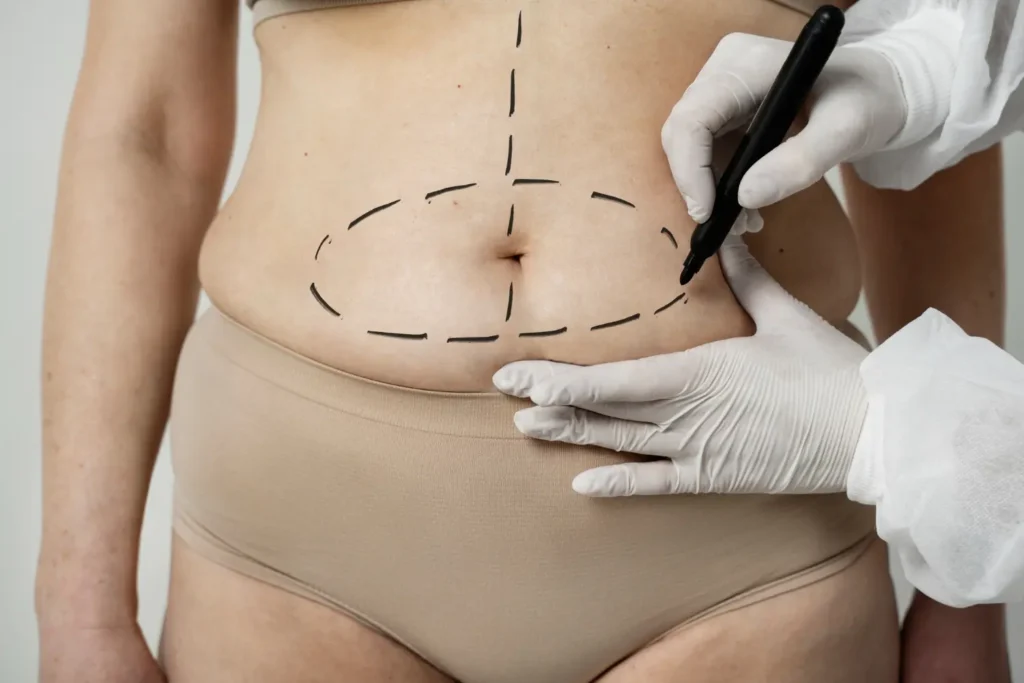
Plastic surgeon marking a patient with pen before plastic surgery

Preparation And The 60/40 Recovery Standard

At Formation, surgery accounts for about 60 percent of the result and recovery for the other 40. That split is the 60/40 Recovery Standard, and it’s why aftercare gets the same planning as the operation. Poor post-op care can undo well-performed surgery.

Preparation starts before you’re on the table. Your health and diet are assessed first. In the window right before and after surgery, nutrition, protein intake, supplements and peptides are adjusted so your body builds the most structure it can. Compression is planned in advance. Lymphatic treatment, nutrition and coaching come from providers Dr. Grandhige has vetted personally for their track records.

That’s the care philosophy Formation was built on. The cannula is the same instrument at every practice. The thinking around it isn’t.

Recovery Week By Week

Most of the recovery work happens in the first month, and the timeline is predictable.

In the first 48 to 72 hours, expect swelling, soreness and drainage. You’ll be up and walking early.

Through week one, compression stays on full time. Most people handle light daily activity but stay off work. Lymphatic treatment starts at your first post-op visit, and if a fluid pocket called a seroma forms, it’s drained.

Over weeks 2 to 4, swelling steadily improves. Lymphatic sessions continue and help keep fluid from collecting. Most patients are back in the gym within one to two weeks and train without restriction between weeks 2 and 4, as long as the garment stays on.

Between 6 and 12 weeks, definition shows more clearly as inflammation settles. By 3 to 6 months, the final contour has matured and most people are comfortable showing results in clothing. From 6 to 12 months, the skin regains normal pliability and sensation returns.

Compression Through A Tampa Summer

Compression is continuous from week one through week four, so check the calendar before you pick a date. A garment worn around the clock is easier to live with in the cooler months than through a Tampa summer. If your schedule is flexible, that’s a fair reason to plan surgery for fall or winter.

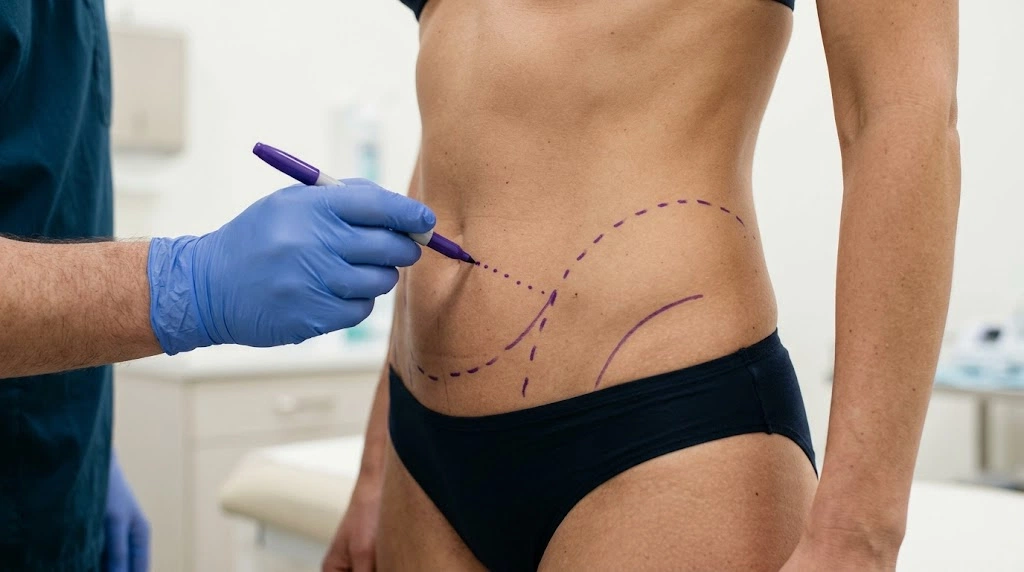
Surgeon marking a patient’s abdomen and flanks before liposuction for a South Westshore patient

Surgery Day And The Team In The Room

Body liposuction at Formation is performed under general anesthesia in an accredited surgical facility, through small, strategically placed incisions. Dr. Grandhige removes fat selectively and leaves some areas in place to keep transitions smooth.

The facilities he uses hold Quad A accreditation, are inspected regularly and are designed only for elective cosmetic surgery. The same anesthesia provider and staff work every one of his cases. His own employed physician assistant assists on all of his surgeries. Each case starts with a time-out and verification, monitoring runs throughout, and you recover in a dedicated area until you’re stable. Then your driver heads back up I-275.

One Surgeon From First Exam To The One-Year Mark

Dr. Gopal Grandhige evaluates every patient himself, designs the surgical plan and performs the operation. He’s board-certified in general surgery and specializes in aesthetic surgery. He earned his medical degree at the University of Michigan Medical School and matched into a combined plastic surgery residency at Yale. He then completed a full general surgery residency, followed by fellowship training in burn surgery, critical care, and minimally invasive metabolic and foregut surgery.

He’s been operating for more than 15 years and has performed several thousand procedures. That training shows in how he plans. Anatomy, wound healing and inflammation all decide how a result holds up years later.

He keeps surgical volume low so he can stay involved before, during and after every case. Follow-up runs a full year, and nearly all Formation patients stay connected for all of it.

What Results Look Like Over Time

Expect clearer muscle visibility, sharper contours and an athletic shape that looks natural at rest and in motion. Extreme definition tends to look fake. The goal is clarity.

One patient, a physician who trained hard and kept a disciplined diet, could never get his abdominal and flank definition to match his effort. He wanted clarity and balance, with nothing etched. Dr. Grandhige performed conservative high-definition liposuction of his abdomen, back, chest, underarms, arms and flanks. Once he’d healed, his core looked athletic standing still and in motion, and nobody suspected surgery. He later sent a Halloween photo of himself dressed as Superman, happy to enjoy his body through every sunny day. You’ll find more cases like his in the men’s high-definition liposuction gallery.

Frequently Asked Questions

About nine miles. A common route is Hillsborough Avenue west to I-275, then south to the Howard and Armenia Avenue exit and on into SoHo. Outside rush hour, the drive is typically under half an hour.

No. It’s a contouring procedure for people already at or near their goal weight. It removes stubborn fat that diet and training don’t reach and works best as a finishing step on top of healthy habits.

Most patients return to the gym within one to two weeks and train without restriction between weeks 2 and 4, as long as they keep wearing their compression garment. Abdominoplasty takes longer: plan on six to eight weeks.

Either works. Recovering at home means arranging rides down I-275 for early visits, including the first post-op appointment where lymphatic treatment starts. If you’d rather stay close for the first days, Formation works with nearby hotels, and Dr. Grandhige visits patients there.

That’s what the Formation Tighten-Or-Remove Line sorts out. Skin that recoils, doesn’t hang at rest and sits over an intact abdominal wall can usually take liposuction, with energy-based tightening as an option. On the abdomen, a hanging fold or separated muscles usually call for abdominoplasty, which Dr. Grandhige performs himself.

State rules cap office-based liposuction at 4,000 cc of supernatant fat, or 1,000 cc when it’s combined with a tummy tuck or another procedure. Dr. Grandhige also weighs whether recovery for every treated area can run at once. If it can’t, he stages the plan.

Yes. The in-office consultation with Dr. Grandhige is a full surgical assessment and carries a fee, which applies toward any procedure or product at Formation. You can also start with a complimentary virtual evaluation with patient coordinator Hanna, who reviews your goals and outlines a plan before you decide to come in.

For a full year. Follow-up visits are scheduled across that year, and nearly all Formation patients stay connected for the whole time.

Planning Liposuction From River Grove

Liposuction works best when it’s matched to the right body, kept inside safe limits and backed by a recovery that gets as much planning as the surgery. From River Grove, that also means planning the drive. You’ll need a ride home on surgery day, a plan for the first post-op visit, and a year of follow-up nine miles down I-275, or a hotel stay near the office for the early days.

Start with a complimentary virtual evaluation with patient coordinator Hanna. Or book an in-office consultation with Dr. Grandhige, a full surgical assessment whose fee applies toward any procedure or product at Formation. Use the form below, and the team will take it from there.

A flatter stomach without a tummy tuck? 👀Pregnancy, and sometimes increased pressure from fat deep inside the abdomen, can cause the abdominal muscles to separate down the middle. This is called diastasis recti, and it can make your belly stick out even if you’re otherwise lean.Traditionally, repairing that separation often meant undergoing a tummy tuck. But what if you don’t have much loose skin to remove?For the right patient, Dr. Gopal can use robotic-assisted surgery to bring those separated muscles back together through three small incisions, without the long scar associated with a traditional tummy tuck.That’s exactly what he did for the patient in these before-and-after photos. No tummy tuck. No additional procedures.**But this approach isn’t for everyone.** If you have significant loose skin or excess fat, a different treatment may be more appropriate. That’s why understanding what’s causing your belly to protrude matters before deciding on surgery.Curious whether you’re a candidate? DM us or schedule a consultation with Dr. Gopal at Formation Tampa. Link in bio.Actual patient results. Individual results vary.#DiastasisRecti #MuscleSeparation #DiastasisRectiRepair #RoboticSurgery #Tampa

18 0
Why does fluid sometimes collect after surgery?After certain surgical procedures, fluid can accumulate beneath the skin, forming what’s called a seroma.In this video, Dr. Gopal demonstrates how he drains a seroma in a patient recovering from diastasis recti repair.This is one of the reasons postoperative follow-up matters. It allows Dr. Gopal to monitor healing, identify any issues, and address them when necessary.Considering surgery? DM us to schedule a consultation with Dr. Gopal at Formation Tampa.#DiastasisRecti #Seroma #TampaSurgeon #AbdominalMuscleRepair

35 2
The fat is gone. But what takes its place?When fat is removed during liposuction, it leaves behind space beneath the skin. As the body heals, fluid can sometimes collect in that space, creating what’s called a seroma.And here’s why that matters.If fluid continues to collect, it can potentially affect the final contour.That’s why Dr. Gopal pays close attention to fluid buildup during recovery. His approach is to identify seromas early and address them quickly.Considering liposuction in Tampa? Schedule a consultation with Dr. Gopal at Formation to learn more.#Liposuction #Seroma #BodyContouring

54 5
From medical weight loss to body contouring, her transformation was approached as a journey, not just a single procedure.This patient started with a personalized medical weight loss program at Formation, working with Dr. Gopal to achieve significant weight loss. Once she reached her goal, Dr. Gopal performed a tummy tuck to remove excess abdominal skin and refine her contour.Considering medical weight loss or a tummy tuck? Schedule a consultation with Dr. Gopal at Formation Tampa. Link in bio.Actual patient results. Individual results vary.

9 2
Not every patient who wants surgery is ready for it.One patient came to Dr. Gopal wanting a tummy tuck. Over the next 18 months, she returned multiple times, having lost more weight each time. And each time, the answer was still no.Not because she couldn’t have the surgery, but because she wasn’t where she wanted to be yet.Instead of rushing into surgery, the focus was on helping her reach a healthier, more sustainable weight through nutritional counseling, lifestyle support, and medical weight management.By the time she had lost 80 pounds, she was ready, both physically and mentally.For Dr. Gopal, being a good surgeon isn’t just about knowing how to perform a procedure. It’s also about knowing when not to perform one.Sometimes the best result starts long before the operating room.Considering a tummy tuck? DM us to schedule a consultation with Dr. Gopal at Formation Tampa.#Tampa #TummyTuck #BodyContouring

68 5
Six hours. Hundreds of decisions.High-definition liposuction is as much about precision as it is about technique.Dr. Gopal can spend 6–7 hours on a single HD liposuction procedure, carefully evaluating the body’s anatomy, refining muscle definition, and making sure each contour transitions naturally into the next.And that level of attention doesn’t change as the hours go by.Because the final result is shaped by hundreds of small decisions made throughout the procedure.Considering HD liposuction in Tampa? Schedule a consultation with Dr. Gopal Grandhige at Formation Tampa.#HDLiposuction #HighDefinitionLiposuction #MaleLiposuction #TampaPlasticSurgery #BodyContouring

23 2
Which one surprised you the most? 👀Liposuction is one of those procedures people have heard a lot about, but not everything they’ve heard is accurate.From what liposuction can actually achieve to how long results take to develop, there are plenty of misconceptions that can lead to unrealistic expectations.Dr. Gopal Grandhige, board-certified plastic surgeon at Formation in Tampa, breaks down some of the most common beliefs about liposuction and explains what’s fact and what’s fiction.#Liposuction #HDLiposuction #BodyContouring #tampa

94 2
This is not your typical liposuction. 👀Most people think liposuction is simply about removing unwanted fat. But high-definition liposuction takes a different approach.Before surgery, Dr. Gopal carefully maps out the patient’s natural anatomy, marking the chest, abdomen, and waist to guide where fat will be removed and where it should be preserved.Why does that matter?Because removing fat evenly isn’t necessarily going to create definition. HD liposuction uses strategic fat removal to highlight the underlying muscle structure and create a more sculpted, athletic appearance.And those lines? They’re part of the planning that makes this level of precision possible.The photos show an actual patient immediately after surgery. Swelling is still present, and the final results will develop as healing progresses.Interested in high-definition liposuction? Schedule a consultation with Dr. Gopal at Formation Tampa through the link in bio.Actual patient photos. Individual results vary.#HDLiposuction #HighDefinitionLiposuction #MaleLiposuction #BodyContouring #Tampa

42 0
Does fat move after lipo?It’s a common concern, especially when someone notices weight gain in an area that wasn’t treated.Here’s what actually happens.The fat cells removed during liposuction are gone permanently. But if someone gains weight afterward, the remaining fat cells can still grow, including in areas that weren’t treated.The fat didn’t move. The body gained weight.That’s why Dr. Gopal emphasizes being at a weight patients can realistically maintain before surgery. Not the lowest weight they can reach, but one they can sustain long after recovery.Considering liposuction? Schedule a consultation with Dr. Gopal at Formation in Tampa. Link in bio.#Liposuction #HDLiposuction #BodyContouring #LiposuctionResults #Tampa

102 5