
Written By: Jeffrey Atlas, PA-C, Health Content Writer
Medically Reviewed By: Dr. Gopal Grandhige, MD, FACS, Board-Certified Surgeon
Last Reviewed: September 12, 2026
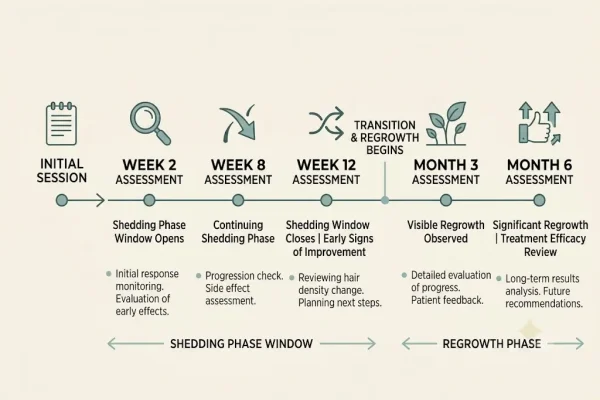
PRP doesn’t cause permanent hair loss. It can cause temporary shedding, and roughly one in three patients notices it. PRP shedding usually starts two to eight weeks after a session and clears within one to four weeks. What falls out is mostly thin, weak hair that was already on its way out. Your own growth factors speed up the hair cycle, and a faster cycle pushes old strands loose so new ones can come through.
I tell patients this before the first needle goes in. Most clinics don’t. And that’s a real problem, because the people who panic at week three and quit are the same people who never see the result they came in for.
This article covers scalp PRP only. I’m not going to get into PRP for joints or tendons, and I’m not going to compare PRP against hair transplant candidacy. Different questions, different visit.
PRP shedding is a temporary rise in hair fall after a platelet-rich plasma scalp treatment. It usually begins two to eight weeks after a session and lasts one to four weeks. The hairs that come out are typically thin, miniaturized strands already sitting in the resting phase. It reflects cycle activity, not follicle damage.
That’s the short version, and for most patients it’s the whole story.
The longer version starts with what’s actually in the syringe. We draw a small amount of your blood, spin it down, and concentrate the platelets. Those platelets carry growth factors that signal follicles to wake up. Nothing foreign goes into your scalp. If you want the mechanics of how platelet-rich plasma gets prepared and why concentration matters, that’s a separate rabbit hole worth going down.
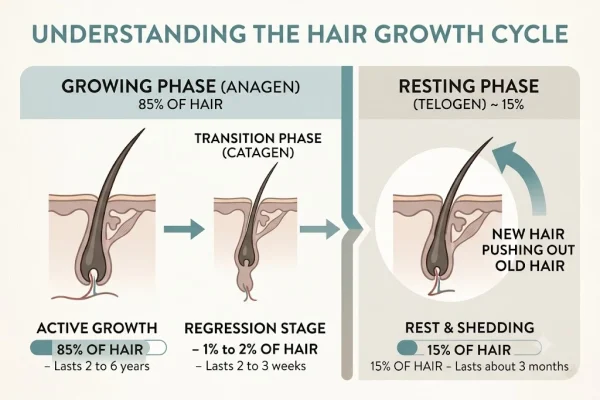
Shedding happens because a new growing hair physically pushes the old resting hair out of the follicle. That’s normal biology. PRP just makes it happen faster and to more follicles at once.
Here’s the math that makes this less alarming. In a healthy scalp, about 85% of hairs are in the growing phase and about 15% are in the resting phase. A follicle grows hair for close to four years, then rests for about four months. When it restarts, whatever was parked in that follicle gets evicted.
So when PRP nudges a batch of resting follicles back into growth at the same time, you get a batch of evictions at the same time. The shower drain looks dramatic. The scalp underneath is doing exactly what you paid it to do.
Minoxidil users already know this feeling. Same mechanism, different trigger.
Most PRP shedding runs one to four weeks and resolves on its own. Some patients see it stretch to eight weeks. Regrowth usually isn’t visible for another two to three months after that, and full assessment takes six months.
That gap is where people give up. Weeks 3 through 12 feel worse than baseline, look worse than baseline, and offer no visible payoff. Then around month three, fine new hairs start showing up along the part line, and by month six there’s something to actually measure.
I’ve watched this sequence enough times to predict it out loud at the first visit. It doesn’t stop patients from texting me at week four. It does stop them from quitting. If you want the full month-by-month picture of how long PRP takes to show results, plan on judging nothing before the six-month mark.
Not all shedding after PRP is good shedding. This is where the standard clinic line falls apart.
You’ve probably read that shedding always means the treatment is working. That’s lazy. Shedding can also mean a follicle got pushed that had nothing left to give, or that an underlying problem nobody screened for is doing the real damage. A 2025 prospective cohort found that patients with elevated TNF-alpha, an inflammatory marker, had higher rates of telogen-type shedding after PRP. That’s not the treatment working. That’s an inflammatory response in a subset of people.
Actually, let me sharpen that. The framing “is my shed good or bad” isn’t quite the right question. The better question is whether anything is coming out that wasn’t already miniaturized. If your shed hairs are thin, short, and wispy, that’s cycle turnover. If they’re thick terminal hairs with a full shaft, something else is going on and the PRP isn’t the cause, it’s the messenger.
Get seen if any of these show up:
That last one is a real diagnostic threshold, not a vibe. Collect everything you lose in one day without washing your hair, and count it. Clinicians confirm telogen effluvium when 25% to 50% of follicles have shifted into the resting phase, and plenty of things cause that shift which have nothing to do with what we injected. If you’re deep into a series and seeing no movement at all, the reasons PRP is not working usually have names, and they’re findable on a blood panel.
No. Large reviews show no consistent signal that PRP causes permanent hair loss. The direction of effect runs the other way.
The biggest synthesis we have is a 2025 systematic review of 43 randomized trials covering 1,877 participants. Pooled results showed hair density rising by about 19.6 hairs per square centimeter overall, and roughly 28.4 hairs per square centimeter when compared against placebo. Resting-phase hairs dropped by about 9.2 percentage points. Growing-phase hairs rose by about 6.4 against placebo.
Read those last two numbers together, because they’re the whole answer. Fewer resting hairs and more growing hairs is the opposite of hair loss. It’s also precisely the shift that produces a temporary shed on the way there.
One honest caveat from the same review: hair thickness showed no measurable change. PRP gets you more hairs. It doesn’t reliably get you thicker individual strands. Anyone promising both is selling.
Rare case reports do exist of alopecia areata appearing after PRP sessions. They’re isolated, they haven’t changed the safety picture across large reviews, and I mention them because you’ll find them if you search long enough and I’d rather you hear it from me first.
Some patients shed more because of who they are. Others shed more because of how their PRP was prepared. The second group is avoidable, and that’s the part nobody discusses.
Preparation is not standardized across clinics. Activation status, platelet concentration, leukocyte content, open versus closed systems, injection density, all of it varies wildly. In that same 2025 review, non-activated PRP was associated with roughly 3.7 times the odds of an adverse effect compared to controls, while activated PRP showed no such difference. Same treatment name. Different outcome profile.
Patient factors matter too. You’ll likely shed more if you have a high baseline percentage of resting hairs, advanced miniaturization, untreated thyroid or iron issues, or an inflammatory profile nobody checked. That’s most of the list, and four of the five items on it are testable before we start.
Preparation differences are also why the PRP and PRF conversation keeps coming up. Different spin, different clot, different release curve.
Worth knowing about the numbers themselves: clinic-reported shedding rates cluster around 30% to 40%, but one older observational series of 210 PRP and microneedling procedures logged transient shedding in just 1.42% of cases. Those figures aren’t reconcilable. They’re measuring different things, in different populations, with different definitions of “shed.” I quote the higher range to patients because over-preparing someone for a normal event costs nothing, and under-preparing them costs them the series.
A proper workup happens before the first injection, not after three sessions produce nothing. It should include a scalp exam, a pull test, and blood work when anything in your history points to a medical cause.
The American Academy of Dermatology describes the sequence plainly. A clinician asks how long you’ve had the loss and how fast it started, examines your scalp and nails, then gently pulls on the hair to see how it’s growing and whether it’s prone to breaking. If disease, hormone imbalance, infection, or a vitamin deficiency looks possible, blood work or a scalp biopsy comes next.
One caution from that same guidance that patients get wrong constantly: only supplement iron, zinc, or biotin when a blood test shows you’re low. Normal levels plus supplements can cause harm. Too much iron leads to iron poisoning, and the early signs are stomach pain and vomiting. Guessing at supplements is not a hair plan.
The AAD also puts the standard PRP schedule at monthly sessions for three months, then once every three to six months. That maintenance cadence isn’t optional. It’s how the result holds.
Skipping the workup is the most expensive mistake in this whole category. Three sessions spent chasing a thyroid problem is three sessions wasted, plus the months you didn’t spend treating the actual cause.
PRP fine-tunes a system that’s already functioning. It doesn’t replace the inputs that system runs on. If your ferritin is on the floor or your thyroid is off, injecting growth factors into that scalp is pouring water into a bucket with a hole in it.
The list of things that drive resting-phase shedding is unglamorous and well documented: low protein intake, iron deficiency, thyroid dysfunction, crash dieting, certain medications including beta blockers and retinoids, and low vitamin D. Iron is the one people miss most. Ferritin is an acute-phase reactant, so a normal ferritin doesn’t rule out deficiency. Iron saturation is the more sensitive marker.
We have a concierge dietician on staff for exactly this reason. Not as an add-on, and not as an upsell. Protein intake and iron status change what your follicles can build with, and no injection substitutes for that. Sleep and scalp blood flow sit on the same list.
Patients who treat PRP as one input among several hold their results. Patients who treat it as the whole plan tend to be back in a year asking why it stopped working. What you do to maintain hair after PRP between sessions is doing more of the work than the sessions are.
We set the expectation before treatment, not after the panic text. Every PRP patient hears the shedding timeline at consultation, in specifics, with the week numbers attached.
Jeff Atlas, PA-C performs all injections here. He came to us from orthopaedics, where PRP has been a working tool for years and where he did a very high volume of image-guided injection work. That background shows up in scalp injection depth and consistency, which is not a small thing when injection density is one of the variables driving results. Dr. Gopal Grandhige is a board-certified general surgeon who specializes in aesthetic surgery. He founded Formation and provides medical oversight for the regenerative program. He does not perform the injections. Patients ask, so I’d rather answer it plainly than have someone show up expecting a different provider in the room.
Formation is a regenerative medicine clinic in Tampa, and the regenerative side operates alongside the aesthetic surgery practice rather than underneath it. Different discipline, different protocols, different visit. We hold SSRP certification and ISSCA certification, the organizations that certify practices in peptides, exosomes, and stem cells. Standards in this space vary enormously, and certification is one of the few things a patient can verify from the outside before booking anything.
Our main clinic is in Tampa, and we do offer services in other locations. Before anyone starts a series, we screen for the things listed above, because starting PRP for thinning hair on an unscreened patient is how you spend three sessions on a problem a blood panel would have caught in a week.
PRP shedding is a normal, temporary phase for most patients, and it isn’t evidence that PRP causes hair loss. It’s evidence your hair cycle moved. Fewer resting hairs, more growing hairs, and a messy few weeks in between while the old strands clear out.
The single most expensive mistake I see is quitting at week four. You absorb the entire downside of the shed and none of the upside of the regrowth. If your shed is thin hair, diffuse, and inside the twelve-week window, stay the course. If it’s patchy, painful, or made of thick terminal hairs, stop and get the scalp examined.
Call us at (813) 922-2920 if you’re mid-series and unsure which one you’re looking at. That’s a five-minute conversation, and it beats guessing at your bathroom sink for another month.
In most cases, no. Temporary shedding reflects resting hairs being pushed out as follicles restart their growth phase, and it's followed by denser regrowth in patients who respond. A 2025 review of 43 randomized trials found resting-phase hairs dropped by about 9.2 percentage points after PRP, which is the shift that produces the shed in the first place. Shedding that continues past 12 weeks with no regrowth is a different situation and needs a scalp exam.
Clinic and review sources put it around 30% to 40% of patients, typically starting two to eight weeks after a session and lasting one to four weeks. One older observational series of 210 procedures reported transient shedding in only 1.42% of cases, so the true rate is genuinely unsettled. Individual variation is high, which is why the timeline matters more than the percentage.
Large reviews show no consistent evidence that PRP causes permanent hair loss. Isolated case reports of alopecia areata developing after PRP sessions exist in the literature, but they haven't changed the overall safety picture. Because PRP is made from your own blood, the risk of an allergic or foreign-body reaction is minimal.
Fine new hairs typically appear around two to three months after a session, with meaningful assessment at six months following a full series. The standard schedule is monthly sessions for three months, then maintenance every three to six months. Judging results earlier than six months gives you a misleading picture.
Usually not, if the shedding is mild, diffuse, and made up of thin hairs. Stopping mid-series means absorbing the temporary downside without reaching the point where regrowth shows. Stop and get evaluated if you develop patchy loss, scalp pain, redness, or scaling.
It appears to. In a 2025 systematic review, non-activated PRP was associated with roughly 3.7 times the odds of an adverse effect compared with controls, while activated PRP showed no such increase. Preparation protocols vary widely between clinics, including activation status, platelet concentration, and injection density, and that variability drives more real-world difference in outcomes than most patients realize.
There's no proven way to prevent the shed itself, but correcting what's underneath helps. Screening and treating iron deficiency, thyroid dysfunction, low protein intake, and vitamin D deficiency before starting gives follicles better material to work with. Only supplement iron, zinc, or biotin if a blood test confirms you're low, since normal levels plus supplements can cause harm.
The last one got 11/10.
Some of the biggest factors affecting liposuction results have nothing to do with what happens in the operating room.
Dr. Gopal rates 13 factors that can influence the final result, from working out before surgery and maintaining a stable weight to compression garments, skin elasticity, and lymphatic massage.
A few of his ratings might surprise you.
For example, he rates skin elasticity a 10/10 because even after the fat is removed, the skin still needs to contract and settle over the new contour.
And lymphatic massage? He gives it an 11/10 because of the role it plays in his recovery protocol, helping manage swelling and supporting how the skin settles over the newly sculpted areas.
The takeaway: great liposuction results depend on more than the surgery itself.
Patient preparation, anatomy, recovery, and long-term weight maintenance all play a role.
Considering liposuction or high-definition liposuction in Tampa?
Schedule a consultation with Dr. Gopal Grandhige at Formation Tampa. Link in bio.
#Liposuction #HDLiposuction #LiposuctionRecovery #LipoAftercare #tampa
The last one got 11/10.
Some of the biggest factors affecting liposuction results have nothing to do with what happens in the operating room.
Dr. Gopal rates 13 factors that can influence the final result, from working out before surgery and maintaining a stable weight to compression garments, skin elasticity, and lymphatic massage.
A few of his ratings might surprise you.
For example, he rates skin elasticity a 10/10 because even after the fat is removed, the skin still needs to contract and settle over the new contour.
And lymphatic massage? He gives it an 11/10 because of the role it plays in his recovery protocol, helping manage swelling and supporting how the skin settles over the newly sculpted areas.
The takeaway: great liposuction results depend on more than the surgery itself.
Patient preparation, anatomy, recovery, and long-term weight maintenance all play a role.
Considering liposuction or high-definition liposuction in Tampa?
Schedule a consultation with Dr. Gopal Grandhige at Formation Tampa. Link in bio.
#Liposuction #HDLiposuction #LiposuctionRecovery #LipoAftercare #tampa
Six to seven hours.
That’s how long an HD liposuction procedure can take with Dr. Gopal’s approach.
He’s not simply removing fat. He’s evaluating every square inch, considering the underlying anatomy, and shaping how each contour transitions into the next.
It’s detailed, physically demanding work.
So when Dr. Gopal says, “Someone’s gotta sweat for the fat to come off,” he means it.
Considering HD liposuction in Tampa? Schedule a consultation (link in bio).
#HDLiposuction #HighDefinitionLiposuction
Six to seven hours.
That’s how long an HD liposuction procedure can take with Dr. Gopal’s approach.
He’s not simply removing fat. He’s evaluating every square inch, considering the underlying anatomy, and shaping how each contour transitions into the next.
It’s detailed, physically demanding work.
So when Dr. Gopal says, “Someone’s gotta sweat for the fat to come off,” he means it.
Considering HD liposuction in Tampa? Schedule a consultation (link in bio).
#HDLiposuction #HighDefinitionLiposuction
Will neck lipo give you the jawline you want?
It depends…
Someone can have fullness under the chin and assume the answer is neck liposuction. But what looks like “fat” from the outside can actually come from several different structures.
Some fat sits directly beneath the skin and can respond very well to liposuction.
But fullness can also come from deeper fat beneath the platysma, the salivary glands under the jaw, muscles under the chin, or even the natural projection of the chin and jaw itself.
That distinction can completely change what neck liposuction can realistically accomplish.
This is why evaluating the anatomy matters before deciding on a procedure.
For the right anatomy, neck liposuction can create a significant change in the neck and jawline.
But when deeper structures are contributing to the fullness, liposuction alone may not create the contour someone is expecting.
A good neck lipo consultation should figure that out first.
Schedule a consultation with **Dr. Gopal Grandhige at Formation Tampa.** Link in bio.
#NeckLipo #NeckLiposuction #DoubleChin #JawlineContouring #NeckContouring
Will neck lipo give you the jawline you want?
It depends…
Someone can have fullness under the chin and assume the answer is neck liposuction. But what looks like “fat” from the outside can actually come from several different structures.
Some fat sits directly beneath the skin and can respond very well to liposuction.
But fullness can also come from deeper fat beneath the platysma, the salivary glands under the jaw, muscles under the chin, or even the natural projection of the chin and jaw itself.
That distinction can completely change what neck liposuction can realistically accomplish.
This is why evaluating the anatomy matters before deciding on a procedure.
For the right anatomy, neck liposuction can create a significant change in the neck and jawline.
But when deeper structures are contributing to the fullness, liposuction alone may not create the contour someone is expecting.
A good neck lipo consultation should figure that out first.
Schedule a consultation with **Dr. Gopal Grandhige at Formation Tampa.** Link in bio.
#NeckLipo #NeckLiposuction #DoubleChin #JawlineContouring #NeckContouring
Want more definition than workouts gave you?
Traditional liposuction focuses primarily on removing fat. HD liposuction goes further. It requires understanding the underlying muscle anatomy, where to remove fat, where to preserve it, and how each contour works together to create natural-looking definition.
That’s the art of it. The goal isn’t to give every patient the same abs or the same body. It’s to work with the anatomy that’s already there and determine how much definition will look right for that individual.
Dr. Gopal Grandhige specializes in high-definition liposuction and advanced body contouring, using nearly two decades of surgical experience to create results that look sculpted, athletic, and intentional.
Considering HD liposuction in Tampa?
Schedule a consultation with Dr. Gopal at Formation Tampa. Link in bio.
#HDLiposuction #HighDefinitionLiposuction #Liposuction #BodyContouring #Tampa
Want more definition than workouts gave you?
Traditional liposuction focuses primarily on removing fat. HD liposuction goes further. It requires understanding the underlying muscle anatomy, where to remove fat, where to preserve it, and how each contour works together to create natural-looking definition.
That’s the art of it. The goal isn’t to give every patient the same abs or the same body. It’s to work with the anatomy that’s already there and determine how much definition will look right for that individual.
Dr. Gopal Grandhige specializes in high-definition liposuction and advanced body contouring, using nearly two decades of surgical experience to create results that look sculpted, athletic, and intentional.
Considering HD liposuction in Tampa?
Schedule a consultation with Dr. Gopal at Formation Tampa. Link in bio.
#HDLiposuction #HighDefinitionLiposuction #Liposuction #BodyContouring #Tampa
Defined abs with HD liposuction.
Unlike traditional liposuction, where the primary goal is removing excess fat, HD liposuction is about strategically removing fat to reveal and enhance the underlying muscle structure.
Those markings you see before surgery help Dr. Gopal map out the patient’s anatomy and plan where to remove fat and where to preserve it to create more visible definition.
The second clip was taken immediately after surgery, so this is not the final result. Swelling and bruising will change significantly as the body heals and the final contour develops over the months that follow.
Considering high-definition liposuction? Schedule a consultation with Dr. Gopal Grandhige at Formation Tampa. Link in bio.
#HDLiposuction #HighDefinitionLiposuction #Liposuction #BodyContouring #MaleLiposuction
Defined abs with HD liposuction.
Unlike traditional liposuction, where the primary goal is removing excess fat, HD liposuction is about strategically removing fat to reveal and enhance the underlying muscle structure.
Those markings you see before surgery help Dr. Gopal map out the patient’s anatomy and plan where to remove fat and where to preserve it to create more visible definition.
The second clip was taken immediately after surgery, so this is not the final result. Swelling and bruising will change significantly as the body heals and the final contour develops over the months that follow.
Considering high-definition liposuction? Schedule a consultation with Dr. Gopal Grandhige at Formation Tampa. Link in bio.
#HDLiposuction #HighDefinitionLiposuction #Liposuction #BodyContouring #MaleLiposuction
Skin quality changes everything.
Neck liposuction can create a more defined jawline and neck contour by removing unwanted fat, but the result also depends heavily on skin quality and elasticity.
When skin has good elasticity, neck lipo alone may be enough for the skin to contract around the new contour. With some skin laxity, Dr. Gopal may combine liposuction with a skin-tightening treatment such as Renuvion or FaceTite. With significant laxity, a neck lift may be the more appropriate option.
That’s why evaluating the skin is an important part of determining the right approach before neck liposuction.
Considering neck liposuction in Tampa? Schedule a consultation with Dr. Gopal Grandhige at Formation Tampa.
#NeckLiposuction #NeckLipo #JawlineContouring #Tampa
Skin quality changes everything.
Neck liposuction can create a more defined jawline and neck contour by removing unwanted fat, but the result also depends heavily on skin quality and elasticity.
When skin has good elasticity, neck lipo alone may be enough for the skin to contract around the new contour. With some skin laxity, Dr. Gopal may combine liposuction with a skin-tightening treatment such as Renuvion or FaceTite. With significant laxity, a neck lift may be the more appropriate option.
That’s why evaluating the skin is an important part of determining the right approach before neck liposuction.
Considering neck liposuction in Tampa? Schedule a consultation with Dr. Gopal Grandhige at Formation Tampa.
#NeckLiposuction #NeckLipo #JawlineContouring #Tampa
Liposuction can change more than the body.
I’ve watched patients become more confident, make changes in their careers, show up differently in their relationships, and start making different choices for themselves.
That’s when I know I’ve done my job well.
Because high-definition liposuction isn’t only about creating a leaner, more defined physique. Sometimes the physical transformation becomes the catalyst for changes that reach far beyond the operating room.
Dr. Gopal Grandhige
Considering HD liposuction in Tampa? Schedule a consultation with Dr. Gopal Grandhige at Formation Tampa.
#BodyContouring #HDLiposuction #tampa #Liposuction
Liposuction can change more than the body.
I’ve watched patients become more confident, make changes in their careers, show up differently in their relationships, and start making different choices for themselves.
That’s when I know I’ve done my job well.
Because high-definition liposuction isn’t only about creating a leaner, more defined physique. Sometimes the physical transformation becomes the catalyst for changes that reach far beyond the operating room.
Dr. Gopal Grandhige
Considering HD liposuction in Tampa? Schedule a consultation with Dr. Gopal Grandhige at Formation Tampa.
#BodyContouring #HDLiposuction #tampa #Liposuction
Male liposuction requires a different approach.
The contours that create a more feminine shape aren’t necessarily the same ones that create a strong, athletic male physique.
With male high-definition liposuction, Dr. Gopal considers how the chest, abdomen, waist, ribs and back work together—and how the underlying muscle anatomy should guide where definition and shadow are created.
That’s also why the chest matters. A highly defined abdomen and back paired with a rounder, less-defined chest can make the overall result feel out of proportion.
The goal is a cohesive, athletic contour that works with the patient’s natural anatomy.
Considering male HD liposuction? Schedule a consultation with Dr. Gopal Grandhige at Formation Tampa.
Male liposuction requires a different approach.
The contours that create a more feminine shape aren’t necessarily the same ones that create a strong, athletic male physique.
With male high-definition liposuction, Dr. Gopal considers how the chest, abdomen, waist, ribs and back work together—and how the underlying muscle anatomy should guide where definition and shadow are created.
That’s also why the chest matters. A highly defined abdomen and back paired with a rounder, less-defined chest can make the overall result feel out of proportion.
The goal is a cohesive, athletic contour that works with the patient’s natural anatomy.
Considering male HD liposuction? Schedule a consultation with Dr. Gopal Grandhige at Formation Tampa.
Choosing a liposuction surgeon isn’t just about looking at before-and-afters.
Liposuction isn’t simply about removing fat. Decisions around how much to remove, which areas to treat, skin quality, post-op care and recovery can all influence the approach to your result.
How a surgeon answers these questions can tell you a lot about how they think, plan and care for their patients.
Save these 6 questions for your next consultation.
Considering liposuction? DM us or schedule a consultation with Dr. Gopal Grandhige at Formation Tampa.
#tampa #hdliposuction #liposuction #bodycountouring
Choosing a liposuction surgeon isn’t just about looking at before-and-afters.
Liposuction isn’t simply about removing fat. Decisions around how much to remove, which areas to treat, skin quality, post-op care and recovery can all influence the approach to your result.
How a surgeon answers these questions can tell you a lot about how they think, plan and care for their patients.
Save these 6 questions for your next consultation.
Considering liposuction? DM us or schedule a consultation with Dr. Gopal Grandhige at Formation Tampa.
#tampa #hdliposuction #liposuction #bodycountouring
6 months post high-definition liposuction with moderate definition.
The goal wasn’t just less fat. It was a leaner, more athletic contour with visible definition through the abdomen and torso, without pushing the result to the highest level of definition.
High-definition liposuction strategically sculpts around the underlying anatomy and can be customized based on a patient’s anatomy, muscle structure, and the degree of definition they want to achieve.
For this patient, moderate definition created the balance Dr. Gopal was looking for.
Results vary by patient and depend on individual anatomy, skin quality, and treatment plan.
Considering HD liposuction? Schedule a consultation with Dr. Gopal Grandhige at Formation Tampa. Link in bio.
#HDLiposuction #Liposuction #BodyContouring #MaleLiposuction #tampa

6 months post high-definition liposuction with moderate definition.
The goal wasn’t just less fat. It was a leaner, more athletic contour with visible definition through the abdomen and torso, without pushing the result to the highest level of definition.
High-definition liposuction strategically sculpts around the underlying anatomy and can be customized based on a patient’s anatomy, muscle structure, and the degree of definition they want to achieve.
For this patient, moderate definition created the balance Dr. Gopal was looking for.
Results vary by patient and depend on individual anatomy, skin quality, and treatment plan.
Considering HD liposuction? Schedule a consultation with Dr. Gopal Grandhige at Formation Tampa. Link in bio.
#HDLiposuction #Liposuction #BodyContouring #MaleLiposuction #tampa

Peptides optimize the effort you are putting in. Get a FREE 15-minute Virtual Protocol Review + our Regenerative Treatment Newsletter.
We’ll show you exactly how we evaluate candidacy — plus, we cover the cost of your baseline labs with all in-person consults ($100).