
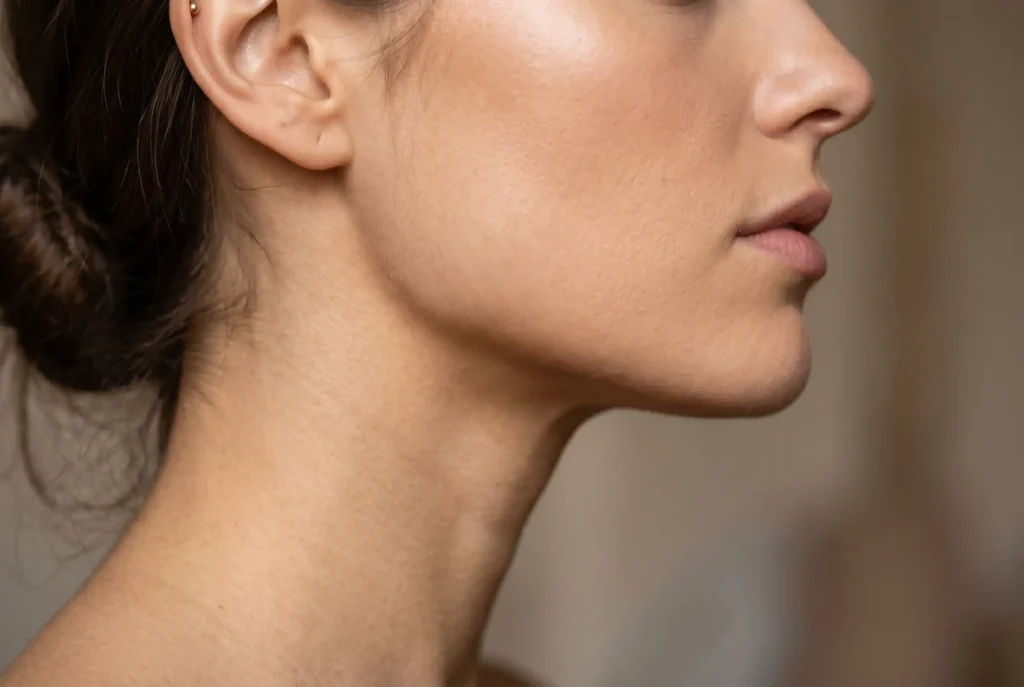
A minimally invasive lift for the cheeks, jawline, and jowls, planned around your anatomy by a board-certified surgeon about 15 minutes from Live Oaks Square.
A PDO thread lift does two separate jobs. It lifts loose skin along the cheeks, jaw, and jowls the day it’s placed, then keeps working for months as the threads dissolve and your body builds collagen around where they sat. You see a change immediately, and a slower firming after the material is gone.
The threads are polydioxanone, a suture material used in surgery for decades. It breaks down over roughly six to nine months. The material itself is well understood and predictable. What the material cannot decide is your result. Where the threads sit, how many go in, how much tension gets used, and whether you belong in the chair at all are the variables that separate a natural lift from a pulled one.
A thread lift is a refinement tool. It works on early to moderate laxity, and it stops working where real skin excess begins. If you have heavy loose skin, deep jowling, or a jawline that has lost its bony frame, threads will disappoint you no matter who places them. A provider who tells you that before you book is more useful than one who books you anyway. Formation approaches a PDO thread lift in Tampa the same way Dr. Grandhige approaches contouring surgery: the anatomy sets the pattern. A template pattern gives you a template face.
Which one had surgery 1 or 2? 👀
High-definition liposuction goes beyond traditional fat removal. Instead of simply reducing fat evenly, the surgeon strategically removes fat around the underlying muscles to make their natural contours more visible.
But here’s what makes it interesting: HD lipo doesn’t create the same six-pack on everyone. Each person’s anatomy, muscle development, and desired level of definition influence the final result.
Now take another look at these two patients.
Which one do you think had HD liposuction, 1 or 2?
Drop your guess below, then check the pinned comment for the answer!
#HDLiposuction #MaleLiposuction #BodyContouring #Tampa
There’s a story behind every decision.
Cosmetic surgery is a personal decision. Yet people who choose it often find themselves having to explain or defend that choice to others.
Some want to restore changes after pregnancy or weight loss. Others have worked hard to get in shape but still have areas they’d like to improve. And some simply want to feel more comfortable with their appearance.
The reasons are different for everyone. And they don’t have to make sense to anyone else.
At Formation, Dr. Gopal believes the decision to pursue cosmetic surgery should be guided by a patient’s personal goals, realistic expectations, and what’s medically appropriate for them.
Because ultimately, the person making that decision is the one who will live with it.
#Tampa #CosmeticSurgery #BodyContouring #Liposuction
Our first four-legged patient. 🐾
Dr. Gopal takes his liposuction and body contouring very seriously.
Even when his patients have four legs.
From loose skin and neck liposuction to a jawline that deserves its own before-and-after reveal, this might be his most dramatic transformation yet.
And yes, he even got the patient’s permission to share the results. 😂
A little Halloween fun from Dr. Gopal and his two very patient pups! 🎃🐶
No dogs underwent surgery. Just two willing participants and one very committed surgeon.
#SurgeonLife #tampa #necklipo
What weight loss can’t fix.
After losing over 100 pounds, this patient had achieved significant weight loss, but was left with excess skin around his abdomen and back that weight loss alone couldn’t address.
During an 8-hour surgery, Dr. Gopal performed a circumferential body lift, a procedure that removes excess skin around the entire midsection to improve body contour.
In this video, Dr. Gopal walks through the procedure, explaining how he removed approximately 3 pounds of skin from the back and estimated another 4–5 pounds would be removed from the abdomen.
He’s also using a small amount of fat collected during the procedure to add volume to the upper chest, improving its contour without performing a separate chest lift.
For patients who have experienced major weight loss, body contouring can help address the excess skin that remains after the weight is gone.
Considering surgery after weight loss? Schedule a consultation with Dr. Gopal at Formation in Tampa to explore your options.
Actual patient footage. Individual results vary.
#BodyContouring #BodyLift #ExcessSkinRemoval
Only 3 months after surgery. And still healing.
This patient had previously undergone a tummy tuck but wanted to improve his abdominal contour, create more definition, and address the appearance of his existing scar.
Dr. Gopal combined several body contouring techniques, including HD liposuction, skin tightening with Renuvion, fat transfer to the chest, and revision of the previous tummy tuck scar.
The result so far? A more defined abdomen, improved body contours, and a revised scar that’s still in the early stages of healing.
At just three months after surgery, these aren’t the final results. Swelling can continue to decrease, and scars typically soften and fade as healing progresses.
Swipe to see a closer look at the scar revision.
Considering body contouring or looking to improve the results of a previous procedure? Schedule a consultation with Dr. Gopal at Formation Tampa. Link in bio.
Actual patient photos. Individual results vary.
#HDLiposuction #BodyContouring #ScarRevision #SkinTightening #TummyTuck
Your fat is liquid gold.
The fat you don’t want might be exactly what another part of your body needs.
During liposuction, the fat we remove doesn’t always have to be discarded. In fact, Dr. Gopal refers to it as “liquid gold.”
Why? Because that fat can sometimes be transferred to another area of the body to add volume, enhance natural contours, and create a more balanced shape.
For women, that might mean adding volume to the breasts, hips, or buttocks. For men, fat transfer can help enhance the chest or shoulders.
And because we’re using your own fat, we can potentially improve two areas during the same surgery.
Of course, fat transfer isn’t right for everyone. It’s something Dr. Gopal discusses with patients beforehand and incorporates into the surgical plan when appropriate.
Considering liposuction in Tampa? Schedule a consultation with Dr. Gopal at Formation to explore your body contouring options.
#TampaLiposuction #FatTransfer #BodyContouring
Cosmetic surgery isn’t just cosmetic.
We often measure the success of plastic surgery by what we can see in before-and-after photos. But some of the most meaningful changes happen in ways a photograph can’t capture.
How someone feels about themselves. The confidence they carry into everyday life. The freedom of no longer feeling uncomfortable in their own skin.
For Dr. Gopal, that’s what makes this work so meaningful.
A patient who underwent body contouring in 2025 recently reached out to share how much the experience continues to mean to her.
She didn’t talk about measurements or how her body looked. She talked about how much better her days had become.
And that’s something Dr. Gopal has always believed: Cosmetic surgery isn’t simply about changing how someone looks. It’s about understanding what that change means to the person choosing it.
#Tampa #CosmeticSurgery #BodyContouring
A flatter stomach without a tummy tuck? 👀
Pregnancy, and sometimes increased pressure from fat deep inside the abdomen, can cause the abdominal muscles to separate down the middle. This is called diastasis recti, and it can make your belly stick out even if you’re otherwise lean.
Traditionally, repairing that separation often meant undergoing a tummy tuck. But what if you don’t have much loose skin to remove?
For the right patient, Dr. Gopal can use robotic-assisted surgery to bring those separated muscles back together through three small incisions, without the long scar associated with a traditional tummy tuck.
That’s exactly what he did for the patient in these before-and-after photos. No tummy tuck. No additional procedures.
**But this approach isn’t for everyone.** If you have significant loose skin or excess fat, a different treatment may be more appropriate. That’s why understanding what’s causing your belly to protrude matters before deciding on surgery.
Curious whether you’re a candidate? DM us or schedule a consultation with Dr. Gopal at Formation Tampa. Link in bio.
Actual patient results. Individual results vary.
#DiastasisRecti #MuscleSeparation #DiastasisRectiRepair #RoboticSurgery #Tampa
Why does fluid sometimes collect after surgery?
After certain surgical procedures, fluid can accumulate beneath the skin, forming what’s called a seroma.
In this video, Dr. Gopal demonstrates how he drains a seroma in a patient recovering from diastasis recti repair.
This is one of the reasons postoperative follow-up matters. It allows Dr. Gopal to monitor healing, identify any issues, and address them when necessary.
Considering surgery? DM us to schedule a consultation with Dr. Gopal at Formation Tampa.
#DiastasisRecti #Seroma #TampaSurgeon #AbdominalMuscleRepair
The fat is gone. But what takes its place?
When fat is removed during liposuction, it leaves behind space beneath the skin. As the body heals, fluid can sometimes collect in that space, creating what’s called a seroma.
And here’s why that matters.
If fluid continues to collect, it can potentially affect the final contour.
That’s why Dr. Gopal pays close attention to fluid buildup during recovery. His approach is to identify seromas early and address them quickly.
Considering liposuction in Tampa? Schedule a consultation with Dr. Gopal at Formation to learn more.
#Liposuction #Seroma #BodyContouring

The fat is gone. But what takes its place?
When fat is removed during liposuction, it leaves behind space beneath the skin. As the body heals, fluid can sometimes collect in that space, creating what’s called a seroma.
And here’s why that matters.
If fluid continues to collect, it can potentially affect the final contour.
That’s why Dr. Gopal pays close attention to fluid buildup during recovery. His approach is to identify seromas early and address them quickly.
Considering liposuction in Tampa? Schedule a consultation with Dr. Gopal at Formation to learn more.
#Liposuction #Seroma #BodyContouring

Thread lifts are low-risk, not no-risk, and the published rates are higher than the marketing language suggests. You deserve the actual figures before you decide.
A systematic review of 19 studies covering 1,406 absorbable thread lift patients found bruising in about 19 percent of cases, swelling in about 17 percent, and tenderness in about 10 percent. Infection came in near 2.5 percent, paresthesia near 1 percent, and hematoma under 1 percent. Most of these resolve on their own. A few do not, and dimpling or visible threads are the ones that bring people back asking for revision. You can read the full comparison of adverse effect rates across thread materials yourself rather than take a clinic’s word for it.
Longevity is the second place the brochures oversell. A separate systematic review of absorbable facial thread lifts found consistent improvement immediately after treatment across every study reviewed, but the longest follow-up ran only two years, and the authors concluded that long-term efficacy data is still lacking. That is not a reason to avoid the procedure. It is a reason to be skeptical of any page promising you 18 months as a floor.
For scale: minimally invasive treatments crossed 28 million procedures in the United States in 2024 according to the American Society of Plastic Surgeons procedural statistics. Volume that high means a wide spread in who is holding the needle. The rates above are averages across all of it.
Two variables move your risk more than the brand of thread or the room it’s done in. The first is how many threads go in. Risk climbs with each additional thread, so a 24-thread full-face plan is not the same bet as a 16-thread lower-face plan. The second is age. The odds of a visible problem rise by decade after 40, because thinner skin holds a barb differently and shows every irregularity underneath it.
Most lower-face plans at Formation use 8 to 12 threads per side. That is deliberately fewer than the counts advertised elsewhere, and it’s the direct consequence of the numbers above. Fewer threads placed in the right plane beat more threads placed generously. Patients past 55 get a different conversation entirely, usually pointing toward collagen-stimulating thread work or a tightening approach rather than mechanical lift.
Before Dr. Grandhige recommends threads, he runs three checks. All three have to clear. Missing one means threads are the wrong tool, even when the other two look perfect.
The test exists because the most common thread lift disappointment isn’t a complication. It’s a technically fine procedure performed on the wrong candidate. Roughly one in five people who come in asking specifically for threads leave with a recommendation to wait or to do something else, and that number is a feature of how the practice runs, not a flaw in it.
Formation is at 1315 South Howard Avenue in South Tampa, roughly a 15 to 25 minute drive from Live Oaks Square depending on I-4 and Kennedy traffic. From the 33610 side of town, east of the interstate near East Ybor and Grant Park, that’s a straight run west rather than a trip across the county.
Live Oaks Square has no thread lift provider of its own, which is why searches from this ZIP code return clinics that describe themselves as serving “Tampa and surrounding areas” without saying how far you’d actually drive. Worth knowing before you book anything: the drive shapes how the treatment gets scheduled.
Two practical details for patients coming from this side of Tampa. First, almost every Live Oaks Square patient here splits the consultation and the treatment into two separate visits rather than doing both in one afternoon, because the fit test can end with a no and nobody should sit in I-4 traffic twice for that. Second, thread appointments for east-side patients get booked before 3 p.m. so the drive home doesn’t land in the westbound backup while your face is still tight.
Swelling and tightness peak in the first two to three days, exactly when you’ll least want to make the drive again. Follow-ups are set with that in mind. Patients who come in for jawline concerns often end up comparing threads against neck liposuction in Live Oaks Square, since the jaw and the neck read as one unit to everyone looking at you.
Dr. Grandhige works from a rule he carried over from surgery: the procedure is about 60 percent of the result and the care afterward is the other 40. Bad aftercare can undo good placement. Recovery here is managed and followed, not handed to you on a printout.
Mild swelling, some bruising, and a tight pulling feeling are all normal for the first two to three days. The soreness reads more like a hard workout in the face than sharp pain. Sleep on your back with your head elevated so nothing presses on the treated areas. Skip facial massage completely. Hold off on hard training and big exaggerated expressions for about two weeks while the threads settle into position. Most patients handle this week from home without anyone noticing.
Early swelling eases inside the first week and the lift starts reading clearly. From there the slow half begins: collagen builds around the thread tracks and skin firmness keeps improving through about week 12. That gradual arc is the reason a well-placed thread lift looks like something that happened on its own rather than something that was done to you. Sun is the main thing working against you during this window, and in Florida that’s a year-round problem rather than a summer one.
Thread lifts are commonly quoted at 12 to 18 months. Across the thread and combination cases planned at Formation over the past two years, the typical hold has landed closer to 10 to 14 months, and shorter for patients with heavy sun exposure. Setting that expectation up front costs a booking occasionally. It also means nobody comes back at month 11 feeling misled. As the threads dissolve, the collagen framework they built stays behind and keeps supporting the tissue, which is why a second round tends to start from a better baseline than the first.
Threads do not vanish without a trace. As polydioxanone breaks down it leaves fibrous tissue along the tracks, and that scarring is part of how the lift holds. It’s also the part almost no clinic page mentions, because it has a downside: fibrous planes are harder to work in later. If a surgical facelift is anywhere in your ten-year plan, the number of thread rounds you stack between now and then is a real variable, not a footnote.
This is not an argument against threads. It’s an argument for knowing what you’re stacking. A patient at 42 doing one conservative round is in a different position than a patient at 55 on a third full-face round. Ask any provider how they account for prior thread work when planning surgery. If the question surprises them, that tells you something.
Threads are the wrong tool when the problem is volume of skin rather than position of skin. The tells are heavy loose tissue in the lower face, jowling that hangs past the jaw border, or laxity in the neck that a cheek lift cannot reach.
Saying no to a procedure is unusual in aesthetics. It’s also the whole reason the fit test exists. The wrong procedure performed well is still the wrong procedure.
Male faces need a different thread pattern, and this is one of the areas Dr. Grandhige is known for. Male skin is thicker, fat distributes differently, and a masculine jaw should read angular rather than lifted and softened. A pattern designed for a female midface will feminize a male one, which is precisely the look most men walk in trying to avoid.
The approach across all his work is restraint: do what’s needed and stop. In male body contouring, even small over-corrections create an artificial appearance, and the same rule holds on the face. The best outcomes are the ones nobody can place. Colleagues say you look sharper or better rested and cannot explain why. PDO thread lifts for men at Formation are built to that standard, and men make up a large share of the thread cases planned here.
Most people arrive with the questions the marketing pages taught them to ask. These are better ones, and any provider worth your time will answer them without hedging.
That last question is the one that separates a plan from a pitch. Consultations at Formation are by appointment and carry a fee, because the visit is a surgical assessment rather than a sales meeting. You leave with a recommendation even when the recommendation is to wait.
Dr. Gopal Grandhige, MD is a board-certified general surgeon who specializes in aesthetic surgery, with more than 15 years of operating experience across complex general surgery and body contouring.
He attended medical school at the University of Michigan, matched into surgical training at Yale, then completed a full general surgery residency followed by fellowship training in burn surgery, critical care, and minimally invasive metabolic and foregut surgery. Years spent in settings where wound healing, inflammation, and tissue behavior carried immediate consequences change how a face gets read for a thread pattern.
Formation stays boutique by design. Surgical volume is limited on purpose so Dr. Grandhige evaluates every patient himself and signs off on every candidacy decision. You are not handed to rotating staff between the consultation and the treatment. The person who assessed your face is the person who built your plan.
For the right candidate with realistic expectations, a PDO thread lift is a low-downtime way to bring back cheek and jawline definition without the recovery of surgery. It isn’t a facelift. It isn’t permanent. Published complication rates are real but modest, and they climb with thread count and age. Provider judgment decides most of the outcome, which is the argument for choosing carefully instead of booking whichever clinic ranks first.
If you’re in Live Oaks Square and you want a straight answer on whether threads fit your face, or whether something else would serve you better, Dr. Gopal Grandhige and the team at Formation will give you one. You’ll get the fit test, the actual numbers for your age and laxity, and a plan built around your goals. If threads are wrong for you, you’ll hear that too. Use the form below to start.
Commonly quoted at 12 to 18 months. In practice, the cases planned here have held closer to 10 to 14 months, and less for patients with heavy sun exposure. Published research on absorbable thread lifts has follow-up out to about two years, so anyone promising more than that is going past the evidence.
Across published reviews of absorbable thread lifts, bruising shows up in roughly 19 percent of cases, swelling in about 17 percent, and tenderness in about 10 percent. Infection sits near 2.5 percent. Most of it is temporary. Dimpling and visible threads are the ones that occasionally need correction, and both track back to placement and thread count.
Done conservatively, no. People register that you look sharper or more rested without identifying why. Over-threading is what makes a thread lift obvious, which is the reason plans here run 8 to 12 threads per side rather than twice that.
It depends on your laxity and your age, and fewer is usually better. Every additional thread adds a little risk, so the count gets set to the minimum that achieves the lift rather than the maximum the area can hold.
It's done in the office under local anesthesia and runs 30 to 60 minutes depending on how many areas get treated. You feel pressure and tugging rather than sharp pain. The days afterward feel like deep muscle soreness in the face and neck.
Yes, though it's worth planning for. Threads leave fibrous tissue behind as they dissolve, and scarred planes are harder to operate in. One conservative round is a minor factor. Several stacked rounds are a bigger one, which is why it comes up at the consultation rather than years later.
Weight gain adds volume to the areas the threads are lifting against, which shortens how long the result reads well. Stable weight protects the outcome the same way it protects any contouring result.
If your laxity is early and your skin still has spring, now is a reasonable time and a conservative round buys you a few years of maintenance. If the laxity is past what threads reach, waiting and doing the right procedure once beats spending on the wrong one twice.
Use the form below to request your consultation, and the team will follow up to schedule your visit. If you are anywhere in Tampa and want a clear read on your candidacy, book a consultation with Gopal Grandhige, MD at Formation. You will leave knowing exactly where you stand, whether that means scheduling a treatment or holding off for now.