
Written By: Jeffrey Atlas, PA-C, Health Content Writer
Medically Reviewed By: Dr. Gopal Grandhige, MD, FACS, Board-Certified Surgeon
Last Reviewed: June 5, 2026
MOTS-C can be stacked with several other peptides, and the pairings that hold up best are the ones built on completely different biological mechanisms.
The standout combination right now? MOTS-C with Retatrutide.
MOTS-C is a 16-amino-acid peptide that lives inside your mitochondria, where it activates AMPK and pushes cells to burn fat for fuel. Retatrutide is a newer triple-receptor agonist that hits GLP-1, GIP, and glucagon receptors at once, producing fat-loss results that beat anything that came before it.
These two compounds don’t compete for the same receptors. They don’t share metabolic shortcuts. They handle different problems. Retatrutide turns down hunger and signals your liver to release stored fat, while MOTS-C makes sure your cells can actually burn what gets released.
At Formation in Tampa, we’ve watched this pairing work for the right patient. Keep reading and I’ll explain who that actually is, where most people go wrong, and what we won’t recommend stacking under any circumstances.
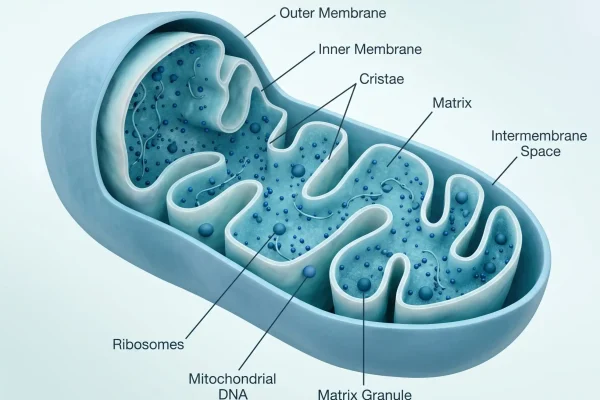
MOTS-C stands for Mitochondrial Open Reading Frame of the 12S rRNA Type-C. The mouthful matters because most peptides come from nuclear DNA. MOTS-C is one of the few that gets coded directly inside your mitochondria, which is also where it does its work.
Your mitochondria are the energy factories inside every cell. They take what you eat and turn it into ATP, the fuel cells run on. When mitochondria slow down (from age, chronic stress, poor diet, or being sedentary), your whole metabolism slows with them. Energy drops. Fat sticks. Recovery drags.
MOTS-C activates AMPK, the master switch that tells cells to start burning fat instead of storing it. When AMPK fires, glucose uptake in muscle goes up, fat oxidation goes up, inflammation comes down, and cells get better at handling stress. Researchers at USC who first identified MOTS-C in 2015 called it an “exercise mimetic” because it triggers many of the same metabolic signals as a hard workout. Later work has built on that finding, including a 2023 peer-reviewed review on MOTS-C’s role in metabolic disorders.
Here’s the part most clinics gloss over: MOTS-C levels naturally drop by around 21% between age 30 and 80. That decline maps almost exactly to the slow metabolic decay people complain about in their 40s and 50s. The premise behind injecting MOTS-C is restoring what time has taken.
That doesn’t make it a miracle. It’s not. I’ve had patients walk into Formation expecting MOTS-C to do the work of diet and training, and they’re always disappointed. The peptide amplifies what you’re already doing. Skip the lifestyle work and you’ll get modest results at best.
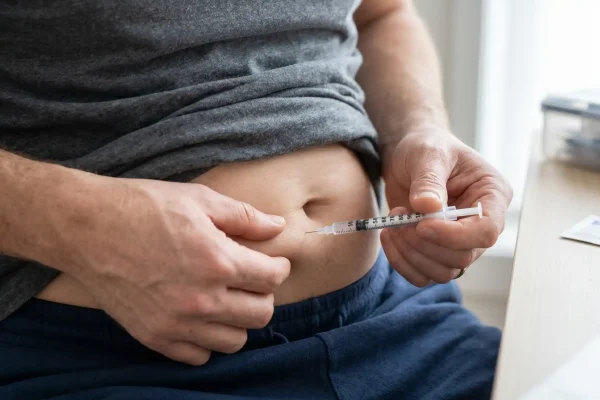
The injectable form goes under the skin, usually in the abdomen or thigh. Half-life runs short, around one to two hours in circulation, which is why most protocols dose two or three times a week instead of once.
The honest answer: because no single peptide handles every problem.
Each one targets a narrow pathway. MOTS-C handles cellular energy. GLP-1 agonists handle appetite. Growth hormone peptides handle muscle and recovery. Repair peptides handle gut and tissue healing. Stack two that work on different systems and you cover more ground without piling on side effects from the same receptor getting hit twice.
That’s the theory. The practice is messier.
Most patients who come to Formation asking about stacks are repeating something they heard on a podcast or read in a forum, and the recommendation usually involves three or four compounds that all overlap. I’ve turned down more peptide stack requests than I’ve approved. When someone tells me they want MOTS-C, Retatrutide, Tirzepatide, BPC-157, and Tesamorelin all running together, I push back hard.
Here’s the contrarian take that gets pushback from the bro-science crowd: more is almost never better with peptides. Each additional compound adds variables that make it harder to figure out what’s working and what’s hurting. A clean two-peptide stack with separate mechanisms beats a five-peptide stack with overlapping mechanisms every time.
The other reason to stack is to cover weaknesses in a single-compound protocol. GLP-1 medications like Retatrutide and tirzepatide suppress appetite so hard that patients sometimes lose energy and muscle along with fat. Adding MOTS-C addresses both gaps.
What this article won’t cover: every theoretical stack combination floating around online. There are dozens of them, and most have no data behind them. I’m sticking to the ones we’ve actually used at Formation or seen in published research.
If you’ve spent any time on peptide forums in the last 12 months, you’ve seen this pairing come up over and over. There’s a reason.
Retatrutide is the first triple-agonist peptide to hit GLP-1, GIP, and glucagon receptors at the same time. The Phase 2 trial data was striking. Patients on the 12mg weekly dose lost an average of 24.2% of body weight over 48 weeks. For comparison, semaglutide tops out around 15% and tirzepatide around 21%. As of mid-2026, Retatrutide is still in Phase 3 trials, with FDA approval expected late this year or early next.
Now layer MOTS-C on top. The math gets interesting.
Retatrutide’s glucagon arm tells your liver to break down stored fat and dump fatty acids into the bloodstream. Without enough mitochondrial capacity to burn those fatty acids efficiently, they get recirculated and re-deposited, or worse, they overwhelm tissues that can’t handle the load (a process called lipotoxicity). MOTS-C addresses that exact bottleneck. It cranks up the cells’ ability to oxidize fat, so the fat Retatrutide mobilizes actually gets used as fuel.
That’s the cellular argument. There’s also a clinical one.
The most common complaint from patients on GLP-1 medications isn’t side effects. It’s energy. Appetite drops so fast that caloric intake plummets, and even though they’re losing weight, they feel wrecked. Workouts suffer. Afternoons get foggy. Some patients quit before they hit their goal because they can’t function.
Adding MOTS-C to a Retatrutide protocol has fixed that pattern in patients I’ve worked with at Formation. Not always, but often. By week three or four, energy stabilizes. Workouts come back. The fat loss continues at the same pace, but the patient isn’t running on fumes to get there.
I want to flag something here. Retatrutide isn’t FDA-approved yet. We’re discussing it because it’s the most promising compound in the pipeline and patients are asking about it constantly. But anything we do with Retatrutide at Formation runs under research protocols with full bloodwork tracking and medical supervision. Same goes for MOTS-C, which is currently in an ongoing Phase 2a clinical trial evaluating its effects on insulin sensitivity in adults with prediabetes and obesity.
Picture it like this. Retatrutide is the foreman who decides what gets pulled out of storage and tells the crew what to do. MOTS-C is the crew that actually does the work.
Actually, that analogy oversimplifies it. The better way to think about MOTS-C is as the infrastructure that makes the crew’s work possible. Without enough mitochondrial capacity, even a perfect signal from Retatrutide produces a backed-up system where mobilized fat doesn’t get oxidized. With MOTS-C running alongside, the infrastructure scales to match the demand.
Both peptides hit insulin sensitivity, but through different doors. Retatrutide improves it through GLP-1 and GIP signaling at the pancreas. MOTS-C improves it through AMPK activation in skeletal muscle, which is the largest insulin-responsive tissue in your body. Combined, you get a double improvement that’s especially useful for patients with prediabetes or early metabolic syndrome.
Both peptides also tamp down inflammation, but again through separate routes. Retatrutide does it indirectly, by stripping out the body fat that produces inflammatory cytokines. MOTS-C does it directly, by suppressing TNF-alpha, IL-6, and IL-1 beta at the cellular level. Patients running both compounds often see C-reactive protein drop within 8 to 10 weeks, which is faster than either peptide produces alone in my experience.
The muscle preservation piece is the one I care about most. Any aggressive fat-loss protocol carries a risk of dropping lean mass along with fat. A 2021 study in Nature Communications showed MOTS-C improves skeletal muscle metabolism and helps preserve muscle homeostasis, especially during caloric deficits. That’s the exact scenario Retatrutide creates. Adding MOTS-C gives the body a fighting chance to hold onto muscle while the fat comes off.
There’s also a longevity angle that doesn’t get talked about enough. MOTS-C is part of a small group of mitochondrial-derived peptides linked to longer lifespan in animal studies. The same anti-aging theme runs through related peptides too, with Tesamorelin and anti-aging research covering similar ground from a growth hormone angle. A specific variant of the MOTS-C gene also shows up in Japanese centenarians at higher rates than in the general population. That doesn’t prove anything in humans yet, but it’s a thread worth following.
What I won’t do: claim this stack delivers anti-aging benefits we can quantify. The data isn’t there yet. What I will say is that the metabolic profile patients end up with after 12 weeks (better fasting glucose, lower A1c, better lipids, more lean mass relative to fat) maps closely to what longevity researchers consider markers of healthy aging.
Yes, and a few combinations come up regularly in patient consultations at Formation.
The same logic that makes MOTS-C work with Retatrutide applies to semaglutide and tirzepatide, just to a lesser degree. Both of those are approved medications with longer track records. Patients already on a stable GLP-1 protocol who want metabolic support during their fat-loss phase tend to do well adding MOTS-C two or three times per week.
The tradeoff: results are less dramatic than the Retatrutide pairing because semaglutide and tirzepatide don’t hit the glucagon receptor. You don’t get the same liver-targeted fat mobilization. Still, the energy and muscle-preservation benefits hold up.
If you’re already on tirzepatide and curious about what to eat during your first week of any GLP-1 protocol, get that piece dialed in before you add anything else.
This is where I push back on a lot of the stacking advice you’ll see online. People combine MOTS-C with CJC-1295, Ipamorelin, Sermorelin, and Tesamorelin without thinking through what each one does.
The case for stacking MOTS-C with GH peptides is real. GH peptides handle body composition and recovery from the top down (signaling), while MOTS-C handles it from the bottom up (mitochondrial function). When the pairing works, patients see better muscle quality, deeper sleep, and faster recovery from training.
The case against: more compounds means more injections, more variables, and more chances for something to interact badly. If you’re choosing between adding MOTS-C to a GH peptide or adding a second GH peptide (compare hexarelin with ipamorelin if you’re in that decision), MOTS-C is usually the cleaner pick.
BPC-157 and TB-500 are repair peptides. Thymosin Alpha-1 is an immune-modulating peptide. Stacking MOTS-C with any of these makes sense when a patient is dealing with both a metabolic goal (fat loss, energy) and a tissue or immune issue (gut healing, joint recovery, post-illness rebuilding). The mechanisms don’t overlap, so there’s no receptor competition. Just understand that piling on more compounds means more cost and more complexity, and at some point the benefits stop scaling.
What I won’t recommend: stacking MOTS-C with Ibutamoren or other oral GH secretagogues purely for fat loss. The mechanisms get muddled, the GH side effects show up, and the metabolic gain from MOTS-C gets harder to isolate.
I’ll be specific because vague claims in this space drive me crazy.
For a patient stacking MOTS-C with Retatrutide over a 12-week period, here’s what I’ve seen at Formation in patients who follow the protocol and put the work in on nutrition and training:
What you shouldn’t expect: 50 pounds lost in 4 weeks. A complete personality reset. Becoming a different person at the cellular level overnight. Peptides amplify good habits. They don’t replace them. I tell every patient this and some still come back disappointed because their friend on TikTok promised faster results.
The other thing worth setting expectations on: outcomes vary. A patient in their 30s with no metabolic issues and a clean training history will respond differently than a patient in their 50s with insulin resistance and 80 extra pounds. Both can benefit. The trajectories look different.
This is the protocol I use most often at Formation for patients who are new to both compounds. It’s intentionally slow. Aggressive titration causes more dropouts than failure does.
Retatrutide at 1mg once weekly for the first two weeks, then 2mg once weekly for weeks three and four. Nothing else added during this phase. The goal is a clean baseline so we can see how the patient responds to Retatrutide alone.
The reason for this gap: if a patient adds two new compounds on day one and gets nauseous, headachy, or unusually fatigued, we have no way to know which one is responsible. Starting Retatrutide alone removes the guesswork. By the end of week four, we know whether the patient tolerates the GLP-1 piece and we have a stable dose to layer onto.
Bloodwork at week four. Always. Fasting glucose, A1c, complete lipid panel, liver enzymes, basic metabolic panel. Sometimes fasting insulin and a thyroid panel depending on the patient’s history.
Retatrutide titrated to 4mg weekly by week eight, with MOTS-C added at 5mg twice per week (Monday and Thursday mornings). This is the dose range most patients settle into.
For patients who tolerate well and want to push results, we sometimes increase Retatrutide to 8mg weekly between weeks 9 and 12, and bump MOTS-C to three times per week. That’s a more aggressive ceiling that not everyone needs.
For patients with rough GI side effects from Retatrutide, we hold at 4mg longer and let the body adjust. MOTS-C dosing stays the same regardless.
Bloodwork again at week eight and again at week twelve. The pattern matters more than any single reading.
A note on who does the actual injections at Formation. Jeff Atlas, our PA-C, handles peptide injections for our patients. Jeff came to us from an orthopaedic background, which means he has hundreds of hours of injection experience under his belt, and he brings the precision and patient communication that orthopaedic work demands. Patients sometimes assume Dr. Grandhige is going to inject them personally. He’s the surgeon. Jeff is the one with the needle.
Timing matters more for MOTS-C than for Retatrutide.
Retatrutide is once weekly with a long half-life. Pick a day and time, stick with it, and you’re fine. Morning is popular because any first-day nausea is easier to manage when you’re upright and moving. Some patients prefer evening so they can sleep through the early hours of side effects. Either works.
MOTS-C is different. Half-life is short, so when you inject affects what you get out of it. Morning injection on an empty stomach is my default recommendation. Patients who train fasted often inject 30 to 60 minutes before cardio or weights, which mimics the natural exercise-induced MOTS-C spike. Endogenous MOTS-C levels rise during exercise and return to baseline within about four hours, so the timing logic tracks.
Intermittent fasting protocols and MOTS-C have a real overlap. Both activate AMPK. Patients running a 16:8 fasting window who inject MOTS-C first thing in the morning often report the most consistent results, though I want to flag that I haven’t run a controlled comparison and this is mostly pattern recognition.
Can you inject both on the same day? Yes. Use different injection sites, use separate syringes, and put a few hours between them. We usually do Retatrutide in the evening and MOTS-C the next morning, which gives a clean separation.
Rotate injection sites. Abdomen at least two inches from the navel, outer thighs, and the back of the upper arms. The same site twice in a row is a quick way to develop irritation or lipohypertrophy.
Retatrutide carries the bigger side effect burden by a wide margin. The Phase 2 trial data showed nausea in roughly 28% of patients at the 12mg dose, diarrhea in 24%, vomiting in 17%, and constipation in 11%. These numbers peak between weeks four and eight, then taper as the body adjusts. About 11% of patients in the trial discontinued because of side effects.
MOTS-C is much milder. The most common reports are mild redness at the injection site, occasional small bumps that resolve on their own, and sometimes a few days of fatigue at the start as AMPK activation ramps up. No hormonal effects. No need for post-cycle therapy. No documented serious adverse events in the available research, though long-term human data is still limited.
When you run both compounds together, MOTS-C doesn’t appear to worsen Retatrutide’s GI effects. If anything, several of my patients have reported that adding MOTS-C made the early titration weeks feel more tolerable from an energy standpoint, even if nausea itself wasn’t reduced.
The side effect I watch for most carefully isn’t on either list. It’s the patient who feels great at week six and decides to push the dose higher than the protocol calls for without telling me. That’s where things go wrong. Retatrutide isn’t a compound where more equals better. Pushing past your tolerance window creates exactly the kind of GI mess that makes patients quit the protocol entirely.
For a detailed look at what side effects can look like with other compounds in this class, see the breakdown on cagrilintide peptide side effects. The patterns are similar across the GLP-1 family.
The FDA has placed MOTS-C in Category 2 of bulk drug substances for compounding, meaning there are noted safety risks that warrant restricted access. That category status doesn’t mean the peptide is dangerous in clinical practice. It means the FDA wants more data before allowing widespread compounding access. We watch the regulatory updates closely at Formation, including the Pharmacy Compounding Advisory Committee review scheduled for July 2026.
Not every patient is a candidate for peptide stacking, and being honest about this is part of why patients trust Formation in the first place.
Skip this stack if you’re pregnant, trying to conceive, or breastfeeding. The data isn’t there to support safety, and we won’t speculate.
Skip if you have active gastroparesis or any serious GI motility issue. Retatrutide will make it worse. I’ve turned down patients with this history more than once.
Skip if you have a personal or family history of medullary thyroid cancer or multiple endocrine neoplasia type 2. This is a boxed warning for the GLP-1 class and Retatrutide carries the same precaution.
Skip if you’ve had pancreatitis. Same reasoning.
Be very cautious if you’re on metformin. Metformin also activates AMPK, the same pathway MOTS-C hits. Stacking the two can amplify blood sugar lowering more than expected. Not necessarily dangerous, but it needs medical oversight and close glucose monitoring.
Be cautious if you’re under 25 unless there’s a specific clinical reason. Most patients in their early 20s don’t need exogenous peptides. Their natural production is fine. The MOTS-C drop happens later.
I want to be clear about one thing. This isn’t a stack you run on your own. I see Reddit threads of guys ordering peptides off sketchy websites, mixing their own protocols, and treating it like a supplement stack. That’s how people end up with contaminated injections, weird side effects they can’t explain, and bloodwork going sideways. If you’re going to run this stack, run it under medical supervision with proper sourcing and proper monitoring.
I want to walk through the patterns I see most often, because the mistakes are predictable.
Starting both compounds on day one. The single most common mistake. Patients want to feel results fast, so they layer everything at once. Then they hit a side effect and have no idea which compound caused it. We always start Retatrutide alone for two to four weeks before adding MOTS-C. Always.
Skipping bloodwork. Running a stack without baseline and mid-protocol labs is flying blind. We require both at Formation. No exceptions. The data tells us whether the protocol is working at the physiological level, not just whether the scale is moving.
Inconsistent MOTS-C dosing. Because the half-life is short, skipping doses leaves gaps in the metabolic signal you’re trying to build. If your protocol calls for three injections per week, get all three in. Sporadic dosing produces sporadic results.
Underestimating protein intake. Retatrutide hammers appetite, and the easiest macro to skip when nothing tastes good is protein. Patients lose muscle they wanted to keep because they were under-eating protein the whole time. Minimum 0.7 grams of protein per pound of bodyweight per day during any aggressive fat-loss protocol. I’d push closer to 1.0 for patients who train hard.
Buying peptides from random online vendors. The peptide market has a lot of unreliable suppliers. Purity matters enormously when you’re injecting these compounds. At Formation, we hold SSRP certification and ISSCA certification, both of which credential us specifically for working with peptides, exosomes, and stem cells. Those certifications mean something about sourcing standards and protocol oversight. Compare that to a patient ordering compounds from a website with no chain of custody and you can see why the outcomes diverge.
Treating peptides as a replacement for lifestyle work. This one frustrates me the most. I’ve had patients come in expecting MOTS-C to make them lean while they eat fast food five times a week. It doesn’t work that way. The peptides multiply effort. Zero effort multiplied by anything is still zero.
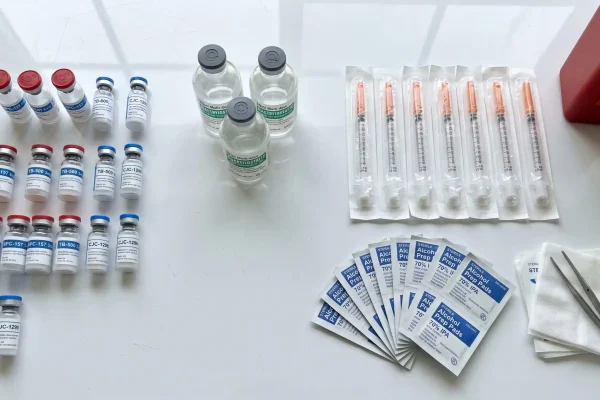
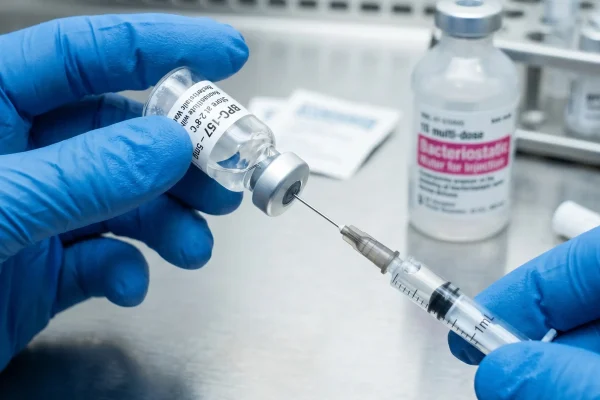
Reconstitution mistakes. Sounds basic, but people get this wrong. Never spray bacteriostatic water directly onto lyophilized powder. Aim it down the inside wall of the vial. Never shake the vial after reconstitution. Swirl gently. Small details, but they preserve peptide integrity and dose accuracy.
A few things separate the way we run peptides at Formation from what you’ll see at a typical wellness clinic.
First, we operate as a regenerative medicine clinic in Tampa with surgical credentials in the background. Dr. Grandhige is a board-certified general surgeon and spearheads the clinic’s peptide work from that medical foundation. We’re not running peptide protocols as a side service. They’re integrated with the regenerative medicine work we do day in and day out.
Second, Jeff Atlas, PA-C handles the actual injection appointments. Jeff came to Formation from orthopaedics, which means he’s done thousands of injections in technically demanding settings. That experience translates. Patients consistently tell us the injection appointments are calmer and more thorough at Formation than what they’ve experienced at GP clinics or wellness chains.
Third, we hold both SSRP certification and ISSCA certification. These organizations credential clinics specifically for working with peptides, exosomes, and stem cells. The certifications come with sourcing requirements, protocol standards, and ongoing review. Most clinics don’t hold either one. We hold both because regenerative medicine work demands that level of rigor.
Fourth, we don’t fast-track patients. Every peptide consultation at Formation includes a full medical history review, baseline bloodwork, goals conversation, and a frank discussion of whether peptides are the right tool for what the patient is trying to accomplish. Sometimes they aren’t. We’ve recommended patients work on diet and training for three months before coming back, and many of them do.
Tampa has plenty of clinics offering peptide injections. Most of them treat it like a transaction. We treat it like medicine, which means saying no when the patient isn’t ready, monitoring closely when they are, and adjusting protocols based on what bloodwork shows rather than what the patient wants to hear.
If you’re in Tampa and you want to talk through whether a MOTS-C stack makes sense for your situation, we’re happy to have that conversation. Bring your most recent bloodwork, a list of medications you’re on, and a clear sense of what you’re actually trying to accomplish.
Stacking MOTS-C with other peptides isn’t a shortcut. It’s a tool that works when the foundation underneath it is solid. Patients who get the best results from a MOTS-C and Retatrutide stack at Formation in Tampa are the ones who showed up already eating clean, training a few days a week, and tracking their own numbers. The peptides made their hard work pay off faster.
The ones who showed up looking for a substitute walked away unimpressed. That’s the honest pattern.
Yes, based on the available research. The two peptides hit different receptors and pathways, so there's no known direct interaction. Use separate injection sites, use separate syringes, and put several hours between them. Most patients at Formation handle this by injecting Retatrutide in the evening and MOTS-C the next morning. The gap helps identify any site-specific reactions.
Most patients report improved energy within 7 to 14 days of starting MOTS-C. Workout performance usually picks up by week three. Metabolic changes that show up in bloodwork (better fasting glucose, improved A1c, lower triglycerides) take 6 to 8 weeks to register. If you don't see anything by week 8, the dose is likely too low or the sourcing is suspect.
Yes. The pairings that hold up best involve peptides with different mechanisms. MOTS-C with growth hormone peptides like Sermorelin or Tesamorelin works well for body composition and recovery. MOTS-C with repair peptides like BPC-157 or TB-500 makes sense if you're dealing with both metabolic goals and a tissue or gut issue. Avoid stacking MOTS-C with multiple peptides that all hit similar receptors. That's where complications start.
No. MOTS-C works through AMPK signaling at the mitochondrial level. It does not interact with androgen receptors, estrogen receptors, or thyroid pathways. This is one of its biggest advantages as a stacking partner. You can add it to a protocol without introducing hormonal complications, which means no post-cycle therapy, no aromatase concerns, and no need to monitor sex hormone panels beyond what you'd already do routinely.
At Formation we run fasting glucose, A1c, complete lipid panel, liver enzymes (ALT, AST), complete blood count, and a basic metabolic panel as a baseline. Depending on the patient's history, we'll add fasting insulin, a thyroid panel, and inflammatory markers like hs-CRP. Repeat the same panel at week 8 and again at week 12 or whenever you finish the protocol. The trajectory matters more than any single reading.
It depends on the medication. Metformin and MOTS-C both activate AMPK, so combining them can push blood sugar down more than expected. Patients on insulin or sulfonylureas need close glucose monitoring on Retatrutide because hypoglycemia risk goes up. Patients on thyroid medication usually need no adjustment, but we check. Bring your full medication list to the consultation and we'll work through interactions one by one.
If you're a competitive athlete, no. MOTS-C is on the USADA and WADA prohibited substances list. For recreational training or general health optimization, it doesn't carry sport-specific implications, but if you compete in any sanctioned sport, this peptide is off the table for you.
Facial Harmonization Step 2
It takes more than one treatment and often more than one treatment session to accomplish facial harmony and balance.
Here’s a look at step 2 in the journey for our surgical coordinator Hanna.
She wanted to address asymmetry and fullness in the lower face. To accomplish this we’ve started with Botox in the masseter to slim the jaw, and create a more feminine, heart shaped face. Now for step 2 we’re placing PDO lifting threads to enhance definition around the jawline without adding volume.
Stay tuned for step 3 and click the link in our bio to set up a consultation to determine your next steps to achieve your aesthetic goals.
#facialbalancing #facialharmony #liftingthreads #beauty #tampa
Facial Harmonization Step 2
It takes more than one treatment and often more than one treatment session to accomplish facial harmony and balance.
Here’s a look at step 2 in the journey for our surgical coordinator Hanna.
She wanted to address asymmetry and fullness in the lower face. To accomplish this we’ve started with Botox in the masseter to slim the jaw, and create a more feminine, heart shaped face. Now for step 2 we’re placing PDO lifting threads to enhance definition around the jawline without adding volume.
Stay tuned for step 3 and click the link in our bio to set up a consultation to determine your next steps to achieve your aesthetic goals.
#facialbalancing #facialharmony #liftingthreads #beauty #tampa
...
Let’s talk filler placements! 👀
From standard touch-ups to total profile balancing, dermal filler is incredibly versatile. Check out the reel to see all the areas we can treat to enhance your natural beauty.
The secret to great filler? A customized plan. 🎨
👇 Take the next step:
DM us “CONSULT” or click the link in our bio to book your one-on-one consultation today. Let’s see what filler can do for you!
Let’s talk filler placements! 👀
From standard touch-ups to total profile balancing, dermal filler is incredibly versatile. Check out the reel to see all the areas we can treat to enhance your natural beauty.
The secret to great filler? A customized plan. 🎨
👇 Take the next step:
DM us “CONSULT” or click the link in our bio to book your one-on-one consultation today. Let’s see what filler can do for you!
...
The power of a profile transformation. 🔥
For this patient, we combined PDO Lifting Threads and advanced chin/jawline filler to completely redefine his lower face. By strategically lifting the mid-to-lower face and sculpting the jaw, we didn’t just enhance one feature—we elevated his entire facial appearance.
An incredible, natural-looking result that brings balance and confidence from every angle.
Note: Minor bunching or puckering is completely normal immediately following a PDO thread lift. The slight bunching visible in the after photo will fully subside on its own over the next 2-4 weeks as the threads settle.
#JawlineContouring #PDOThreads #FacialSculpting #JawlineFiller #mensaesthetics
The power of a profile transformation. 🔥
For this patient, we combined PDO Lifting Threads and advanced chin/jawline filler to completely redefine his lower face. By strategically lifting the mid-to-lower face and sculpting the jaw, we didn’t just enhance one feature—we elevated his entire facial appearance.
An incredible, natural-looking result that brings balance and confidence from every angle.
Note: Minor bunching or puckering is completely normal immediately following a PDO thread lift. The slight bunching visible in the after photo will fully subside on its own over the next 2-4 weeks as the threads settle.
#JawlineContouring #PDOThreads #FacialSculpting #JawlineFiller #mensaesthetics
...
Last week, we partnered with @epicutis for an exclusive evening of luxury, connection, and next-level skin. From complimentary skin analysis scans to good company and great vibes — this is what elevated beauty looks like. Thank you to everyone who joined us. 🥂
#Epicutis #Tampa
#LuxurySkicare #Emage #skingoals
Last week, we partnered with @epicutis for an exclusive evening of luxury, connection, and next-level skin. From complimentary skin analysis scans to good company and great vibes — this is what elevated beauty looks like. Thank you to everyone who joined us. 🥂
#Epicutis #Tampa
#LuxurySkicare #Emage #skingoals
...
Check out this incredible before and after of our gorgeous patient 6 months following her Female HD Liposculpture! ⏳
While these results are already stunning, here is a little insider secret: she’s not even at her final result yet! Healing from high-definition liposculpture is a journey. Over the next few months, residual swelling will continue to subside, and any temporary skin texture changes or minor discoloration will fully resolve. As the tissues settle, her skin will keep tightening to reveal even more crisp, beautifully defined athletic contours.
We love seeing our patients blossom through their recovery. Patience pays off, and her body will only continue to lean out and lock in over the coming months!
What do you think of her 6-month transformation? Drop a 👇 in the comments!
#BodyContouring #HDLipo #SkinTightening #PostOpHealing
Check out this incredible before and after of our gorgeous patient 6 months following her Female HD Liposculpture! ⏳
While these results are already stunning, here is a little insider secret: she’s not even at her final result yet! Healing from high-definition liposculpture is a journey. Over the next few months, residual swelling will continue to subside, and any temporary skin texture changes or minor discoloration will fully resolve. As the tissues settle, her skin will keep tightening to reveal even more crisp, beautifully defined athletic contours.
We love seeing our patients blossom through their recovery. Patience pays off, and her body will only continue to lean out and lock in over the coming months!
What do you think of her 6-month transformation? Drop a 👇 in the comments!
#BodyContouring #HDLipo #SkinTightening #PostOpHealing
...
PRP (Platelet-Rich Plasma) scalp injections use your own growth factors to reawaken dormant follicles, thicken existing strands, and naturally stimulate regrowth — no surgery, no downtime.
If you’ve been watching your part widen or your ponytail thin, this is your sign. 👇
📍Formation | Tampa
📞 Book your free consultation via the link in bio.
#PRPHairTreatment #HairRestoration #PRPScalpInjections #HairLossSolution #HairGrowth
PRP (Platelet-Rich Plasma) scalp injections use your own growth factors to reawaken dormant follicles, thicken existing strands, and naturally stimulate regrowth — no surgery, no downtime.
If you’ve been watching your part widen or your ponytail thin, this is your sign. 👇
📍Formation | Tampa
📞 Book your free consultation via the link in bio.
#PRPHairTreatment #HairRestoration #PRPScalpInjections #HairLossSolution #HairGrowth
...
Did you know that you can snatch your jaw with Botox?
Use the link in our bio to schedule a consultation so we can discuss all of the ways injectables can benefit YOU
#nefertitilift #botox #tampa
Did you know that you can snatch your jaw with Botox?
Use the link in our bio to schedule a consultation so we can discuss all of the ways injectables can benefit YOU
#nefertitilift #botox #tampa
...
This patient’s transformation showcases the power of combining procedures:
High-Definition Liposculpture + Renuvion® skin tightening with fat transfer to the chest.
HD Lipo goes beyond traditional liposuction to sculpt and define the underlying muscle anatomy, while Renuvion uses helium plasma energy to tighten the skin from the inside out. The fat transfer to the chest adds natural volume and projection for a truly athletic contour.
The work is done. The confidence is his. 💪
📍 Formation Tampa
📲 Book your consultation via the link in bio.
#HDLipo #HighDefinitionLiposuction #Renuvion #BodySculpting #FatTransfer MaleBodyContouring
This patient’s transformation showcases the power of combining procedures:
High-Definition Liposculpture + Renuvion® skin tightening with fat transfer to the chest.
HD Lipo goes beyond traditional liposuction to sculpt and define the underlying muscle anatomy, while Renuvion uses helium plasma energy to tighten the skin from the inside out. The fat transfer to the chest adds natural volume and projection for a truly athletic contour.
The work is done. The confidence is his. 💪
📍 Formation Tampa
📲 Book your consultation via the link in bio.
#HDLipo #HighDefinitionLiposuction #Renuvion #BodySculpting #FatTransfer MaleBodyContouring
...
Six months post extended abdominoplasty, and we are loving these seamless, natural results. By focusing on feminine contours and a refined waistline, we achieved a silhouette that looks as good as it feels.
Proof that surgery can—and should—look effortless.
#NaturalResults #Abdominoplasty #BodyTransformation #Tampa #tummytuck
Six months post extended abdominoplasty, and we are loving these seamless, natural results. By focusing on feminine contours and a refined waistline, we achieved a silhouette that looks as good as it feels.
Proof that surgery can—and should—look effortless.
#NaturalResults #Abdominoplasty #BodyTransformation #Tampa #tummytuck
...
Lift, tighten, and refresh — without going under the knife. ✨ PDO thread lifts are one of the most effective non-surgical treatments for restoring structure to the face. They stimulate collagen production, improve skin texture, and deliver natural-looking results that keep getting better over time. Ready to turn back the clock? Drop your questions below 👇
#PDOThreads #ThreadLift #NonSurgicalLift #CollagenBoost #antiaging
Lift, tighten, and refresh — without going under the knife. ✨ PDO thread lifts are one of the most effective non-surgical treatments for restoring structure to the face. They stimulate collagen production, improve skin texture, and deliver natural-looking results that keep getting better over time. Ready to turn back the clock? Drop your questions below 👇
#PDOThreads #ThreadLift #NonSurgicalLift #CollagenBoost #antiaging
...
References:
Reynolds, J. C., Lai, R. W., Woodhead, J. S. T., Joly, J. H., Mitchell, C. J., Cameron-Smith, D., Lu, R., Cohen, P., Graham, N. A., Benayoun, B. A., Merry, T. L., & Lee, C. (2021). MOTS-c is an exercise-induced mitochondrial-encoded regulator of age-dependent physical decline and muscle homeostasis. Nature Communications, 12(1), 470. https://doi.org/10.1038/s41467-020-20790-0
Weng, F. B., Zhu, L. F., Zhou, J. J., & Shan, Y. Y. (2023). Mitochondria-derived peptide MOTS-c: Effects and mechanisms related to stress, metabolism and aging. Journal of Translational Medicine, 21(1), 36. https://doi.org/10.1186/s12967-023-03885-2
Li, H., Ren, K., Jiang, T., & Zhao, G. J. (2023). MOTS-c: A promising mitochondrial-derived peptide for therapeutic exploitation. Frontiers in Endocrinology, 14, 1120533. https://doi.org/10.3389/fendo.2023.1120533
Lee, C., Zeng, J., Drew, B. G., Sallam, T., Martin-Montalvo, A., Wan, J., Kim, S. J., Mehta, H., Hevener, A. L., de Cabo, R., & Cohen, P. (2015). The mitochondrial-derived peptide MOTS-c promotes metabolic homeostasis and reduces obesity and insulin resistance. Cell Metabolism, 21(3), 443–454. https://doi.org/10.1016/j.cmet.2015.02.009
Merry, T. L., Chan, A., Woodhead, J. S. T., Reynolds, J. C., Kumagai, H., Kim, S. J., & Lee, C. (2020). Mitochondrial-derived peptides in energy metabolism. American Journal of Physiology-Endocrinology and Metabolism, 319(4), E659–E666. https://doi.org/10.1152/ajpendo.00249.2020
Peptides optimize the effort you are putting in. Get a FREE 15-minute Virtual Protocol Review + our Regenerative Treatment Newsletter.
We’ll show you exactly how we evaluate candidacy — plus, we cover the cost of your baseline labs with all in-person consults ($100).