

loader image

Botox In Oldsmar, FL

Botox, a brand of botulinum toxin type A, relaxes the small muscles that crease your forehead, pull your brows together and fan lines out from the corners of your eyes. While those muscles rest, the creases soften and stop deepening. For Oldsmar patients, every plan starts with how your face moves, not with a unit count from a package.

What Botox Does And What A Unit Count Covers

Botox blocks the signal a nerve sends to the muscle it controls. A muscle that can’t fire hard stops folding the skin above it. The effect starts within a day or two, builds through the first week and gets judged at two weeks.

Every dose is counted in units. The drug’s prescribing information sets a standard dose for each approved upper-face area:

  • Frown lines between the brows: 20 units across five points.
  • Crow’s feet: 24 units, 12 on each side.
  • Forehead lines: 20 units, always given with the 20 for frown lines, for 40 total.
  • All three areas in one session: 64 units.

That arithmetic matters when you compare unit packages. A package of 20 units covers the labeled dose for frown lines and nothing more. Spread it across three areas and each one gets less than the trials used.

Units don’t travel between brands either. The label says Botox units can’t be compared to or converted into the units of any other botulinum toxin. Every treatment at Formation starts from a fresh read of your muscles, not a figure carried over from another clinic’s chart.

Why Forehead Lines Are Treated With Frown Lines

The label pairs forehead lines with frown lines to lower the chance of a dropped brow. Your forehead muscle is the only one lifting your brows. Relax it while the muscles pulling them down keep working, and the brows can sag. Even with the pairing, 2% of patients in the forehead trials had a drooping brow and 9% had a headache.

Why Some Results Fade Before Three Months

Botox wears off gradually. In the trials, more than half of patients no longer met the bar for success by day 90, even at the full labeled dose.

The frown-line trials behind the drug’s approval show the curve. Investigators rated 80% of treated patients as responders at day 30, 70% at day 60, 48% at day 90 and 25% at day 120. Patients judged themselves more generously: 63% still reported at least moderate improvement at day 90.

Those numbers come with limits. They reflect one treatment, a strict bar for success (lines graded none or mild at a full frown) and a trial group that was 82% women. Plan your calendar around the middle of the curve, not its tail.

If a past treatment seemed gone in six weeks, check three things:

  1. Your dose against your muscle strength. The label tells injectors to set the dose by watching how hard each muscle fires. In the same trials, 85% of women and 59% of men responded at day 30, one reason Botox for men is planned differently.
  2. Whether the line moves at all. A crease still visible with your face fully relaxed has moved into the skin, and no dose of toxin reaches it.
  3. Which brand you had. One maker’s unit isn’t another’s, so the same number on two receipts can describe two different doses.

Early top-ups aren’t the fix. The label says dosing more often than every three months hasn’t been studied. It also notes that more frequent or higher doses may raise the odds of forming antibodies to the toxin, and it advises the lowest dose that works at the longest practical interval. In the crow’s feet trials, 1.5% of patients formed binding antibodies and none formed the neutralizing kind that can blunt the effect.

A Surgeon-Led Read On Your Face

Every plan at Formation starts with a surgeon’s assessment. Dr. Gopal Grandhige is a board-certified general surgeon who specializes in aesthetic surgery.

He trained at the University of Michigan Medical School and matched into Yale’s six-year combined plastic surgery residency before pivoting to a full general surgery residency. Fellowship training followed in burn surgery, critical care, and minimally invasive metabolic and foregut surgery. He has practiced in Tampa for more than 15 years and performed several thousand procedures.

That training centers on how tissue behaves under stress and how it heals. It also shapes how he talks to patients. He would rather tell you to wait, or to change course, than sell you a treatment that won’t help. Read more about Dr. Grandhige’s training and background.

Dr. Ahmad Saad, a board-certified plastic surgeon, is also part of the Formation team. Injectables are placed in-office under physician oversight.

Man at a Botox consultation in a Palma Ceia South Tampa studio

What Oldsmar's Age Profile Means For Your Plan

Oldsmar’s age profile points to a long treatment horizon. At the 2020 census count, the city had 14,898 residents and a median age of 41.7, with 16.5% aged 65 or older.

A 40-year-old who keeps a result going could be treated three or four times a year for two decades. That long horizon is why the antibody guidance above matters here. Keep a written record of every session: brand, units, areas and date. The drug’s Medication Guide asks patients to tell their doctor about any botulinum toxin received in the last four months and to know exactly which product it was.

For the one resident in six who is past 65, the label adds a caution. In all three upper-face trials, responder rates appeared lower in patients 65 and older. Only 6% of the frown-line trial patients were in that age group, so the finding shapes the plan rather than ruling anyone out.

What Botox Can And Can't Do For The Neck

Botox can soften the vertical cords that appear when you tense your neck. It can’t tighten loose skin or remove fat under the chin. Most necks show aging in more than one layer at once, and each layer needs its own answer.

The cords are platysmal bands, made by the platysma, a thin sheet of muscle across the front of the neck. Since October 2024, Botox Cosmetic has been FDA-approved for moderate to severe platysmal bands, its first approved use below the face. The labeled dose is 26, 31 or 36 units, depending on how many bands show on each side.

Patients in the approval trials ranged from 19 to 82 years old. At day 14, about a third met the strictest measure: the investigator and the patient both graded the bands minimal or mild, at least two grades better than before. When bands are the main problem and keep returning, the surgical answer is MyEllevate, a permanent suspension suture, combined with platysmaplasty.

Loose skin is another layer. FaceTite in Oldsmar, a radiofrequency-assisted tightening device, suits neck and jawline skin that still has some elasticity, roughly skin ages 25 to 55. Fat under the chin is a third layer. One Formation patient, a professional in his 40s who had always disliked how his neck looked in photos, was treated with neck liposuction and jawline contouring. Afterward he felt his neck matched the rest of his body, and he started getting into pictures again.

Anyone beyond what tightening or contouring can reach is referred out. Formation stays in contact with surgeons who do facelift-level work well and points patients to the right one.

What Gets Assessed Before And Adjusted After

Health and diet are assessed before treatment. Nutrition, supplements and peptides are then adjusted in the window right before and after, so your body builds the most structure it can.

With toxin alone, that window matters less. Once a plan adds filler, tightening or surgery, it matters a lot, because the result depends on what your own tissue does in the months that follow. For surgery, Dr. Grandhige splits the result 60/40: the operation accounts for 60% and post-operative care for 40%. That’s the 60/40 Recovery Standard, and it’s why Formation owns its post-operative care. Formation’s philosophy treats any single procedure as one step in a longer plan.

The medication review gets specific. The label flags two kinds of medicine that can strengthen the toxin’s effect: aminoglycoside antibiotics and muscle relaxants. It also calls for caution with existing heart disease and neuromuscular conditions such as myasthenia gravis. Bring your full list, including blood thinners, aspirin-type products and any sleep or allergy medicine.

The vial is identical at every practice that orders it. The thinking around it isn’t.

When Botox Isn't The Right Tool

Botox relaxes muscle. It doesn’t add volume, lift sagging tissue or reach lines already set into resting skin.

Oldsmar sits at the top of Old Tampa Bay. Squinting into glare off the water is a movement, which puts those lines in Botox territory. Years of sun on the same skin are a different problem. Check in a mirror with your face completely relaxed. Any line still visible at rest has moved into the skin itself and calls for resurfacing or filler rather than more toxin.

A chin that’s lost projection, or a jaw angle that’s softened, is a structure problem. That’s the job of jawline fillers using Radiesse, a calcium hydroxylapatite, or Juvederm, a hyaluronic acid. A measured first dose, judged at two weeks, is the safer start.

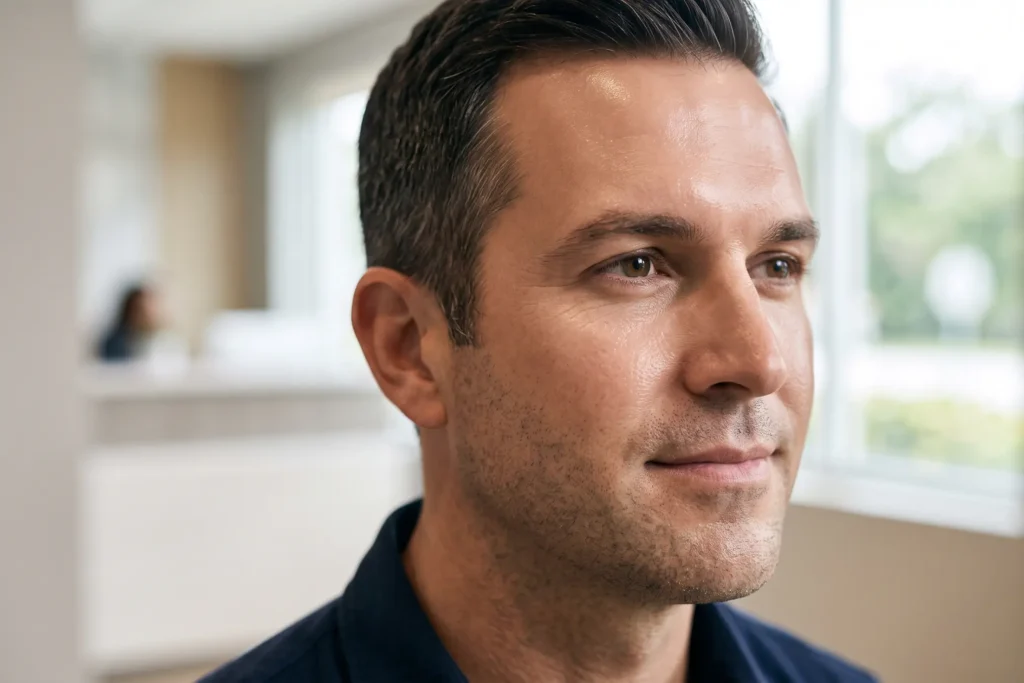
Man with a natural, well-rested look after Botox near Live Oaks Square, Tampa

The Formation Natural-Look Standard

Every plan for Botox treatment in Tampa at Formation has to pass three checks before anything goes into a syringe. Rested versus obvious is a judgment call, and the checks make that judgment visible.

The Expression Check

Your face is read while it moves: talking, smiling, lifting your brows. A forehead that’s working to hold up heavy brows gets a lighter touch than one that isn’t, or the brows drop.

The Recognition Check

Coworkers on Monday’s video call should think you slept well. Nobody should ask what you had done.

The Proportion Check

Each change is judged against the rest of your features. A balanced change reads as you on a good day. An unbalanced one draws the eye, however small it is.

Across every procedure at Formation, the fear patients raise most is that the result won’t look natural. Many say it to the staff rather than to Dr. Grandhige. The staff pass it along, so it gets answered without the patient having to bring it up twice.

Your fat is liquid gold.The fat you don’t want might be exactly what another part of your body needs.During liposuction, the fat we remove doesn’t always have to be discarded. In fact, Dr. Gopal refers to it as “liquid gold.”Why? Because that fat can sometimes be transferred to another area of the body to add volume, enhance natural contours, and create a more balanced shape.For women, that might mean adding volume to the breasts, hips, or buttocks. For men, fat transfer can help enhance the chest or shoulders.And because we’re using your own fat, we can potentially improve two areas during the same surgery.Of course, fat transfer isn’t right for everyone. It’s something Dr. Gopal discusses with patients beforehand and incorporates into the surgical plan when appropriate.Considering liposuction in Tampa? Schedule a consultation with Dr. Gopal at Formation to explore your body contouring options.#TampaLiposuction #FatTransfer #BodyContouring

27 0
A flatter stomach without a tummy tuck? 👀Pregnancy, and sometimes increased pressure from fat deep inside the abdomen, can cause the abdominal muscles to separate down the middle. This is called diastasis recti, and it can make your belly stick out even if you’re otherwise lean.Traditionally, repairing that separation often meant undergoing a tummy tuck. But what if you don’t have much loose skin to remove?For the right patient, Dr. Gopal can use robotic-assisted surgery to bring those separated muscles back together through three small incisions, without the long scar associated with a traditional tummy tuck.That’s exactly what he did for the patient in these before-and-after photos. No tummy tuck. No additional procedures.**But this approach isn’t for everyone.** If you have significant loose skin or excess fat, a different treatment may be more appropriate. That’s why understanding what’s causing your belly to protrude matters before deciding on surgery.Curious whether you’re a candidate? DM us or schedule a consultation with Dr. Gopal at Formation Tampa. Link in bio.Actual patient results. Individual results vary.#DiastasisRecti #MuscleSeparation #DiastasisRectiRepair #RoboticSurgery #Tampa

18 0
Why does fluid sometimes collect after surgery?After certain surgical procedures, fluid can accumulate beneath the skin, forming what’s called a seroma.In this video, Dr. Gopal demonstrates how he drains a seroma in a patient recovering from diastasis recti repair.This is one of the reasons postoperative follow-up matters. It allows Dr. Gopal to monitor healing, identify any issues, and address them when necessary.Considering surgery? DM us to schedule a consultation with Dr. Gopal at Formation Tampa.#DiastasisRecti #Seroma #TampaSurgeon #AbdominalMuscleRepair

35 2
The fat is gone. But what takes its place?When fat is removed during liposuction, it leaves behind space beneath the skin. As the body heals, fluid can sometimes collect in that space, creating what’s called a seroma.And here’s why that matters.If fluid continues to collect, it can potentially affect the final contour.That’s why Dr. Gopal pays close attention to fluid buildup during recovery. His approach is to identify seromas early and address them quickly.Considering liposuction in Tampa? Schedule a consultation with Dr. Gopal at Formation to learn more.#Liposuction #Seroma #BodyContouring

55 5
From medical weight loss to body contouring, her transformation was approached as a journey, not just a single procedure.This patient started with a personalized medical weight loss program at Formation, working with Dr. Gopal to achieve significant weight loss. Once she reached her goal, Dr. Gopal performed a tummy tuck to remove excess abdominal skin and refine her contour.Considering medical weight loss or a tummy tuck? Schedule a consultation with Dr. Gopal at Formation Tampa. Link in bio.Actual patient results. Individual results vary.

9 2
Not every patient who wants surgery is ready for it.One patient came to Dr. Gopal wanting a tummy tuck. Over the next 18 months, she returned multiple times, having lost more weight each time. And each time, the answer was still no.Not because she couldn’t have the surgery, but because she wasn’t where she wanted to be yet.Instead of rushing into surgery, the focus was on helping her reach a healthier, more sustainable weight through nutritional counseling, lifestyle support, and medical weight management.By the time she had lost 80 pounds, she was ready, both physically and mentally.For Dr. Gopal, being a good surgeon isn’t just about knowing how to perform a procedure. It’s also about knowing when not to perform one.Sometimes the best result starts long before the operating room.Considering a tummy tuck? DM us to schedule a consultation with Dr. Gopal at Formation Tampa.#Tampa #TummyTuck #BodyContouring

68 5
Six hours. Hundreds of decisions.High-definition liposuction is as much about precision as it is about technique.Dr. Gopal can spend 6–7 hours on a single HD liposuction procedure, carefully evaluating the body’s anatomy, refining muscle definition, and making sure each contour transitions naturally into the next.And that level of attention doesn’t change as the hours go by.Because the final result is shaped by hundreds of small decisions made throughout the procedure.Considering HD liposuction in Tampa? Schedule a consultation with Dr. Gopal Grandhige at Formation Tampa.#HDLiposuction #HighDefinitionLiposuction #MaleLiposuction #TampaPlasticSurgery #BodyContouring

23 2
Which one surprised you the most? 👀Liposuction is one of those procedures people have heard a lot about, but not everything they’ve heard is accurate.From what liposuction can actually achieve to how long results take to develop, there are plenty of misconceptions that can lead to unrealistic expectations.Dr. Gopal Grandhige, board-certified plastic surgeon at Formation in Tampa, breaks down some of the most common beliefs about liposuction and explains what’s fact and what’s fiction.#Liposuction #HDLiposuction #BodyContouring #tampa

95 2

How To Vet Any Injector, Formation Included

Ask the same questions anywhere you’re considering treatment. Clear answers are a good sign.

  1. Which brand are you getting, and how many units go to each area? Compare the answer with the labeled doses above.
  2. Ask to see the vial. Botox Cosmetic vials and cartons carry U.S. License number 1889. The label says not to use the product if that number is missing or the tamper-evident seals look broken.
  3. Look up the injector’s license. For an MD, that’s the Florida Board of Medicine.
  4. Before-and-after photos should show someone who still looks like themselves in the after. That’s the same test Dr. Grandhige gives patients choosing a surgeon.

His broader advice holds here too: look for the injector who is right for you rather than the one with the loudest marketing.

Getting Here From Oldsmar

Formation is at 1315 South Howard Avenue in Tampa’s Hyde Park, about 13 miles southeast of Oldsmar as the crow flies. Take State Road 580 east out of Oldsmar, where it becomes Hillsborough Avenue, and pick up the Veterans Expressway south past Tampa International Airport. Then follow Kennedy Boulevard east through Westshore and turn south on Howard Avenue. Plan on 25 to 35 minutes outside rush hour.

Formation sees patients Monday through Friday, 9 a.m. to 5 p.m., with no weekend appointments. If Saturday is the only day that works, a practice closer to home may be the practical choice, as long as it passes the questions above.

Keeping a result means three or four visits a year. If your workday already runs through Westshore, Hyde Park is a short hop further east on Kennedy Boulevard. A midday slot keeps you out of commute traffic both ways.

The drive pays off most when more than one thing is changing. A Botox visit can sit alongside a conversation about neck and jawline contouring, filler or tightening. One surgeon reads the whole face.

Frequently Asked Questions About Botox In Oldsmar

About three to four months, fading gradually rather than stopping at once. In the frown-line trials, fewer than half of treated patients still met the investigators' bar for success at day 90, so most people notice some movement returning before the four-month mark.

Check three things: whether the dose matched your muscle strength, whether the lines were partly etched into the skin, and which brand was used, since units differ between brands. Bring the brand, units, areas and date of your last treatment so your plan starts from facts.

The label's standard doses are 20 units for frown lines, 24 for crow's feet, 40 for forehead and frown lines together, and 64 for all three areas. Your actual dose is set by watching how your muscles move, and men's plans often differ from women's.

Dosing more often than every three months hasn't been studied, and frequent or higher doses may raise the chance of forming antibodies to the toxin. The safer habit is spacing treatments at least three months apart and judging each one at two weeks.

No. Formation sees patients Monday through Friday, 9 a.m. to 5 p.m. A midday appointment keeps the drive from Oldsmar clear of the worst commute traffic.

It can soften moderate to severe platysmal bands, the vertical cords that show when you tense your neck. It can't tighten loose skin or remove fat under the chin, which call for tightening or contouring.

They should notice you look rested, not that something was done. Every plan has to pass the Formation Natural-Look Standard's expression, recognition and proportion checks before anything is injected.

The in-office consultation with Dr. Grandhige carries a fee and is a full surgical assessment, and the fee can be applied toward any procedure or product at the practice. Formation also offers a complimentary virtual evaluation with patient coordinator Hanna, who reviews your goals and outlines a plan before you decide to come in.

Where To Start From Oldsmar

You can start without leaving Oldsmar. Formation offers a complimentary virtual evaluation with patient coordinator Hanna, who reviews your goals and outlines a plan before you make the drive. The in-office consultation with Dr. Grandhige carries a fee and is a full surgical assessment, and that fee can be applied toward any procedure or product at the practice.

Before either one, gather three things:

  • The brand, units and dates of any past toxin treatments.
  • Your full medication list.
  • A short phone video of the lines you want softened while you frown, squint and raise your brows.

Movement is what gets treated, so movement is what the plan is built on.