loader image

PDO Thread Lift In Sun City Center, FL

A PDO thread lift repositions a softening jawline and upper neck in about an hour, without an operation and without general anesthesia. The lift is there when you stand up from the chair. At Formation, a board-certified general surgeon places the threads and will tell you plainly when threads are the wrong instrument for your anatomy. In this community, that second part matters more than the first.

What A PDO Thread Lift Does, And What It Does Not

A thread lift moves tissue. It removes nothing and it builds nothing. That one sentence sorts most people into the right treatment before they book anything.

PDO is polydioxanone, an absorbable suture material used in surgery for decades. Threads enter through a few small points along the jawline, jowls and upper neck. Barbs along each thread catch loose tissue, carry it where it should sit, and hold it there. The entry points close on their own.

The result runs on two clocks. The mechanical lift fades as the threads dissolve, and most patients describe it holding for roughly 12 to 18 months. The second half comes from your own tissue, because threads provoke the fibroblasts that lay down collagen and elastin, so skin quality keeps improving for about six months. Your physiology decides how much of that second half you get, which is why the weeks around your appointment matter more than most clinics admit.

If your concern sits along the jaw line rather than the whole lower face, a jawline thread lift treats that single line with fewer threads and a shorter appointment.

One note on the label, because most pages in this market get it wrong. PDO threads reach the United States market as Class II devices through the 510(k) clearance pathway. That is clearance, not approval, and the wording is not uniform. Several PDO barbed sutures are cleared for soft tissue approximation, with the summary stating the suture is not intended for lifting and supporting tissues. Look up your device in the FDA 510(k) database before your appointment.

The Four-Layer Neck Read, And Where Threads Fit

Most necks show aging in more than one layer at once, and threads reach only one of them. Formation screens every neck and jawline patient with the Four-Layer Neck Read before anything gets scheduled. It takes a few minutes in the exam chair and it decides the plan.

Layer One, Fat

Pinch the tissue under your chin and ask what you are holding. A soft pad of fat means threads are the wrong instrument, because threads move tissue and remove nothing. Fat under the chin responds to chin and neck liposuction. Most people who walk in asking for threads belong here, and most clinics place the threads anyway.

Layer Two, The Platysma

Vertical cords that stand out when you tense your neck are platysmal bands, and threads do not touch muscle. Bands call for MyEllevate with platysmaplasty, a permanent suspension suture paired with a muscle repair. A PDO thread dissolves, a MyEllevate suture does not, and the permanent one can be removed if it ever needs to come out.

Layer Three, Skin

Skin that has lost its snap is the layer threads work on, within limits, because they reposition skin more than they tighten it. When the skin itself needs heat to contract, FaceTite jawline tightening, a radiofrequency device that works from under the skin rather than across the surface, reaches deeper than any suspension. Threads perform well roughly from skin age 25 to 55, and a good share of Sun City Center residents sit past the far end of that.

Layer Four, Chin Projection And Jaw Angle

A weak chin or a soft jaw angle is a structure problem, not a laxity problem. Formation applies the Add-or-Subtract Rule here: decide whether the jawline needs something taken away or something put in, because the two answers use opposite instruments. No thread builds a superhero jawline out of a recessed chin. Structural filler does. Radiesse, a calcium hydroxylapatite, and Juvederm, a hyaluronic acid, add projection along the chin and jaw, and many patients get more from chin and jawline filler than from any lift.

Clear layers one, two and four, land inside layer three, and you are a strong candidate. Fail layer one or layer two and threads will disappoint you no matter who places them.

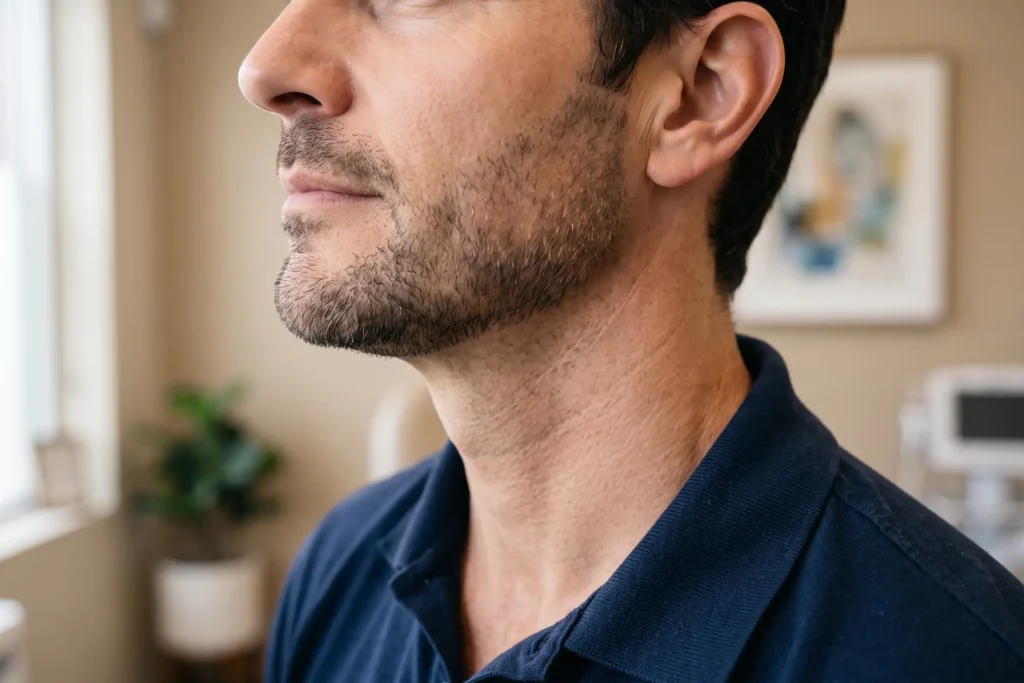
Man's firm jawline showing PDO thread results over time at a Tampa clinic
Which one had surgery 1 or 2? 👀High-definition liposuction goes beyond traditional fat removal. Instead of simply reducing fat evenly, the surgeon strategically removes fat around the underlying muscles to make their natural contours more visible.But here’s what makes it interesting: HD lipo doesn’t create the same six-pack on everyone. Each person’s anatomy, muscle development, and desired level of definition influence the final result.Now take another look at these two patients.Which one do you think had HD liposuction, 1 or 2?Drop your guess below, then check the pinned comment for the answer!#HDLiposuction #MaleLiposuction #BodyContouring #Tampa

15 5
There’s a story behind every decision.Cosmetic surgery is a personal decision. Yet people who choose it often find themselves having to explain or defend that choice to others.Some want to restore changes after pregnancy or weight loss. Others have worked hard to get in shape but still have areas they’d like to improve. And some simply want to feel more comfortable with their appearance.The reasons are different for everyone. And they don’t have to make sense to anyone else.At Formation, Dr. Gopal believes the decision to pursue cosmetic surgery should be guided by a patient’s personal goals, realistic expectations, and what’s medically appropriate for them.Because ultimately, the person making that decision is the one who will live with it.#Tampa #CosmeticSurgery #BodyContouring #Liposuction

26 4
Our first four-legged patient. 🐾Dr. Gopal takes his liposuction and body contouring very seriously.Even when his patients have four legs.From loose skin and neck liposuction to a jawline that deserves its own before-and-after reveal, this might be his most dramatic transformation yet.And yes, he even got the patient’s permission to share the results. 😂A little Halloween fun from Dr. Gopal and his two very patient pups! 🎃🐶No dogs underwent surgery. Just two willing participants and one very committed surgeon.#SurgeonLife #tampa #necklipo

106 25
What weight loss can’t fix.After losing over 100 pounds, this patient had achieved significant weight loss, but was left with excess skin around his abdomen and back that weight loss alone couldn’t address.During an 8-hour surgery, Dr. Gopal performed a circumferential body lift, a procedure that removes excess skin around the entire midsection to improve body contour.In this video, Dr. Gopal walks through the procedure, explaining how he removed approximately 3 pounds of skin from the back and estimated another 4–5 pounds would be removed from the abdomen.He’s also using a small amount of fat collected during the procedure to add volume to the upper chest, improving its contour without performing a separate chest lift.For patients who have experienced major weight loss, body contouring can help address the excess skin that remains after the weight is gone.Considering surgery after weight loss? Schedule a consultation with Dr. Gopal at Formation in Tampa to explore your options.Actual patient footage. Individual results vary.#BodyContouring #BodyLift #ExcessSkinRemoval

46 0
Your fat is liquid gold.The fat you don’t want might be exactly what another part of your body needs.During liposuction, the fat we remove doesn’t always have to be discarded. In fact, Dr. Gopal refers to it as “liquid gold.”Why? Because that fat can sometimes be transferred to another area of the body to add volume, enhance natural contours, and create a more balanced shape.For women, that might mean adding volume to the breasts, hips, or buttocks. For men, fat transfer can help enhance the chest or shoulders.And because we’re using your own fat, we can potentially improve two areas during the same surgery.Of course, fat transfer isn’t right for everyone. It’s something Dr. Gopal discusses with patients beforehand and incorporates into the surgical plan when appropriate.Considering liposuction in Tampa? Schedule a consultation with Dr. Gopal at Formation to explore your body contouring options.#TampaLiposuction #FatTransfer #BodyContouring

27 0
A flatter stomach without a tummy tuck? 👀Pregnancy, and sometimes increased pressure from fat deep inside the abdomen, can cause the abdominal muscles to separate down the middle. This is called diastasis recti, and it can make your belly stick out even if you’re otherwise lean.Traditionally, repairing that separation often meant undergoing a tummy tuck. But what if you don’t have much loose skin to remove?For the right patient, Dr. Gopal can use robotic-assisted surgery to bring those separated muscles back together through three small incisions, without the long scar associated with a traditional tummy tuck.That’s exactly what he did for the patient in these before-and-after photos. No tummy tuck. No additional procedures.**But this approach isn’t for everyone.** If you have significant loose skin or excess fat, a different treatment may be more appropriate. That’s why understanding what’s causing your belly to protrude matters before deciding on surgery.Curious whether you’re a candidate? DM us or schedule a consultation with Dr. Gopal at Formation Tampa. Link in bio.Actual patient results. Individual results vary.#DiastasisRecti #MuscleSeparation #DiastasisRectiRepair #RoboticSurgery #Tampa

18 0
Why does fluid sometimes collect after surgery?After certain surgical procedures, fluid can accumulate beneath the skin, forming what’s called a seroma.In this video, Dr. Gopal demonstrates how he drains a seroma in a patient recovering from diastasis recti repair.This is one of the reasons postoperative follow-up matters. It allows Dr. Gopal to monitor healing, identify any issues, and address them when necessary.Considering surgery? DM us to schedule a consultation with Dr. Gopal at Formation Tampa.#DiastasisRecti #Seroma #TampaSurgeon #AbdominalMuscleRepair

36 2
The fat is gone. But what takes its place?When fat is removed during liposuction, it leaves behind space beneath the skin. As the body heals, fluid can sometimes collect in that space, creating what’s called a seroma.And here’s why that matters.If fluid continues to collect, it can potentially affect the final contour.That’s why Dr. Gopal pays close attention to fluid buildup during recovery. His approach is to identify seromas early and address them quickly.Considering liposuction in Tampa? Schedule a consultation with Dr. Gopal at Formation to learn more.#Liposuction #Seroma #BodyContouring

56 5

What Age And Thread Count Do To Your Odds

Sun City Center is the specific reason this section exists. At the 2020 census the community median age was 70.4 and 63.8 percent of residents were 65 or older. The largest study of thread lift complications ever published measures risk by exactly that variable, and no clinic page serving this ZIP code puts the two together.

A multicenter analysis of 2,000 PDO thread lift cases across 105 clinics, published in Aesthetic Plastic Surgery in June 2026, put the overall complication rate at 12.4 percent. Skin retraction led at 6.35 percent, followed by asymmetry at 2.9 percent and pain at 1.75 percent. Two variables predicted trouble independently. Each additional thread raised the odds by roughly 12 percent. Age raised them steeply: against patients under 40, the odds ran about twice as high at 40 to 49, more than three times as high at 50 to 59, and roughly five times as high at 60 and over.

That does not put threads off the table after 60. It means thread count stops being a menu choice and becomes a clinical decision, and a provider treating a 68-year-old the way they treat a 42-year-old is ignoring the variable the data says matters most.

Two limitations belong beside those numbers. All 105 clinics sit inside one Japanese cosmetic surgery network, which is what makes the data consistent and also what limits how far it travels. And it is a retrospective chart review, not a trial. Treat the pattern as real and the percentages as a range.

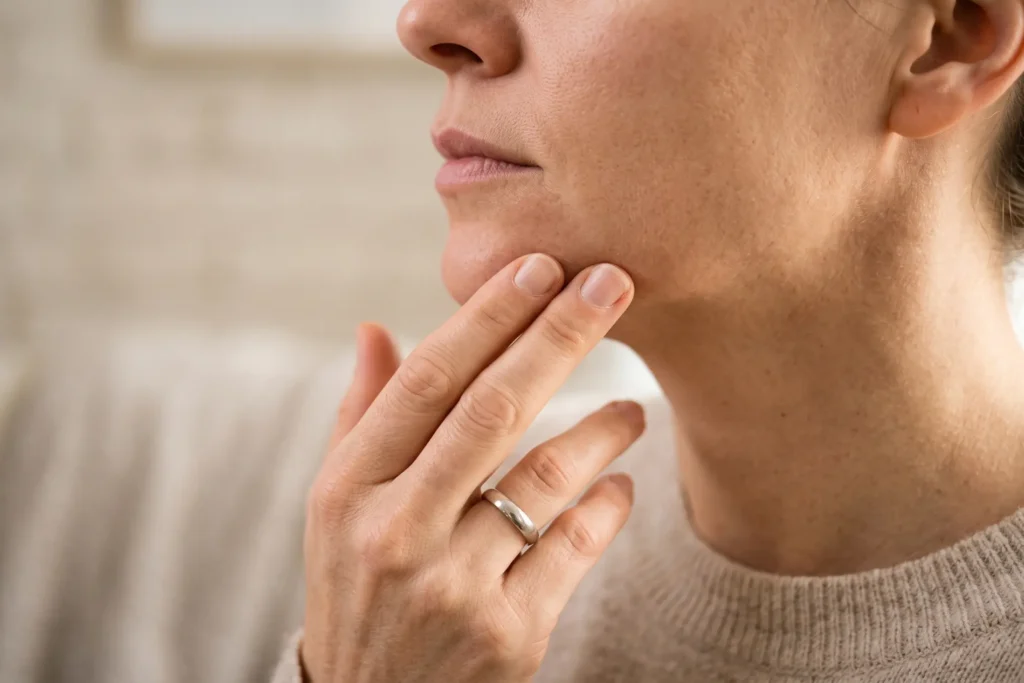
Patient checking under the jawline to feel a PDO thread after treatment

How Formation Prepares You Before The Threads Go In

The second half of a thread result is collagen your body has to build, so Formation treats the weeks around your appointment as part of the procedure.

Your health and diet are assessed before anything is placed. Protein intake, inflammation, sleep and current supplements all get reviewed. Nutrition, supplements and peptides are then adjusted in the window immediately before and after the appointment, so your tissue builds the most structure it can while the threads hold it in position. Dr. Gopal Grandhige has run his surgical practice this way for years, and the reasoning carries straight across to threads.

Formation works to a 60/40 standard. Placement is 60 percent of the result and aftercare is the other 40. Poor aftercare can undo well-placed threads, and good aftercare cannot rescue bad placement.

The threads themselves are the same product every practice buys. The instrument is identical across this market. The thinking around it is not.

The Drive From Sun City Center, And The Golf Cart Problem

Formation sits on South Howard Avenue in South Tampa, roughly 25 to 30 miles north of Sun City Center. Leave by Sun City Center Boulevard, take I-75 north, and cut west on the Selmon Expressway. Budget about 40 minutes, longer on a weekday morning.

Before you spend a morning on the interstate, Formation offers a complimentary virtual evaluation with patient coordinator Hanna, who reviews your goals and outlines a plan remotely. The in-office consultation with Dr. Grandhige carries a fee, runs as a full surgical assessment rather than a sales meeting, and that fee can be applied toward any procedure or product at the practice.

Then there is the part nobody else in this market will raise. Sun City Center runs on golf carts, and they are street legal on community roads during daylight hours only. Every cart trip happens in direct sun, in an open vehicle, with nothing overhead filtering anything. Ultraviolet exposure degrades collagen, and collagen is the exact material the second half of your thread result depends on. For the first two weeks after placement that becomes a scheduling question rather than a footnote. Run errands early or late, keep a wide-brim hat and broad-spectrum protection in the cart, and take the car when the trip is long.

Bruising along the jaw peaks in the first three days and takes one to three weeks to clear. With five golf courses inside the community and a club roster covering almost every interest, something usually lands within three weeks of any date you pick. Threads placed three weeks ahead of an event are comfortable. Threads placed the week of it are a gamble.

Treatment Day And The Weeks After

Plan on about an hour in the office, not an operating room, and plan on looking worse before you look better. The entry points and treatment area are numbed with local anesthetic. Threads go in through a few small points, each vector is set, and symmetry is checked side to side during placement. You will feel pressure and some tugging, and you leave with a visible lift already in place.

Days one to three. Swelling and bruising peak. Tenderness along the jaw feels like mild sunburn, and small puckers at the entry points look worse when you smile.

Days four to seven. Bruising turns yellow and swelling drops off. Skin begins to feel tighter as the threads settle. Training resumes at the one-week mark.

Weeks two to four. Visible side effects are largely gone, though some tightness can linger while tissue integrates around the threads. Hold steady sun protection through this window.

Months two to six. Skin quality keeps improving as new collagen lays down. This is where the result matures, and where the settled outcomes in the before-and-after gallery come from.

If your read points to layer one and the plan becomes neck liposuction with skin tightening, the timeline changes. A chin compression garment goes on 12 to 24 hours a day, you are back to work at one week, fat removal shows at two to four weeks, tightening at three months, and the final result at six to nine months. Dr. Grandhige follows his surgical patients for a full year, and nearly all of them stay in contact for the entire stretch.

Man with a defined jaw after a PDO thread lift in Eastern Heights, FL

Why Dr. Gopal Grandhige Places Your Threads

Thread lifts are often placed by injectors rather than physicians. At Formation, yours are placed by a board-certified general surgeon who specializes in aesthetic surgery.

Dr. Grandhige earned his MD at the University of Michigan Medical School and first matched into a six-year combined residency at Yale before completing a full general surgery residency, with fellowship training in burn surgery, critical care, and minimally invasive metabolic and foregut surgery. He is certified by the American Board of Surgery and has operated for more than 15 years across several thousand cases.

The published data puts skin retraction, asymmetry and dimpling in the group that tracks technique and anatomy rather than product, which means the variable you are actually buying is judgment about tissue. The same judgment carries into thread lifts for men, where heavier dermis and stronger jaw structure change both the vectors and the count.

Patients whose laxity has moved past what any suspension can hold get referred out to surgeons who do facelift work well, and Formation stays in contact with those surgeons rather than selling a treatment that will underdeliver. For patients whose read points toward a surgical plan, Formation operates in Quad A accredited facilities with the same anesthesia provider and the same surgical team on every case.

Early swelling versus settled result as PDO threads dissolve over months

Questions To Ask Before You Book Anywhere

One thing belongs in any consultation at this end of the age range. A 2025 case series in Aesthetic Plastic Surgery reviewed ten patients who had a facelift after two or more prior thread lifts, and the surgeon found fibrosis, tissue distortion and reduced mobility of the SMAS layer, with visible dimpling in seven of the ten. Ten patients from one surgeon is a small series, so treat it as a consideration rather than a verdict. If surgery sits anywhere in your future, ask about it now.

  • Who places the threads, and are they a physician? At many medspas it is an injector working under a supervising physician who is not in the room.
  • Which of the four layers is driving my complaint? A provider who cannot separate fat from muscle from skin from bone structure is guessing.
  • How many threads are planned, and why that number? Each additional thread raises the published odds of a complication.
  • Does my age change the plan? Published risk climbs steeply after 60, and the answer tells you whether they have read anything recent.
  • Will you tell me when threads are the wrong choice? The answer to this one tells you the most.

Frequently Asked Questions About PDO Thread Lifts

 The mechanical lift fades as the threads dissolve, and most patients describe it holding for roughly 12 to 18 months. The collagen your tissue builds around the threads lasts longer than the threads do.

Age alone does not disqualify you, but it changes the plan. Published data puts complication odds roughly five times higher at 60 and over than under 40, and thread count multiplies that. The real answer depends on which of the four layers is driving your complaint.

 You will feel pressure and tugging through the local anesthetic. Tenderness along the jaw for the first few days feels like mild sunburn.

The lift is visible the day it is placed. Bruising and swelling clear over one to three weeks, and skin quality keeps improving for about six months.

 A thread lift is done under local anesthetic, so most patients drive themselves. If you are given anything oral for anxiety, arrange a ride.

 It can. Published surgical reports describe fibrosis along old thread tracks that slows dissection and limits skin redraping. The evidence is a small series, so raise it before you book.

 Often, and the combination depends on your layer read. Structural filler for chin projection and radiofrequency tightening for skin quality do different jobs than a suspension does.

The in-office consultation with Dr. Grandhige carries a fee and runs as a full surgical assessment, and that fee can be applied toward any procedure or product. The virtual evaluation with patient coordinator Hanna is complimentary.

Your Next Step From Sun City Center

A thread lift is the right tool for mild to moderate sagging when you want visible change without an operation. It is the wrong tool for heavy laxity, for a chin that needs structure, and for fat under the jaw. Knowing which of those describes you is the whole decision, and it takes about four minutes in the chair.

Start with the complimentary virtual evaluation if the drive is the obstacle. Book the in-office assessment when you want the full read. Either way you leave knowing where you stand, including when the answer is to wait.

Take The Next Step

Use the form below to request your consultation, and the team will follow up to schedule your visit. If you are anywhere in Tampa and want a clear read on your candidacy, book a consultation with Gopal Grandhige, MD at Formation. You will leave knowing exactly where you stand, whether that means scheduling a treatment or holding off for now.