

Written By: Jeffrey Atlas, PA-C, Health Content Writer
Medically Reviewed By: Dr. Gopal Grandhige, MD, FACS, Board-Certified Surgeon
Last Reviewed: September 13, 2026
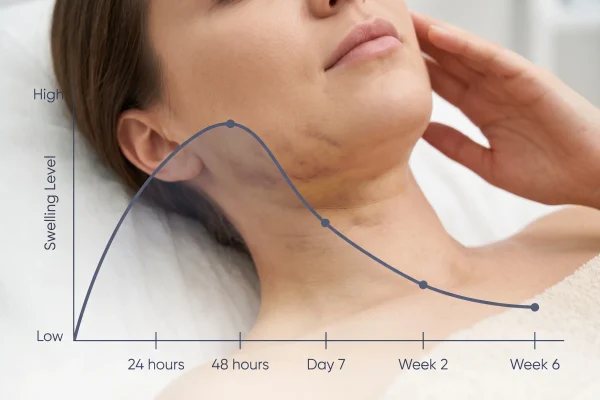
Most swelling after PDO threads peaks between 24 and 48 hours, drops sharply by day 7, and looks close to gone at two weeks. A firm, slightly puffy feeling under the skin can hang around for four to six weeks, and that’s still normal. What isn’t normal is swelling that grows after day three, swelling that arrives with spreading redness, or swelling on one side only. How much swelling is normal after PDO threads depends far more on how many threads went in and how old your tissue is than on how carefully you followed aftercare. Below is the timeline we give patients at Formation in Tampa, plus the specific signs that should get you on the phone.
Nobody warns you that week one feels tight. That’s the part patients actually call about.
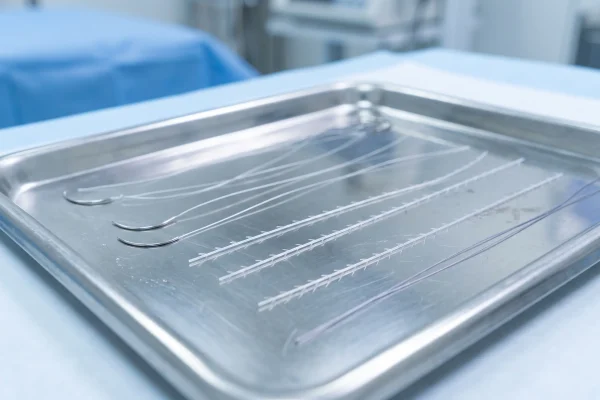
A PDO thread lift is an in-office procedure where a provider places absorbable polydioxanone sutures under the skin through a fine needle or cannula. The threads pull loose tissue upward and set off a collagen response as they break down. No incisions, no general anesthesia, no scalpel work on the face.
Polydioxanone is the same material surgeons have used to close wounds since the 1980s. That matters for swelling. Your body treats a thread the way it treats any foreign suture, with a controlled inflammatory response. The puffiness you see on day two isn’t a side effect of the lift. It’s the first stage of it.
A PDO thread treatment at Formation runs under an hour, and patients drive themselves home from our Howard Avenue office the same afternoon.
You’ll see a lift the same day. Then you’ll watch it get worse before it gets better, which almost nobody prepares patients for.
Days 2 through 4 often produce what patients describe as an overcorrected face. Fuller cheeks, a heavier jawline, puffy rather than lifted. The real result surfaces somewhere in week two, once fluid clears and the tissue settles onto the threads.
The industry line is “immediate results, no downtime.” Half of that is true.
Actually, calling it downtime isn’t quite right. You can work, drive, eat out, take calls. You just won’t like photographs for about ten days. I’ve watched patients cancel plans they didn’t need to cancel and keep plans they should have moved. Knowing the shape of the curve before you book solves both problems.
Normal swelling follows a predictable arc: worst at 24 to 48 hours, clearly better by day 7, mostly resolved at two weeks, with firmness possible through week six.
Reported swelling rates vary more than you’d expect. A meta-analysis published in Frontiers in Surgery on March 31, 2026 pooled data from 26 studies covering 2,827 patients and reported swelling in 34% of cases, bruising in 26%, visible or palpable threads in 10%, and dimpling in 7%. The same paper’s random-effects model put swelling closer to 16%, with individual studies scattered anywhere from 7% to 34%.
Both figures come from the same data set. The gap is definitional. Swelling that clears in 48 hours often never gets written down as a complication at all, which is why any single percentage you read online should be treated as a rough signal rather than a promise.
The same paper notes that swelling typically resolved within two to four weeks across most reporting studies, and bruising within one to three weeks. That matches what we see.
Threads placed along the jawline and neck behave differently from cheek threads, because gravity and lymph drainage both work against you down there.
Yes, if it reads as firmness rather than puffiness. At three weeks I expect to feel a slight ridge along the thread path and see nothing on camera. Visible asymmetry at three weeks is a different conversation, and I’d rather look at it in the office than wait it out.
Two factors predict swelling better than anything a patient does at home. Thread count and tissue age.
Age carries real weight in the data. Niu and colleagues pooled 26 studies in Aesthetic Plastic Surgery and found swelling in 35% of patients, dimpling in 10%, paresthesia in 6%, and infection in 2%. Patients over 50 carried nearly three times the dimpling risk of younger patients, 16% versus 5.6%, and roughly eight times the infection risk, 5.9% versus 0.7%. Satisfaction also slipped over time, from 98% immediately after treatment down to 88% at six months.
Everything else is secondary, but it stacks:
Tampa summers work against you here. Heat and salt both encourage fluid retention, and August in Hillsborough County is not a gentle recovery environment. We tell thread patients to budget a few extra days of puffiness for a July appointment compared with a January one. Nobody says this out loud in consults, and it’s a real scheduling variable.
It does, and the number to remember is ten. A 1,500-patient multicenter analysis published in PRS Global Open in October 2025 found postoperative dissatisfaction in 3.4% of cases, with two independent predictors: age 43 or older, and more than ten threads. More threads means more lift and more inflammation, and past a certain point you’re paying for swelling instead of definition.
This is where I part ways with how threads usually get sold. A heavy thread count photographs beautifully at two weeks and poorly at six months, because the mechanical lift fades before the collagen benefit shows up. For a 38-year-old with early jawline softening, eight well-placed threads beat sixteen generous ones. For a 58-year-old with real laxity, no thread count solves the problem. That patient needs skin removed or energy applied, and we say so in the room.
Call your provider if swelling increases after day three, spreads outward, feels hot, comes with fever, or shows up on one side only. Those five patterns cover almost everything that needs attention.
Specific signs to act on:
Infection is uncommon. It is not never. The pooled rate across the studies that tracked it in the 2026 meta-analysis was 2%. In a separate series of 190 patients treated for thread complications elsewhere, infection accounted for 8.9% of the problems, and most of those infections started at the thread ends rather than along the middle of the thread. Technique and sterile handling drive most thread lift problems, not what a patient does at home.
Four things have consistent support. Head elevation, cold in the first 48 hours, low sodium, and holding still. The rest is optional. Every item below carries its reason, because directives without reasons get forgotten by dinnertime.
Lymphatic facial massage gets recommended constantly for the first week. We don’t do it. Massaging fresh threads can shift them before the tissue anchors. At three weeks, gentle pressure on a firm ridge is fine. Before that, hands off. This puts us at odds with a lot of med spas in this city, and I’ll take that trade every time.
Expect six to eight months of mechanical lift and 12 to 18 months of collagen benefit. Claims past that don’t survive contact with the evidence.
The lift softens as the threads dissolve, usually starting around month five. What remains is the collagen your body laid down along the thread tracks, and that fades gradually rather than all at once. Marketing copy promising 18 months of lift is measuring the collagen and calling it the lift.
One trade-off gets skipped in most consults. Threads leave fibrous tissue along their paths, and tissue fibrosis appears in the thread-lift literature as a documented complication in its own right, not just a footnote. If a surgical facelift is realistic for you within five years, stacking thread sessions becomes a decision to make on purpose rather than by default. Worth it? Depends on your timeline.
Two omissions on purpose. Cost, because thread pricing swings so widely by region and provider that any number printed here would mislead you more than help. And brand comparisons, because the thread you receive matters far less than the hands placing it.
One regulatory detail does matter. Most PDO threads reach the U.S. market cleared as absorbable sutures for soft tissue approximation, which means wound closure, not face lifting. A small number of barbed PDO devices have since picked up a narrower clearance tied to mid-face suspension. Either way, clearance is not the same thing as FDA approval, and a lot of advertising blurs the two deliberately.
For scale, ASPS national procedural statistics counted 28.2 million minimally invasive treatments in 2024. Neuromodulators at roughly 9.9 million and hyaluronic acid fillers at roughly 5.3 million dominate that figure. Threads aren’t broken out separately at all, which tells you how thin the U.S. data still is next to the high-volume Asian series most research draws from. One Japanese group alone logged 111,948 facial thread procedures between 2020 and 2024 across more than 100 clinics, and the median patient age climbed across that window. American thread data has nothing close to that.
So ask who is holding the cannula, and ask how many of these they place in a month. That question tells you more than any brand name will.
Ask about swelling before you book, not after you’re puffy and worried on a Tuesday night. Formation is a plastic surgery clinic in Tampa where Dr. Gopal Grandhige, a board-certified surgeon specializing in aesthetic surgery, evaluates every patient personally, and plastic surgeon Dr. Ahmad Saad is part of the team. If your laxity has moved past what threads can hold, we say so in the room rather than selling you sixteen threads and an optimistic timeline.
Patients come to our Howard Avenue office from Hyde Park, Davis Islands, Westchase, and Carrollwood, plus St. Petersburg and Clearwater. You can schedule a consultation and bring your calendar with you. Timing recovery around a wedding, a work trip, or a photo shoot is half the conversation.
Knowing how much swelling is normal after PDO threads is the difference between a calm second week and a panicked phone call. Ask first.
Peak swelling happens between 24 and 48 hours, and mild fullness across the cheeks and jawline is expected during that window. A March 2026 meta-analysis in Frontiers in Surgery covering 2,827 patients reported swelling in 34% of cases. Sleeping with your head raised and using cold compresses in short intervals makes the biggest difference during these two days.
By two weeks, visible swelling should be largely gone. What typically remains is firmness rather than puffiness, sometimes felt as a slight ridge along the thread path, and that can persist through week six. Visible asymmetry at the two-week mark deserves an in-person look rather than more waiting.
Most patients do. You'll be functional immediately, though the tightness when smiling or chewing is more noticeable than the swelling itself. Plan on about ten days before you feel good about photographs.
Yes. A 1,500-patient multicenter analysis published in PRS Global Open in October 2025 found postoperative dissatisfaction in 3.4% of patients, and identified two independent predictors: age 43 or older, and more than ten threads placed. More threads produce more mechanical lift and more inflammation at the same time.
It does. Pooled data from 26 studies in Aesthetic Plastic Surgery found patients over 50 had a dimpling rate of 16% compared with 5.6% in younger patients, and an infection rate of 5.9% compared with 0.7%. Skin thickness and healing speed both decline with age, which is why the same thread count behaves differently at 55 than at 35.
Infection presents as swelling that increases after day three rather than decreasing, spreading redness, warmth, drainage, or fever above 100.4 F. Pooled rates are low, around 2% in the 2026 Frontiers in Surgery meta-analysis, but any of those signs warrants a same-day call. Most reported thread infections start at the thread ends rather than along the middle.
No, and they resolve on different schedules. Bruising is blood in the tissue and follows a color progression over roughly one to three weeks, while swelling is fluid and typically clears faster. The Frontiers in Surgery meta-analysis put bruising at 26% and swelling at 34%, so it's common to get one without the other.
6 months post high-definition liposuction with moderate definition.
The goal wasn’t just less fat. It was a leaner, more athletic contour with visible definition through the abdomen and torso, without pushing the result to the highest level of definition.
High-definition liposuction strategically sculpts around the underlying anatomy and can be customized based on a patient’s anatomy, muscle structure, and the degree of definition they want to achieve.
For this patient, moderate definition created the balance Dr. Gopal was looking for.
Results vary by patient and depend on individual anatomy, skin quality, and treatment plan.
Considering HD liposuction? Schedule a consultation with Dr. Gopal Grandhige at Formation Tampa. Link in bio.
#HDLiposuction #Liposuction #BodyContouring #MaleLiposuction #tampa
6 months post high-definition liposuction with moderate definition.
The goal wasn’t just less fat. It was a leaner, more athletic contour with visible definition through the abdomen and torso, without pushing the result to the highest level of definition.
High-definition liposuction strategically sculpts around the underlying anatomy and can be customized based on a patient’s anatomy, muscle structure, and the degree of definition they want to achieve.
For this patient, moderate definition created the balance Dr. Gopal was looking for.
Results vary by patient and depend on individual anatomy, skin quality, and treatment plan.
Considering HD liposuction? Schedule a consultation with Dr. Gopal Grandhige at Formation Tampa. Link in bio.
#HDLiposuction #Liposuction #BodyContouring #MaleLiposuction #tampa
Your lipo results at 2 weeks are not your final results.
And sometimes, what you see during those early weeks can be unsettling.
Swelling can temporarily make the treated area look larger. The tissue may feel firm, tight or lumpy. The definition you were expecting may not be visible yet.
That doesn’t necessarily mean something went wrong. It simply means your body is still healing.
After liposuction, recovery happens in stages, from the initial inflammation and swelling to tissue repair, skin contraction and the gradual emergence of the new contour.
Significant changes often become more apparent around the 3–6 month mark, with continued refinement as the tissues heal and mature.
That’s why comparing yourself a few weeks after surgery to someone’s polished before-and-after photo can create a very unrealistic expectation. Those two photos may represent months of healing in between.
The operation creates the contour. The final result reveals itself over time.
If you’re considering HD liposuction, schedule a consultation with Dr. Gopal to understand the procedure, recovery, and what to realistically expect from your results (link in bio).
#tampa #liposuction #hdliposuction
Your lipo results at 2 weeks are not your final results.
And sometimes, what you see during those early weeks can be unsettling.
Swelling can temporarily make the treated area look larger. The tissue may feel firm, tight or lumpy. The definition you were expecting may not be visible yet.
That doesn’t necessarily mean something went wrong. It simply means your body is still healing.
After liposuction, recovery happens in stages, from the initial inflammation and swelling to tissue repair, skin contraction and the gradual emergence of the new contour.
Significant changes often become more apparent around the 3–6 month mark, with continued refinement as the tissues heal and mature.
That’s why comparing yourself a few weeks after surgery to someone’s polished before-and-after photo can create a very unrealistic expectation. Those two photos may represent months of healing in between.
The operation creates the contour. The final result reveals itself over time.
If you’re considering HD liposuction, schedule a consultation with Dr. Gopal to understand the procedure, recovery, and what to realistically expect from your results (link in bio).
#tampa #liposuction #hdliposuction
Some surgical decisions are much harder to correct than they are to avoid.
That’s what Dr. Gopal means when he says, “I wish more patients knew that you pay more to undo a cheaper procedure.”
With liposuction and body contouring, removing fat is only one part of the process. Your surgeon has to understand your anatomy, know how much fat to remove and where to preserve it, create smooth transitions between areas, and consider how the final contour fits the rest of your body.
But the procedure doesn’t end when you leave the operating room. Recovery and aftercare matter too. The right guidance around compression, lymphatic massage, incision and drainage care, activity and nutrition can help manage swelling and support your body as it heals.
When something doesn’t go as planned, correcting dents, irregularities, poor proportions or an unnatural contour can be more complicated than doing the procedure properly the first time. And sometimes, there’s less to work with the second time around.
So when you’re comparing surgeons, don’t compare price alone. Look at their training, experience, surgical approach, before-and-after results, and what their care includes before and after surgery.
Because a cheaper procedure can become a very expensive one when you have to do it twice.
#tampa #HDLiposuction #lipo
Some surgical decisions are much harder to correct than they are to avoid.
That’s what Dr. Gopal means when he says, “I wish more patients knew that you pay more to undo a cheaper procedure.”
With liposuction and body contouring, removing fat is only one part of the process. Your surgeon has to understand your anatomy, know how much fat to remove and where to preserve it, create smooth transitions between areas, and consider how the final contour fits the rest of your body.
But the procedure doesn’t end when you leave the operating room. Recovery and aftercare matter too. The right guidance around compression, lymphatic massage, incision and drainage care, activity and nutrition can help manage swelling and support your body as it heals.
When something doesn’t go as planned, correcting dents, irregularities, poor proportions or an unnatural contour can be more complicated than doing the procedure properly the first time. And sometimes, there’s less to work with the second time around.
So when you’re comparing surgeons, don’t compare price alone. Look at their training, experience, surgical approach, before-and-after results, and what their care includes before and after surgery.
Because a cheaper procedure can become a very expensive one when you have to do it twice.
#tampa #HDLiposuction #lipo
Lipo recovery can be a lot.
There can be swelling, drainage, compression garments, limited activity, and a period where your body may look worse before it starts looking better. And when the final result can take months to fully reveal itself, recovery can take an emotional toll too.
That’s why Dr. Gopal views a successful surgical experience as three equally important parts: pre-op care, the operation itself, and post-op care.
At Formation, that process starts four weeks before surgery. Patients are prepared physically for the procedure and mentally for what they may experience during recovery.
That support continues after surgery with a private nurse during the initial recovery period, supplies and education for at-home care, nutritious meals, and in-home lymphatic massage to help manage postoperative swelling and fluid.
None of those pieces are considered extras. They’re part of the surgical experience.
Because the goal isn’t just to perform the procedure. It’s to make sure you know what to expect, you’re prepared for it, and you’re properly cared for through the recovery that follows.
Considering liposuction or body contouring in Tampa? Schedule a consultation with Dr. Gopal Grandhige at Formation Tampa.
#tampa #hdLiposuction
Lipo recovery can be a lot.
There can be swelling, drainage, compression garments, limited activity, and a period where your body may look worse before it starts looking better. And when the final result can take months to fully reveal itself, recovery can take an emotional toll too.
That’s why Dr. Gopal views a successful surgical experience as three equally important parts: pre-op care, the operation itself, and post-op care.
At Formation, that process starts four weeks before surgery. Patients are prepared physically for the procedure and mentally for what they may experience during recovery.
That support continues after surgery with a private nurse during the initial recovery period, supplies and education for at-home care, nutritious meals, and in-home lymphatic massage to help manage postoperative swelling and fluid.
None of those pieces are considered extras. They’re part of the surgical experience.
Because the goal isn’t just to perform the procedure. It’s to make sure you know what to expect, you’re prepared for it, and you’re properly cared for through the recovery that follows.
Considering liposuction or body contouring in Tampa? Schedule a consultation with Dr. Gopal Grandhige at Formation Tampa.
#tampa #hdLiposuction
Your body decides where fat comes off, and it doesn’t always come from the area you want it to.
For someone who is already at a stable weight, continuing to lose weight can mean getting leaner in the face, arms, legs or other areas while localized abdominal fat remains.
That’s where the difference between weight loss and body contouring matters.
Liposuction isn’t designed to make the number on the scale significantly lower. It’s designed to address localized fat and change contour and proportion.
So if you’ve reached a weight you feel good at, but there’s still an area that doesn’t seem to change no matter what you do, you may not need to keep chasing a lower number on the scale.
It may be worth finding out whether liposuction is appropriate for your body and the result you’re trying to achieve.
DM us or schedule a consultation with Dr. Gopal Grandhige at Formation Tampa (link in bio).
Your body decides where fat comes off, and it doesn’t always come from the area you want it to.
For someone who is already at a stable weight, continuing to lose weight can mean getting leaner in the face, arms, legs or other areas while localized abdominal fat remains.
That’s where the difference between weight loss and body contouring matters.
Liposuction isn’t designed to make the number on the scale significantly lower. It’s designed to address localized fat and change contour and proportion.
So if you’ve reached a weight you feel good at, but there’s still an area that doesn’t seem to change no matter what you do, you may not need to keep chasing a lower number on the scale.
It may be worth finding out whether liposuction is appropriate for your body and the result you’re trying to achieve.
DM us or schedule a consultation with Dr. Gopal Grandhige at Formation Tampa (link in bio).
The abdomen can be one of the most stubborn areas to change, even with consistent diet and exercise.
For this patient, HD liposuction addressed the persistent abdominal fullness while creating more definition through the waist and midsection.
At 10 months post-op, you can see how much that one area affected the proportions of her entire torso.
If you’re dealing with stubborn abdominal fat despite diet and exercise, schedule a consultation with Dr. Gopal at Formation Tampa to learn whether liposuction may be appropriate for you.
#HDLiposuction #LiposuctionTampa #FemaleLiposuction #BodyContouring
The abdomen can be one of the most stubborn areas to change, even with consistent diet and exercise.
For this patient, HD liposuction addressed the persistent abdominal fullness while creating more definition through the waist and midsection.
At 10 months post-op, you can see how much that one area affected the proportions of her entire torso.
If you’re dealing with stubborn abdominal fat despite diet and exercise, schedule a consultation with Dr. Gopal at Formation Tampa to learn whether liposuction may be appropriate for you.
#HDLiposuction #LiposuctionTampa #FemaleLiposuction #BodyContouring
Many surgeons abandon this lipo technique because it’s so physically demanding.
The approach to HD liposuction Dr. Gopal uses requires an extraordinary level of detail and precision.
Rather than simply etching lines, every contour and transition is shaped around the patient’s underlying anatomy, a process that can take several hours.
Dr. Gopal trained in this technique in Barcelona with one of the world’s leaders in HD liposuction and now teaches it to other physicians. It’s a demanding approach, but that level of precision is what allows for definition that looks natural to the individual.
Considering HD liposuction in Tampa? Schedule a consultation at Formation Tampa (link in bio).
Many surgeons abandon this lipo technique because it’s so physically demanding.
The approach to HD liposuction Dr. Gopal uses requires an extraordinary level of detail and precision.
Rather than simply etching lines, every contour and transition is shaped around the patient’s underlying anatomy, a process that can take several hours.
Dr. Gopal trained in this technique in Barcelona with one of the world’s leaders in HD liposuction and now teaches it to other physicians. It’s a demanding approach, but that level of precision is what allows for definition that looks natural to the individual.
Considering HD liposuction in Tampa? Schedule a consultation at Formation Tampa (link in bio).
“Glad I took my time researching.”
That line matters.
Choosing to have plastic surgery isn’t just about deciding you want a change. It’s about deciding who you trust to understand the result you’re looking for, especially when the goal isn’t simply removing fat, but creating a shape that still looks natural to you.
For our lovely patient, that meant a tighter stomach and waist, feeling more comfortable in fitted clothing, and most importantly, getting the result she wanted “without looking fake.”
That’s the goal of thoughtful body contouring: not to make you look like someone else, but to create a result that works with your body and your goals.
Dr. Gopal Grandhige specializes in liposuction and body contouring in Tampa, creating treatment plans around each patient’s anatomy, proportions, and goals.
Considering liposuction? DM us or Schedule a consultation at Formation to learn what approach may be right for you (link in bio).
“Glad I took my time researching.”
That line matters.
Choosing to have plastic surgery isn’t just about deciding you want a change. It’s about deciding who you trust to understand the result you’re looking for, especially when the goal isn’t simply removing fat, but creating a shape that still looks natural to you.
For our lovely patient, that meant a tighter stomach and waist, feeling more comfortable in fitted clothing, and most importantly, getting the result she wanted “without looking fake.”
That’s the goal of thoughtful body contouring: not to make you look like someone else, but to create a result that works with your body and your goals.
Dr. Gopal Grandhige specializes in liposuction and body contouring in Tampa, creating treatment plans around each patient’s anatomy, proportions, and goals.
Considering liposuction? DM us or Schedule a consultation at Formation to learn what approach may be right for you (link in bio).
More definition doesn’t automatically mean a better liposuction result.
The goal of body contouring is to create definition that makes sense for your anatomy, not to create the most sculpted abdomen possible simply because we can.
Low-, medium-, and high-definition liposuction can create very different looks, from subtle contouring to a more athletic or highly sculpted appearance.
The right level depends on your existing muscle definition, proportions, surrounding areas of the body, and the result you want to achieve.
For Dr. Gopal Grandhige, a board-certified surgeon specializing in body contouring and high-definition liposuction in Tampa, the goal is balance: the abdomen, chest, back, arms and shoulders should look like they belong to the same body.
The result should feel cohesive, proportional, and natural to your anatomy.
Considering liposuction? DM us or schedule a consultation at Formation to discuss the level of definition that makes sense for your body and your goals (link in bio).
More definition doesn’t automatically mean a better liposuction result.
The goal of body contouring is to create definition that makes sense for your anatomy, not to create the most sculpted abdomen possible simply because we can.
Low-, medium-, and high-definition liposuction can create very different looks, from subtle contouring to a more athletic or highly sculpted appearance.
The right level depends on your existing muscle definition, proportions, surrounding areas of the body, and the result you want to achieve.
For Dr. Gopal Grandhige, a board-certified surgeon specializing in body contouring and high-definition liposuction in Tampa, the goal is balance: the abdomen, chest, back, arms and shoulders should look like they belong to the same body.
The result should feel cohesive, proportional, and natural to your anatomy.
Considering liposuction? DM us or schedule a consultation at Formation to discuss the level of definition that makes sense for your body and your goals (link in bio).
One of the biggest misconceptions about liposuction? That the fat either “comes back” or simply moves somewhere else.
Liposuction permanently removes fat cells from the treated area. But it doesn’t remove every fat cell, and the cells that remain can still grow larger with weight gain.
That’s why long-term results aren’t just about what happens during the procedure. Maintaining a relatively stable weight helps preserve the contour created through liposuction.
Dr. Gopal Grandhige specializes in advanced high definition liposuction and body contouring, with an emphasis on creating results that complement each patient’s natural anatomy.
If you’re considering liposuction in Tampa, schedule a consultation at Formation to learn what approach makes sense for your body and goals (Link in bio).

One of the biggest misconceptions about liposuction? That the fat either “comes back” or simply moves somewhere else.
Liposuction permanently removes fat cells from the treated area. But it doesn’t remove every fat cell, and the cells that remain can still grow larger with weight gain.
That’s why long-term results aren’t just about what happens during the procedure. Maintaining a relatively stable weight helps preserve the contour created through liposuction.
Dr. Gopal Grandhige specializes in advanced high definition liposuction and body contouring, with an emphasis on creating results that complement each patient’s natural anatomy.
If you’re considering liposuction in Tampa, schedule a consultation at Formation to learn what approach makes sense for your body and goals (Link in bio).